

Understanding the complex tapestry of events that led to World War II, and specifically the United States’ eventual intervention, requires a clear-eyed examination of the global political and economic landscape. It’s a narrative woven from the lingering resentments of one devastating conflict, the desperate scramble for economic survival, and the aggressive expansionist ideologies that ultimately plunged the world into an even greater cataclysm. Our discussion will unfold chronologically, pausing at the very precipice of direct American entry, just before the fateful bombing of Pearl Harbor.
The Lingering Shadow of the Great War and the Rise of Aggressive Ideologies
The Great Depression, a global phenomenon, found its roots deeply embedded in the aftermath and sequelae of World War I. That prior conflict had shattered the old land empires of Europe, simultaneously sparking aspirations for new ones. In the Far East, the “World War” had utterly dismantled the existing imperialist balance of power. The attempts to forge a lasting peace through mechanisms like the Treaty of Versailles, the League of Nations, and the Washington treaty system ultimately proved insufficient to avert the century’s deadliest conflict. The seeds of future animosity were sown in the very ground where peace was purportedly built.
This fragile interwar period saw a global shift towards economic nationalism. The world descended into a chaotic monetary environment characterized by competitive currency devaluations, stringent exchange controls, and the emergence of warring trade blocs, all underscored by protectionist restrictions. This trend was significantly amplified when the United States, in 1933, chose to devalue its dollar and abandon the gold standard domestically, charting a course that inadvertently steered much of the world onto a similar path of monetary nationalism.
Germany’s particular brand of economic nationalism in the 1930s was profoundly shaped by its horrifying experience with runaway inflation and currency depreciation in the early 1920s, culminating in the complete monetary collapse of 1923. Consequently, unable to devalue its currency due to political pressures, Germany resorted to strict exchange controls and engaged in bilateral trade agreements. These arrangements, bypassing traditional gold and international banking systems, deeply angered the United States and other Western powers, who saw them as a direct threat to their “Open Door” trade philosophy and a key factor in the drive towards war. Secretary of State Cordell Hull, a staunch advocate for multilateral trade and an “Open Door” policy for American products, was a leading voice against Germany’s autarkic economic practices, viewing them as directly leading to “economic warfare” and ultimately war.
Beyond economic friction, the 1930s witnessed the alarming rise of aggressive, authoritarian regimes across Europe and Asia. Italy, under Mussolini, became the first fascist state in 1922. Hitler, after consolidating power in Germany, began to expand his territorial ambitions. In March 1938, Germany annexed Austria without resistance from the great powers. The following September, France, Italy, and Great Britain famously (or perhaps infamously) engaged in the “appeasement at Munich,” cooperating with Nazi Germany in the partition of Czechoslovakia. This act, which Czechs remember as a “betrayal,” underscored the failure of bourgeois democracy to protect small nations from fascism and suggested that the West was willing to sell out Czechoslovakia to Hitler. Italy’s invasion of Ethiopia in 1935, marked by the savage use of mustard gas and a pretense of self-defense, was largely met with a “moral embargo” from the U.S. that American industry often ignored. Similarly, a fascist rebellion in Spain in 1936 received critical aid from Hitler and Mussolini, while U.S. neutrality legislation ironically cut off help to the elected Spanish government.
In Asia, Japan’s expansionist tendencies were fundamentally driven by its industrialization, overpopulation, and a dire lack of natural resources, compounded by the closing of world markets to its exports. This led to Japan’s attack on China in 1937, marking another clear act of aggression.
The geopolitical landscape further darkened with the signing of the Molotov-Ribbentrop Pact in August 1939, a non-aggression agreement that secretly partitioned parts of Eastern Europe between Nazi Germany and the Soviet Union. Both regimes attacked Poland in September 1939, occupying the country together for nearly two years. This alliance not only isolated Japan but also allowed Stalin to resume his terror in Soviet-occupied Poland and provided Hitler with the opportunity to implement his initial policies of mass killing in occupied Polish territories.
The formal beginning of World War II in Europe is marked by Germany’s invasion of Poland on September 1, 1939. This act triggered defense agreements, bringing Great Britain and France into the war. Germany, benefiting from Soviet supplies, rapidly occupied Norway, Denmark, the Low Countries, and France by the spring of 1940. Britain’s stubborn refusal to capitulate, a decision that defied many expectations, forced Hitler to contend with a two-front war, inadvertently aligning Moscow and London as unexpected allies.
The United States’ Shifting Stance: From Neutrality to “All Aid Short of War”
For the United States, a nation historically guided by a deep-seated tradition of neutrality dating back to its very founders, entering this unfolding European and Asian conflict was far from an easy decision. Public sentiment, still reeling from the disappointment and perceived futility of World War I, remained resistant to foreign entanglements. Congress had even passed Neutrality Acts explicitly designed to prevent a repetition of prior involvement, blocking warring countries from purchasing arms or securing loans in the U.S.. This era was marked by a pervasive “illusion of neutrality”.
Despite this prevailing isolationist mood, President Franklin D. Roosevelt understood that the policy of non-intervention could not be maintained indefinitely. He faced the immense political challenge of preparing an American populace, still grappling with the Great Depression, for a potential second global conflict.
Roosevelt’s evolving approach to the looming war was a masterclass in political maneuvering. His 1937 “Quarantine Speech” was an early, albeit ambiguous, attempt to encourage Americans to oppose aggressor nations, but his inability to clearly articulate what such “quarantining” would entail led to public fears of entanglement in unforeseen overseas disasters. Consequently, he reverted to a more traditional stance of neutrality, providing supplies and credits to “friends” while imposing economic sanctions on “foes”.
However, the rapid deterioration of the situation in Europe prompted Roosevelt to push for increasingly active measures to aid the Allies, even at the risk of war. He tirelessly argued for the repeal of the arms embargo, stressing that American security was intertwined with the fate of Europe’s “very large group of nations”. He framed the conflict as a defense of fundamental values – “religion, democracy, and good faith among nations” – and starkly warned that a victorious Axis in Europe could eventually establish footholds in Latin America and even launch attacks on the United States itself.
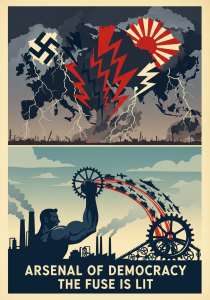
This commitment materialized in concrete actions, such as the “destroyers-for-bases” deal in September 1940, which allowed the U.S. to provide naval vessels to Britain in exchange for military base access in the Atlantic. The crucial Lend-Lease Act, passed in March 1941, granted Roosevelt the authority to send massive amounts of war materiel to Allied nations, effectively circumventing neutrality laws and transforming the U.S. into the “arsenal of democracy”. Hull viewed the inclusion of Article 7 in Lend-Lease agreements, which vaguely committed recipients to multilateral trade, as a crucial step towards his long-held vision of an open global economy.
The isolationist conviction that America could remain a “Fortress America,” safely buffered by vast oceans, was deeply ingrained. This perspective was systematically challenged by interventionist publicists and policymakers who, particularly after the fall of France in June 1940, argued that the nation’s security was indeed tied to the European balance of power. New maps, emphasizing trans-polar air routes, graphically illustrated the proximity of North America to Europe and Asia, chipping away at the psychological comfort of geographic isolation. Advocates for intervention consciously framed their arguments not on abstract Wilsonian idealism, but on a “Realpolitik” basis of national security, recognizing that the public was wary of another “crusade for democracy”.
While private financial interests, notably the House of Morgan, had played a significant role in pushing for U.S. entry into World War I to protect Allied loans, their influence in World War II was diminished. The federal government, far more powerful than in Wilson’s era, now took direct charge of industrial mobilization through agencies like the War Production Board. Private banks, no longer large enough to independently finance such massive conflicts, ceded their historical role to the central banks and vast taxing powers of modern nation-states. Though some Morgan partners initially expressed doubts about the Allies’ chances against Germany, they ultimately supported aid short of direct intervention.
In the Pacific, Japan’s relentless expansion directly threatened U.S. economic interests, particularly access to vital resources like tin, rubber, and oil in Southeast Asia. In response, the United States imposed total embargoes on scrap iron and oil in the summer of 1941. These measures were understood in Washington to carry “grave risks of war”. Militarily, the U.S. entered World War II with an industrial base still geared towards the 1920s, with much of its factory machinery dating from that decade or even earlier. While the Roosevelt administration adhered to a “Germany first” strategy, recognizing Europe as the primary theater, U.S. defenses in the Pacific, like those in the Philippines and Guam, were woefully incomplete and considered “absolutely indefensible” in some areas. The lessons of Hitler’s “Blitzkrieg” in Europe highlighted the need for a powerful air force, spurring increased U.S. military spending and demand for strategic materials.
By the close of 1941, the United States found itself not yet formally at war, but deeply committed to assisting the Allied cause, particularly Britain. Its economic might was being mobilized, its strategic outlook was rapidly globalizing, and its policies towards Japan were creating an increasingly tense and precarious situation in the Pacific. The stage was set, the actors were in position, and the fuse was burning rapidly, ready to ignite the cataclysm that would redefine the 20th century.