

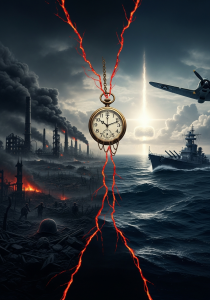
The preceding discussion illuminated the intricate web of economic and ideological factors that propelled the world toward World War II, culminating in the United States’ deeply strained neutrality as the global conflagration ignited. We left our narrative poised at the precipice of direct American involvement, with the nation committed to aiding the Allied cause through material support and sanctions against aggressors, but not yet formally at war. What transpired next would irrevocably alter the course of American history and the global order.
The Cataclysmic Entry of the United States into World War II
The long-feared American entry into the global conflict was precipitated by a sudden, devastating act of aggression. On December 7, 1941, Japanese warplanes launched a surprise attack on the U.S. fleet at Pearl Harbor in Hawaii. This assault, which left an “indelible image of national vulnerability” with its smoking hulks of battleships, was quickly followed by another Japanese air attack nine hours later on the U.S. territory of the Philippines. There, Japan laid waste to the largest concentration of U.S. warplanes outside North America. These unprovoked strikes, coupled with Germany’s “foolish” decision to declare war on the United States shortly thereafter, effectively forced America’s hand, drawing it formally into World War II. Italy also declared war on the United States right after Pearl Harbor. The conflict, already widespread, instantly became a “global war”.
Mobilizing the “Arsenal of Democracy”
The United States, still grappling with the lingering effects of the Great Depression, now faced the monumental task of industrial and societal mobilization for a two-front war. Its industrial base, with much of its factory machinery dating from the 1920s or earlier, needed a dramatic retooling. By 1945, American factory production had doubled that of 1939, transforming the nation into the “arsenal of democracy”. The federal government assumed direct control over industrial mobilization through agencies like the War Production Board. This process led to a significant concentration of wealth: by 1941, three-fourths of the value of military contracts were handled by just fifty-six large corporations, and a substantial portion of government-funded scientific research also flowed to a select few.
While private financial interests, like J.P. Morgan, had been influential in advocating for U.S. entry into World War I, the federal government’s power had grown considerably by World War II, lessening their singular sway. Nevertheless, Morgan-affiliated individuals, having long-standing connections with Britain and France, played a role in promoting an internationalist foreign policy. After the war, the Rockefellers, fueled by the rising prominence of oil, would assume the dominant position in the financial establishment, with Morgan partners transitioning into a “junior partner” role.
Strategically, the U.S. adhered to a “Germany first” policy, recognizing that the European theater was the primary concern.
The War Unfolds: Europe and the Pacific
In Europe, the Long, Brutal Struggle: Before American entry, Germany had achieved rapid successes, occupying Norway, Denmark, the Low Countries, and France by the spring of 1940. France, despite its powerful military, capitulated within six weeks to Germany’s “Blitzkrieg” tactics. Britain’s stubborn refusal to surrender, however, meant Hitler still faced an enemy in the West, inadvertently aligning London with Moscow.
The true turning point in Europe began with Operation Barbarossa in June 1941, Germany’s invasion of the Soviet Union. This initiated a “calamity” that resulted in over ten million soldiers and a comparable number of civilians dying on the Eastern Front, making the Germans responsible for almost all political murder between 1941 and 1945. The German “Hunger Plan” aimed to starve millions in Eastern Europe, transforming it into an “exterminatory agrarian colony”. Yet, the Red Army, despite immense losses, did not collapse, and the Soviet leadership remained in Moscow, thwarting German expectations of a swift victory. The Soviets continued to bear the brunt of the land war, with 80% of German troops engaged on the Eastern Front by the time of the D-Day invasion.
Concurrently, the Battle of the Atlantic raged. American advancements in technology, particularly radar and the application of statistical analysis through “operations research,” proved crucial. Vannevar Bush spearheaded efforts to develop an offensive strategy against U-boats, leading to the formation of the “Tenth Fleet,” which, despite having no ships, used information to find, track, and sink German submarines. This significantly curtailed U-boat activity by mid-1943, securing Allied logistical supply lines across the Atlantic.
Allied ground offensives in Europe began with the invasion of North Africa in 1942, followed by Italy in 1943. Strategic bombing campaigns intensified against Germany from January 1943, with the goal of destroying its military-industrial complex and undermining civilian morale. This included devastating “saturation bombing” raids on cities like Cologne, Essen, Frankfurt, and Hamburg. The bombing of Dresden in early 1945, which created a massive firestorm, killed over 100,000 people.
Germany’s final major offensive, the Battle of the Bulge in late 1944 and early 1945, was crushed by advancing Allied forces from the west and Soviet armies from the east. Hitler committed suicide in his bunker on April 30, 1945, as Russian soldiers fought their way into Berlin, marking the effective end of the war in Europe.
In the Pacific, the Relentless Advance: Following the initial blitz, Japan’s empire stretched across Southeast Asia and Micronesia, transforming the Pacific into a “giant oceanic blockade”. The U.S. adopted an “island-by-island” advance strategy, pushing closer to Japan from 1943 onwards. Unlike the quick U.S. surrenders in 1941-42, Japanese resistance was fierce, characterized by fortifications and a military culture that shunned surrender. Examples include the U.S. Marine Corps’ invasion of Guam in summer 1944, preceded by a thirteen-day aerial and naval bombardment of unprecedented scale.
The final, brutal land battle of the Pacific theater was Okinawa, beginning in April 1945. Lasting three months, this campaign saw over fifteen hundred Japanese kamikaze planes strike American ships, killing nearly five thousand sailors. On the island, American troops endured a 35% casualty rate, the highest of any battle in the war, with 7,000 killed and 40,000 wounded, while approximately 110,000 Japanese perished.
Alongside ground operations, the U.S. carried out extensive “saturation bombing” of Japanese cities, aiming to destroy civilian morale. One nighttime fire-bombing of Tokyo resulted in 80,000 deaths.
The war in the Pacific concluded with the unprecedented use of atomic weapons. On August 6, 1945, the U.S. dropped the first atomic bomb on Hiroshima, immediately killing approximately 100,000 people, with thousands more dying from radiation poisoning in the ensuing months and years. Three days later, a second atomic bomb was dropped on Nagasaki, killing nearly 40,000. The U.S. government justified these bombings as necessary to hasten Japan’s surrender and avoid a potentially long and costly invasion of the Japanese home islands. Despite these claims, Japan was already in a desperate state and ready to surrender by August 1945. On August 14, Japan formally sought peace, and World War II officially ended on September 2, 1945, with the signing of surrender documents aboard the USS Missouri in Tokyo Harbor.
The Aftermath and a New Global Order
World War II, the deadliest conflict in human history, resulted in an estimated fifty-five million deaths globally, with the U.S. suffering 522,000 fatalities. The sheer scale of destruction, particularly the “utter barbarity of the Holocaust”, left a complex mixture of despair and hope for the future. For many Americans, the war was perceived as a “total triumph over the very forces of evil,” validating the immense sacrifices.
The United States emerged from the conflict in an extraordinary position of power. It was the world’s only nuclear power, accounted for over half of global manufacturing production, and, with its vast industrial capacity already in place from the 1920s, had effectively ended the Great Depression through war spending. U.S. foreign policy officials began grappling with the nation’s new “planetary presence,” developing policies for countless regions worldwide. While President Truman stated the U.S. did not “covet any territory,” the acquisition of over two thousand overseas base sites during the war and the occupation of parts of Germany, Austria, Korea, and all of Japan, suggested a lasting global footprint.
Economically, the U.S. aggressively pursued an “Open Door Policy” globally, aiming to reduce tariffs and eliminate trade barriers that had restricted American exports and investments. The Bretton Woods Agreement of July 1944 was a key step in this direction, establishing a new multilateral monetary order based on the dollar and shifting the world’s financial center from London to the U.S. Treasury.
Domestically, the war brought unprecedented prosperity, with real personal income more than doubling and income distribution becoming more equitable. Unemployment plummeted, and opportunities expanded for many, including African Americans, whose incomes rose and who secured more civilian jobs. However, internal issues like racism persisted, and labor unrest, fueled by frozen wages amidst surging corporate profits, led to numerous strikes during the war years.
Despite the “total triumph” narrative, the war’s conclusion unveiled profound new challenges. Europe and parts of Asia lay devastated, resembling “a rubble heap, a charnel house”. The retreat of Axis forces created immense “power vacuums”. The Soviet Union, though devastated by the war, quickly consolidated its influence in Eastern Europe, installing friendly governments and maintaining military presence across the region, as well as in Iran, Manchuria, and northern Korea. Simultaneously, Communist insurgencies gained momentum in various nations. While American leaders recognized Stalin’s cruelty, they also acknowledged the Soviet Union’s immense wartime sacrifices.
The rapid demobilization of the U.S. military, from 12.3 million to 1.5 million by mid-1946, highlighted America’s traditional reluctance for a large peacetime military. However, the emerging geopolitical realities, marked by differing visions for the post-war world and the growing ideological chasm between the U.S. and the Soviet Union, would quickly set the stage for the Cold War. The world had been irrevocably altered, and a new era of global competition was about to begin.