

The release of Stanley Kubrick’s satirical masterpiece, Dr. Strangelove or: How I Learned to Stop Worrying and Love the Bomb, in 1964, was more than just a cinematic event; it was a profound cultural moment that tapped directly into the deepest anxieties and intellectual currents of the Cold War era. This film, a “Dr. Strangelove school of political critique”, offered a darkly comedic, yet uncomfortably prescient, look at the potential for nuclear annihilation, dissecting the very systems of power and thought that underpinned the perilous standoff between superpowers.
At its core, Dr. Strangelove confronted the terrifying realities of the nuclear age, an era characterized by consistently high Soviet-American tensions and a pervasive sense of insecurity. The film emerged into a world still grappling with the implications of the “missile gap,” a notion (though later proved wrong) that the United States had lost its technological edge in the nuclear arsenal it had created. The Soviet Union had indeed taken the lead in the space race by launching Sputnik in 1957, a technological feat that caused Americans to “shiver at the apparent loss of technological superiority”. This palpable fear, further fueled by “Russia’s atomic test” and a “pugilistic speech” by Joseph Stalin in early 1946, created an environment ripe for artistic expressions of existential dread.
The film’s genius lay in its direct engagement with the concept of “deterrence theory,” a military strategy of “massive retaliation” that promised devastating consequences for any nuclear attack. Dr. Strangelove audaciously suggested that this very theory, designed to prevent war, could instead “bring on the ultimate cataclysm” through a combination of human fallibility and technological absurdity. It laid bare the “absurdities and fears of the Atomic Age”, portraying a world where rational decision-making was undermined by rigid protocols, paranoia, and the inherent unpredictability of complex systems. The film’s depiction of “retaliatory threats against Russian civilians” resonated with the growing unease among antinuclear activists, who in 1982 would call for a mutual, verifiable nuclear freeze amidst deepening anxiety over military spending increases under Ronald Reagan.
Beyond its immediate critique of nuclear policy, Dr. Strangelove also spoke to a broader skepticism towards elite decision-making and the concentration of power. The early 1960s saw a rising “technocracy” movement, which advocated for replacing elected politicians with engineers and scientists, believing they could plan more effectively without the need to respond to voters. Yet, as the film starkly illustrates, even brilliant minds can be flawed, and rigid systems, regardless of their supposed “scientific” basis, can lead to catastrophic outcomes. This resonated with critiques of “bureaucratic collectivism” and concerns that a “culture industry” promoted an ideology of consensus that dictated individual taste, as described by figures from the Frankfurt School. The “Cold War mode of knowledge production” itself, with its deep integration of military funding into universities, created a pervasive intellectual framework that influenced how “reality” was defined.
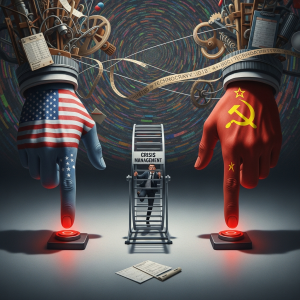
The film’s release also coincided with a period when the Kennedy administration was lauded for its “crisis management” approach, a style that, according to then-Secretary of Defense Robert McNamara, meant there was “no longer any such thing as strategy…only crisis management”. Dr. Strangelove can be seen as a devastating satire of this very approach, highlighting the inherent danger when “vigor” and “activism” overshadow meticulous planning and ethical considerations, leading to a “perpetual state of reaction to one crisis after another”.
In a society increasingly confronted with new information streams and challenges to conventional thought, Dr. Strangelove joined a burgeoning countercultural discourse. By 1977, discussions about LSD, which could once be discussed “scientifically, objectively, rationally,” faced “neo-Inquisitorial fury”. However, the film’s release preceded this shift, landing in a time when the exploration of “mind-changing drugs” and “alternative perspectives on reality” by figures like Robert Anton Wilson were still intellectually significant. Timothy Leary’s pioneering work with psychedelics, which he called “microscopes” for exploring the nervous system’s focus and re-focus capabilities, sought to expand consciousness and challenge fixed “reality tunnels”. Leary, like the film, questioned the “mechanical reactions of our nervous systems” and the notion that we are “as mechanical as the rats in a behaviorist laboratory”. He believed that psychedelics could lead to “new neurological imprint[s]” that would allow individuals to break free from old conditioning. This intellectual environment, with its focus on expanded consciousness and the potential to “change the parameters of your nervous system”, provided a fertile ground for a film that dared to suggest the entire world could be destroyed by a system seemingly beyond human control.
Ultimately, Dr. Strangelove stands as a powerful cultural artifact of the Cold War. It not only articulated widespread fears about nuclear war and the arms race but also critiqued the underlying structures of power, the reliance on supposed “experts,” and the narrow confines of mainstream thought. Its enduring relevance is a testament to its brutal honesty and its ability to dissect the truth of a world living under the shadow of its own destructive potential.