

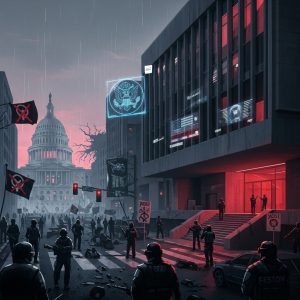
It is now nearing the end of 2025, and the events of the current year, far from offering a return to political normalcy, have only accelerated America’s trajectory toward systemic instability and upheaval. As historians, we are charged with documenting and interpreting the past, and while it is often debated whether one can be truly objective about events so immediately upon us, the actions taken by the Trump administration since the January 20th inauguration already stand out as profoundly consequential, defining a new era of executive action, institutional friction, and cultural conflict.
The administration, bolstered by a unified Republican government, has pursued an agenda characterized by the rapid consolidation of executive power, unrestrained corruption, and an aggressive re-framing of national reality—an “authoritarian trifecta” that political observers had warned about.
The Erosion of Accountability: Jan. 6 Clemency and the Rule of Law
Perhaps the single most historically defining act of the early second Trump administration was the comprehensive clemency granted to nearly 1,600 individuals involved in the January 6, 2021, attack on the U.S. Capitol. On his first day in office, President Trump issued pardons and commutations to all those charged or convicted in connection with the attack, including individuals who assaulted police officers and leaders of extremist groups like the Oath Keepers and Proud Boys convicted of seditious conspiracy.
This action carries immense historical weight because it fundamentally redefines the executive branch’s relationship to political violence and accountability. Where previous post-Watergate eras led to reforms intended to strengthen democracy, this move served to erase the judicial consequences of an attempt to overturn a democratic election—an action unprecedented in American history. It was described by critics as a “grave national injustice” being perpetrated, and an “Opening Act of Contempt” that was met with palpable dismay from law enforcement officials who endured the attack. Furthermore, the administration subsequently ordered the Department of Justice to purge previously published press releases concerning the arrests and convictions and initiated an internal review of the remaining Jan. 6 prosecutions, alongside reports that candidates for top intelligence and law enforcement positions were screened for political loyalty regarding whether the 2020 election was “stolen”. These moves align squarely with the authoritarian playbook of targeting the “referees” to consolidate power and ensure ideological conformity within the federal government.
The Domestic Military Escalation and Federal Overreach
The administration’s deployment of federal force domestically represents another historically significant escalation in 2025. In response to protests against immigration raids, President Trump authorized the deployment of the National Guard and Marines to Los Angeles, a move swiftly decried by California officials as illegal federal commandeering of state resources.
The President framed these actions in stark, alarming terms, signing a memorandum asserting that protests and civil disobedience that inhibit law enforcement constituted a “form of rebellion against the authority of the government of the United States”. This rhetoric of calling legitimate protest a “rebellion” marks a sharp departure from norms and raises immediate constitutional concerns about the Posse Comitatus Act and the principles of federalism embedded in the Tenth Amendment. The potential misuse of the Insurrection Act, which President Trump had previously contemplated for use against peaceful protests in 2020, signifies a normalization of using the military and federal agencies to solve domestic political problems, a defining feature of systems moving toward authoritarian rule.
Relatedly, the administration tested the limits of legal authority by invoking the Alien Enemies Act of 1798—a law rarely used since World War II—to expedite the deportations of suspected Venezuelan gang members, an action that faced immediate legal challenge concerning due process. This willingness to utilize obscure, antiquated, and constitutionally questionable laws demonstrates a commitment to aggressive, high-stakes executive action.
Rewriting History: The Attack on Cultural and Educational Institutions
In 2025, the administration intensified efforts to control the national narrative, viewing history itself as a front line in the political struggle. The removal of references to President Trump’s two impeachments from the Smithsonian’s “Limits of Presidential Power” exhibit demonstrates a tangible effort to mold public perception of the presidency.
This move coincides with an executive order titled “Restoring Truth and Sanity to American History,” which aims to force public institutions to focus exclusively on narratives of “American greatness,” effectively censoring historical truths concerning events like slavery and Japanese internment. Vice President J.D. Vance was explicitly tasked with overseeing federal funding for cultural programs to ensure they do not “degrade shared American values”. This campaign reflects the classical authoritarian strategy of historical erasure, replacing factual complexity with a simplified, nationalistic mythology. Historians and observers worry that this anti-education tide is part of a broader effort to delegitimize centers of independent intellectual inquiry, such as universities and the media, which act as vital checks against rising authoritarianism.
The Transactional State and Institutional Purges
The second presidency opened with a dizzying rush of activity, including 143 executive orders and 42 memorandums and proclamations in the first 100 days—a record amount. Many of these actions reflected a core ideological shift toward transactional foreign policy and the dismantling of existing governmental structures and expertise.
The administration’s approach is defined by prioritizing personal or political benefits over national interests, which critics have long associated with corruption. This approach was immediately evident in the financial activities launched by the President on the eve of his second term, including World Liberty Financial and meme coins, setting the stage for self-dealing and selling access.
Institutionally, 2025 has seen an accelerated purge of career personnel and agencies perceived as politically disloyal or ideologically inconvenient.
- Federal Workforce & Oversight: The administration fired at least 17 independent inspectors general and replaced the scientifically vetted Advisory Committee for Immunization Practices (ACIP) with individuals described as anti-vaccine activists and science denialists.
- Foreign Aid and Diplomacy: The U.S. State Department slashed domestic personnel. The reorganization of the U.S. Digital Service into the Department of Government Efficiency (DOGE) quickly led to the gutting of USAID, with 83% of its programs being canceled and remaining staff being fired.
- Economic Policy: New tariffs of at least 20% to 50% were imposed on 22 countries, including China, Brazil, India, Mexico, and Canada. This trade policy favors “America First” and transactional dealmaking.
In conclusion, the first year of the second Trump presidency, as detailed by these contemporary accounts, marks a critical inflection point where the subtle norms that once defined American democracy are being deliberately broken and replaced with a framework resembling “competitive authoritarianism”. Whether focused on the use of pardons to nullify political accountability, the deployment of federal force domestically, the intentional rewriting of history in public institutions, or the systematic dismantling of bureaucratic and diplomatic expertise, the actions taken in 2025 have already left an indelible, and alarming, mark on American political history. We are, undeniably, in a moment of reckoning, where history is not merely being studied, but is actively being shaped by the executive branch’s willingness to disregard precedent and constitutional constraints.