

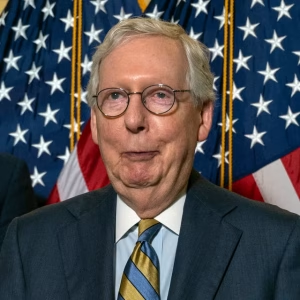
The confirmation of Neil Gorsuch in 2017, following Mitch McConnell’s controversial move to eliminate the judicial filibuster for Supreme Court nominees, wasn’t just a procedural shift; it was a profound declaration about power, precedent, and the future ideological direction of the courts.
To grasp the full weight of this event, we must rewind a bit. For over 150 years, between 1866 and 2016, the U.S. Senate had never once prevented a president from filling a Supreme Court seat when the nomination occurred prior to the election of their successor. This was a long-standing norm, a “soft guardrail” of democracy that ensured the smooth functioning of government even amid political differences.
However, this tradition shattered in February 2016, when Justice Antonin Scalia unexpectedly passed away. Almost immediately, then-Senate Majority Leader Mitch McConnell declared that the Senate would not consider anyone nominated by the sitting Democratic President, Barack Obama, arguing that the vacancy should be filled by the next president elected in November. Obama nominated Merrick Garland, a widely respected and ideologically moderate appellate judge. But for the first time in American history, the Senate outright refused to even consider an elected president’s nominee for the highest court. This was an “extraordinary instance of norm breaking,” effectively “stealing a Supreme Court seat” in the eyes of many.
Then came the 2016 presidential election, a surprise victory for Donald Trump. With a Republican in the White House and Republicans retaining control of the Senate, they were perfectly positioned to get their wish for a conservative justice. True to form, Donald Trump nominated Neil Gorsuch to fill Scalia’s seat.
Gorsuch himself was a clear choice for the conservative legal movement. His mother, Anne Gorsuch Burford, had been Ronald Reagan’s deregulatory EPA administrator. He graduated cum laude from law school, and while he wasn’t on the Harvard Law Review, he was on the flagship journal of the Federalist Society. This connection to the Federalist Society is crucial: it’s an “absolute juggernaut” that, under figures like Leonard Leo, has spent decades systematically “remaking the federal and state judiciaries to align them with conservative free market values”. Leo, who advised the Trump administration on judicial nominations, explicitly stated that the “administrative state” was a “huge, glaring issue” for the proper role of the courts. Gorsuch had already established himself as an “archenemy of the administrative state,” describing agencies as “behemoth[s]” difficult to square with the Constitution. The Trump administration’s White House counsel even admitted that their judicial selections and deregulatory efforts were “the flip side of the same coin”.
When Gorsuch’s confirmation faced resistance from Democrats, who largely voted against him, Senator Lindsey Graham declared, “I don’t know what to do other than to change the rules”. And that’s precisely what happened. In April 2017, Mitch McConnell “blew up the last remnant of the judicial filibuster,” invoking what’s known as the “nuclear option” to abolish the 60-vote requirement for Supreme Court nominees. This was the culmination of a decade-long escalation in judicial confirmation battles, marked by increased filibuster use by both parties during the Bush and Obama years. But eliminating the filibuster for Supreme Court nominees was a significant escalation, ensuring Gorsuch’s quick confirmation.
The implications of this move are far-reaching:
- Politicization of the Judiciary: The removal of the filibuster for Supreme Court nominations cemented the idea that judicial appointments are “a wholly political exercise”. This makes the courts more susceptible to “fringe-minority rule,” as justices are appointed, not elected, and presidents like Trump have been able to appoint justices confirmed by senators representing less than a majority of Americans.
- Advancement of a Specific Agenda: With a streamlined path for conservative nominees, the Court has become a primary vehicle for advancing a political agenda focused on issues like overturning Roe v. Wade, restricting LGBTQ+ rights, and dismantling the administrative state. The major questions doctrine, for example, adopted by Gorsuch and five other Republican justices in 2022, effectively empowers the courts (rather than expert agencies) to interpret statutes with “economic and political significance,” a clear embodiment of the deregulatory philosophy.
- Erosion of Democratic Norms: This event is a stark example of the “unraveling” of democratic norms and institutional forbearance, as one party trampled on a long-standing tradition for partisan gain. It reflects a dangerous trend where political rivals are increasingly treated as enemies, and a willingness to use power to punish critics and weaken institutional buffers.
- Influence of Dark Money and Think Tanks: The Federalist Society, fueled by “billions of dollars in dark money from very wealthy people who hate paying taxes and hate environmental regulations”, has played a critical role in shaping judicial nominations. This network directly influences conservative policy and judicial placement, demonstrating how money translates into judicial power. The Heritage Foundation, a key player in Project 2025, actively plans to staff future Republican administrations with personnel aligned with these goals.
In essence, the Gorsuch confirmation was not merely the filling of a Supreme Court vacancy; it was a deliberate and consequential escalation in the partisan battle for control of American institutions, paving the way for a judiciary increasingly aligned with a specific ideological vision. The ramifications continue to reverberate, defining the legal and political landscape to this day.