

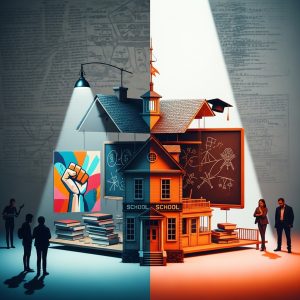
The issuance of Executive Order 13950, “Combating Race and Sex Stereotyping,” by President Donald Trump on September 22, 2020, stands as a critical juncture in the escalating “culture wars” in the United States, particularly concerning education and public discourse around issues of race, gender, and identity. This executive order, far from an isolated incident, was a direct and potent response to the societal shifts and protests that characterized 2020, and it laid foundational groundwork for a wave of subsequent legislative and policy actions across the nation.
To truly understand this executive order, we must situate it within its immediate historical and social context. The year 2020 witnessed significant mass protests for racial justice, following the murder of George Floyd, prompting many Americans and institutions to attempt a deeper reckoning with the historical role of race and racism in American society. This push for cultural change, however, was met with a “ferocious” backlash from those opposed to it. It was in this environment that certain Republican legislators and conservative activists “capitalized on this backlash,” employing the academic framework of “critical race theory” (CRT) as an inaccurately applied “bogeyman” for a wide array of ideas and practices related to advancing diversity, equity, or inclusion. This campaign was actively “fueled” by figures like Christopher Rufo, constituting a “manufactured disinformation campaign” aimed at silencing anti-racism advocates.
Executive Order 13950, “Combating Race and Sex Stereotyping,” directly emerged from this dynamic. Trump, who had already “railed against the 1619 Project”, “seized upon ‘diversity trainings’ and anti-racism teachings as a scapegoat to rally supporters”. The order asserted that “many people are pushing a… vision of America that is grounded in hierarchies based on collective social and political identities rather than in the inherent and equal dignity of every person as an individual”. It explicitly decried this vision as a “destructive,” “malign” ideology that “threatens to infect core institutions of our country”.
At its core, the executive order adopted “sweeping rules” that specifically defined “divisive concepts” related to race and sex in America. These concepts included, for instance, the notion that “the United States is fundamentally a racist country”. The order then went on to “prohibit the expression of these concepts” in any federal employee training, any training offered by institutions contracting with the federal government, and even within the U.S. military. Beyond these specific prohibitions, the order was transparently “aimed at shutting down discussions of societal privilege or racial disparities,” effectively prohibiting “race or sex stereotyping” or “race or sex scapegoating”. The intent was clear: to impose “ideological constraints” on educators and trainers in the name of preventing anti-racist “indoctrination”.
The impact of Executive Order 13950 was both immediate and enduring, despite its eventual revocation. Although President Joe Biden rescinded it on his first day in office in January 2021, the executive order had already been “instrumental in galvanizing a broad effort” that continued to gain momentum at the state level throughout 2021 and 2022. This “nationwide movement among Republican legislators, governors, pundits, and activists” sought to “crush a sweeping set of ideas and teachings dubbed ‘critical race theory’ and specific curricula they associate with it”.
The evidence of this galvanizing effect is striking:
- Surge in Educational Gag Orders: Proposed educational gag orders increased by 250 percent in 2022 compared to 2021, with 137 bills introduced across 36 states, up from 54 bills in 22 states. While 19 such orders became law in 15 states, with six additional executive orders signed, the assault on education was predicted to continue in 2023.
- Punitive Measures and Scope: These bills became “strikingly more punitive” in 2022, threatening heavy fines, loss of state funding for institutions, and even termination or criminal charges for teachers. They aimed to assert “political control over everything from classroom speech to library content, from teachers’ professional training to field trips and extracurricular activities”.
- Targeted Content: While the initial wave of bills in 2021, modeled on Trump’s EO 13950, focused on race and sex stereotyping, and patriotism/US history, 2022 saw a “sharp increase in the number of bills targeting LGBTQ+ issues and identities”. Florida’s HB 1557, known as the “Don’t Say Gay” bill, became a highly publicized example. The anti-LGBTQ+ legislation often disproportionately affects poor people of color and transgender individuals.
- Targeting Higher Education: Bills introduced in 2022 targeted higher education more frequently than in 2021, reflecting a “broader legislative attack on colleges and universities”. This included attempts to control curriculum relating to race, gender, and sexuality, efforts to abolish tenure, and bans on diversity statements in hiring.
- Politicization and Chilling Effect: Republican legislators overwhelmingly drove these gag order bills. Statements by officials, such as South Dakota Governor Kristi Noem claiming her state’s HB 1012 had “banned [critical race theory] in our universities” despite the law’s less expansive language, created a “broad chilling effect” on educators’ pedagogical choices. This mirrors the Trump administration’s broader pattern of using rhetoric to attack opponents and delegitimize institutions, including the media and the judiciary.
- Alignment with Broader Conservative Movement: The “anti–critical race theory” campaign, influenced by Trump’s EO, aligned with social conservative efforts against LGBTQ+ identities. Project 2025, a blueprint for a potential second Trump administration, developed by the Heritage Foundation and other right-wing think tanks, explicitly plans to change federal service rules to allow for the replacement of tens of thousands of civil service workers with those loyal to Trump’s agenda. It details plans to “gut the U.S. government”, including every major agency, with a focus on issues like abortion, gender ideology, and eliminating diversity, equity, and inclusion (DEI) programs. The project’s architects explicitly stated their mission is “institutionalizing Trumpism” and reordering society according to conservative values.
In sum, Executive Order 13950 was more than just a policy directive; it was a potent ideological statement that catalyzed a nationwide movement to restrict speech and education on sensitive topics. It demonstrated a willingness to weaponize governmental power to impose a specific cultural and historical narrative, a pattern consistent with Trump’s broader approach to governance and his attacks on perceived enemies and institutions. While President Biden rescinded the order, its legacy persists through state-level legislation and ongoing legal battles, continuing to shape the landscape of academic freedom and public discourse in the United States.