
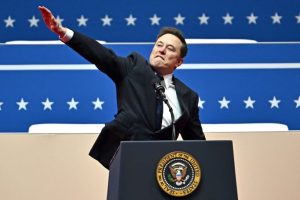
Very well. With a clear commitment to truth and a comprehensive view of the sources, let us delve into the fascinating and often controversial figure of Elon Musk, expanding upon the threads we’ve already touched upon regarding his influence and actions, particularly in the context of the Trump administration.
What emerges from the sources is a portrait of a man wielding immense influence, not just in the private sector, but deeply entwined with the highest echelons of government, particularly during Donald Trump’s second term. It’s a truth that his impact extends far beyond mere business, touching upon the very fabric of American governance and policy, often with a transactional flair.
Firstly, let’s understand his deep immersion into the federal government. Donald Trump, “at the suggestion of Elon Musk,” announced the creation of a Government Efficiency Commission. This commission, tasked with a “complete financial and performance audit of the entire federal government” and recommending “drastic reforms,” was likened to historical efforts like Theodore Roosevelt’s Keep Commission. After Trump’s election victory in November 2024, Musk, alongside Vivek Ramaswamy, was officially named co-chair of the Department of Government Efficiency (DOGE), a temporary organization established by executive order on Trump’s first day in office.
Musk’s role in DOGE was, to say the least, unconventional and widely debated. He was termed a “Special Government Employee” (SGE), a designation typically for short-term consultants, which notably did not require Senate confirmation. Despite this, Trump publicly stated that he had “put a man named Elon Musk in charge” of DOGE. This public assertion from the President starkly contrasted with the White House’s legal team, who, in federal court, claimed they did not know who held the title of DOGE administrator and that Musk was merely a “senior adviser” with “no actual or formal authority to make government decisions”. This created an “on-the-record contradiction,” leading to a “Joker origin story” for some observers. Indeed, a judge later partially agreed with plaintiffs that Musk was “at a minimum likely the official performing the duties and functions of the United States Doge service administrator”.
Musk’s activities within DOGE, as described, were swift and far-reaching, often cloaked in rhetoric about cutting fraud and waste:
- Federal Budget & Agency Reductions: Musk initially promised to cut $2 trillion from the federal budget, later reducing the target to $1 trillion after the administration took office. However, the actual verified cuts were estimated to be much less, around $5 billion for fiscal year 2026, largely through claiming contract values with unexercised options. DOGE under Musk was responsible for “half of all layoffs that have occurred in 2025 across industries”.
- Targeting USAID: A notable instance of DOGE’s impact was the drastic reduction of USAID, the world’s largest humanitarian aid agency. Musk publicly claimed USAID was a “giant money laundering operation” and boasted on Twitter about “feeding the agency to the wood chipper,” causing its website to vanish and thousands of employees to be placed on leave. While he claimed Ebola prevention funding had not been cut, sources indicate it was, alongside programs for HIV/AIDS and polio vaccination, and $290 million for preventing severe acute malnutrition. The Secretary of State, Marco Rubio, reportedly canceled 83% of USAID contracts and fired nearly all of its 10,000 staff.
- Gutting the IRS and Consumer Protection: DOGE was said to be “gutting the IRS,” with plans to reduce its workforce by 40%, specifically targeting agents trained to audit high-net-worth individuals. Musk also sought to “completely annihilate the CFPB” (Consumer Financial Protection Bureau), and did send a “little helper” to gut the bureau, who was “heavily invested in the companies CFPB regulates”.
- Regulatory Oversight of His Own Companies: DOGE slashed up to 10% of the staff at the National Highway Traffic Safety Administration (NHTSA), which oversees self-driving technology, just as Tesla’s “robotaxi ambitions ramp up”. Furthermore, all FDA inspectors overseeing Neuralink were fired, bringing Musk “one step closer to putting a chip in your brain”. This suggests a convenient alignment of his government role with his private business interests, aiming to ease regulatory pressures on his companies.
- Data Access and “Data Heist”: Perhaps most alarmingly, Musk and his team, including engineers as young as 19, secured access to “sensitive government databases and the Treasury Department’s payment system,” which processes over $5 trillion annually in Social Security, Medicare, and tax refunds. This access included names, Social Security numbers, birth dates, home addresses, and bank account information for “seemingly every American”. Concerns were raised about the potential for this data to be sold, used for blackmail, or fed into insecure AI systems. One former Neuralink, X, Tesla, and Boring Company staffer, a “longtime confidant,” even joined DOGE to oversee Social Security fraud detection. Some characterize this as Musk performing “one of his greatest data heists of all time”. A judge did issue a temporary restraining order to stop Musk from accessing US Treasury data, though this was later appealed and overturned by a higher court.
Musk’s influence also manifested in his relationship with President Trump and the broader political landscape:
- Political Support and Investment: Musk didn’t endorse Trump until July 2024 but then actively “manipulated Twitter to promote the campaign” and reportedly “poured about $300 million into the presidential race in Trump’s favor”. The Trump campaign even “outsourced his ground game to Musk”.
- “Shadow President” and Influence-Peddling: Musk has been described as a “shadow president” due to his amassed influence, even securing a role in the incoming Trump administration. Corporations like Disney, Comcast, IBM, Lionsgate, and Warner Bros. Discovery, which had previously boycotted X (formerly Twitter) due to hate speech concerns after Musk’s takeover, “scurried back” and resumed ad spending, likely to “get on their good side” with the administration. This demonstrates a clear strategy by corporations to “protect their businesses, and their profits” by channeling money into Musk’s platform, given his “lot of influence over the direction the government will take”.
- Conflicts and Feuds: Despite their alliance, the Trump-Musk relationship has been rocky. Their “bromance” was “short-lived”. A notable public spat occurred when Musk criticized Trump’s “big beautiful budget bill” as a “pork-filled abomination” and accused Trump of being in the Jeffrey Epstein files. Trump retaliated by threatening to “cancel all of Musk’s government contracts” for Tesla, SpaceX, and Starlink. This led to a public back-and-forth on social media, with Musk eventually deleting his criticisms and Epstein allegations, indicating a de-escalation after considering the “fate of SpaceX and Tesla”.
- “Project 2025” Alignment: Musk and Trump, following the blueprint outlined in “Project 2025,” “successfully undermined merit-based civil service protections,” shifting federal employment from merit to political loyalty. This systemic push is perceived as potentially turning the federal government “upside down” and making “everything but everyone can be bought or sold”.
Musk’s companies and their operations also reflect his broad, often controversial, reach:
- SpaceX and NASA Contracts: As DOGE chief, Musk oversaw federal spending while SpaceX held significant NASA contracts totaling $15.16 billion. There are calls from some right-wing commentators to even “nationalize SpaceX” due to the US dependence on its orbit launch service.
- Starlink: Starlink is being reconsidered for major rural broadband projects. The FCC denied Starlink government subsidies, a decision Brendan Carr (Trump’s pick to head the FCC) criticized as “regulatory harassment”.
- X (formerly Twitter): Musk’s takeover of Twitter led to a collapse in revenue and an 84% decrease in company value, despite his message to advertisers to “Go f*ck yourself”. The Saudi Kingdom Holding Company became the second-largest investor in the private entity after Musk.
- Palantir Integration: Musk’s allies, like Peter Thiel’s Palantir, are also cashing in, with Palantir “embedded with DOGE and the IRS to build a mega API to centralize access to all IRS data” and to build “immigration surveillance technology,” potentially merging all this data into a “central government operating system”.
- Union Busting: When workers at Tesla tried to unionize, “Elon fired them,” as one former employee stated, “because I tried to improve the lives of my coworkers and myself”.
- Environmental Policy Shifts: Musk’s actions have had a direct impact on environmental policy, with criticisms arising from cuts to electric vehicle incentives in the budget bill, despite no oil and gas subsidies being touched. This aligns with the Republican party’s dedication to fossil fuels and opposition to green energy, potentially alienating Tesla customers who are not Trump supporters.
In sum, Elon Musk, as depicted in the sources, is a figure of immense wealth and power, strategically leveraging his influence through political alliances and direct involvement in government. His actions reveal a transactional approach to power, where business interests and political decisions are deeply intertwined, raising significant questions about accountability, the rule of law, and the concentration of authority in the hands of a few. The consequences of this influence extend from the highest levels of federal policy to the daily lives of citizens, affecting everything from data privacy and social services to the future of technology and environmental regulation.