

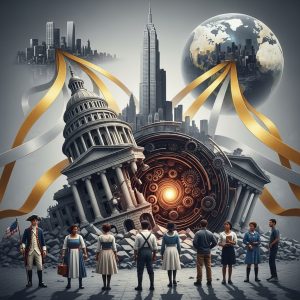
It is a foundational truth that the intricate relationship between global trade, elite interests, and the health of democracy has been a persistent, often hidden, struggle throughout history. The notion that markets operate as purely natural forces, divorced from human agency and political design, is a mythology that, as the sources reveal, has frequently served to obscure the rigging of systems by powerful elites. To understand the effect on the average citizen and democracy, we must delve into the historical currents that have shaped this dynamic.
From the very inception of what would become the United States, concerns about concentrated wealth and its political implications were present. In the early 1770s, wealth was already heavily concentrated in cities like Boston, Philadelphia, and New York, with the top 5 percent of Boston’s taxpayers controlling nearly half of the city’s taxable assets. This led to grievances among the lower classes, who sometimes used town meetings to voice their discontent, outvoting the “Gentlemen, Merchants, Substantial Traders and all the better part of the Inhabitants”. Upper-class politicians, while excluded from the direct ruling circles tied to England, skillfully mobilized this lower-class energy for their own purposes, a tactic seen throughout American political history. Indeed, there were moments when this fury against the rich escalated beyond the leaders’ intentions, as seen in the destruction of wealthy merchants’ homes in Boston in 1765, interpreted by some as a “War of Plunder, of general levelling and taking away the Distinction of rich and poor”. Mechanics and ordinary people, particularly in Philadelphia, actively demanded political democracy, including open assemblies, public roll-call votes, more equitable taxes, and price controls. Some even launched “a full-scale attack on wealth and even on the right to acquire unlimited private property,” proposing that “an enormous proportion of property vested in a few individuals is dangerous to the rights, and destructive of the common happiness, of mankind”. This early American struggle clearly framed concentrated land ownership and control over commerce as an aristocratic system that undermined citizenship and liberty.
The nation’s founders, having arisen from a protest against the British Empire’s infringement of liberties, including taxes on trade, intrinsically linked economic and political freedoms. They embraced the idea of private parties as agents of commerce, influenced by Adam Smith’s The Wealth of Nations, which argued that all parties would gain from trade, seeing commerce not as a zero-sum transaction but as a path to mutual benefit. Alexander Hamilton, once the Constitution was ratified, used trade regulation and customs revenues to animate his economic system, though he generally “disliked high, protective tariffs”. However, Thomas Jefferson’s attempt to weaponize trade through an embargo in 1807-09 mistakenly proved that such policies could hurt America more than its European targets, highlighting the complexities of trade as a foreign policy tool.
As the United States moved into the late 19th and early 20th centuries, a new chapter in trade and elite manipulation unfolded, often termed the “Gilded Age”. This era saw the emergence of powerful industrial and financial empires, built by “shrewd, efficient businessmen” like John D. Rockefeller and Andrew Carnegie, who amassed unprecedented fortunes. These titans choked out competition, maintained high prices, kept wages low, and readily used government subsidies, essentially becoming the “first beneficiaries of the ‘welfare state'”. Industries concentrated power, with banks interlinking through shared corporate directors, leading to a system where the government, while pretending neutrality, largely served the interests of the rich.
A crucial historical revelation is that the Progressive Movement, often portrayed as a popular uprising against big business, was in fact heavily influenced by these very interests. Figures like J.P. Morgan and Company, having failed to establish effective cartels in free markets (e.g., in railroads), realized that government coercion was the only way to “establish and maintain cartels”. This meant transforming the economy from laissez-faire to “centralized and coordinated statism”. The public’s long-standing opposition to government-imposed monopolies was overcome by redefining “monopoly” not as government-granted exclusive privilege, but as “big business” or “price cutting”. This intellectual “shell game” allowed regulatory commissions to be lobbied for and staffed by big businessmen from the very industries they were supposed to regulate, all under the guise of “curbing ‘big business monopoly’ on the free market” and promoting the general welfare.
Intellectuals and technocrats played a vital legitimizing role in this transformation. Many, trained in German graduate schools, embraced statist and organicist ideas, seeking “greater share of the pie than they could possibly achieve on the free market”. They lent “the patina of their allegedly scientific expertise” to the elite’s drive for a central bank, seeing opportunities for cushy jobs in the burgeoning bureaucracy. This era also saw the rise of imperialism, driven by the perceived need for “an enlarged field for . . . product” and investment of savings at profitable rates. Imperialism was also seen as a means to “curb the tendency of democracy to enjoy a too great freedom from restraint”. Even economists like Edwin R.A. Seligman of Columbia, from a prominent Wall Street banking family, hailed the “new industrial order” and prophesied economists as “the real philosopher of social life” who would “control and mold” material forces. The Federal Reserve System, established in 1913, was a “governmentally created and sanctioned cartel device” to allow banks to inflate the money supply, with key financial elites like the Morgan and Rockefeller interests heavily involved in its creation and control.
Cordell Hull, America’s longest-serving Secretary of State, dedicated his life to the idea that free trade could prevent conflicts and build prosperity. He argued that economic misery caused by barriers and unfair competition led societies to “fall . . . easy prey to dictators”. Yet, his vision faced internal administration rivals who advocated for “managed trade” and bilateral barter deals, such as George Peek’s controversial barter with Germany, which Hull argued subsidized German rearmament and undermined open markets. Hull’s constant struggle to advance open trading systems while navigating domestic protectionist pulls underscores how political decisions, not just market forces, shaped trade.
The post-World War II era brought a restructuring of industrial power, with New Dealers seeking to decentralize financial power and free businesses from bankers. They aimed to build a global trading system to spread democracy and thwart Soviet influence, even breaking up cartels that had contributed to the war. However, a significant shift in intellectual thought began to reshape the discourse around trade and corporate power. John Kenneth Galbraith’s concept of “countervailing power” posited that the rise of large corporations automatically led to the emergence of strong buyers (like large retail chains) and strong labor unions, thus balancing economic power. This idea, though disputed, undermined the traditional belief in competition’s beneficent role and dismissed decades of antimonopoly struggle as unnecessary, suggesting that concentrated corporate power was an inevitable and even beneficial aspect of modernity and affluence. Galbraith’s increasingly deterministic view even suggested that “much of what happens is inevitable and the same… on all societies,” blurring the lines between modern Western corporations and Soviet bureaucracies.
This intellectual shift, alongside the rise of the Chicago School of economics, fundamentally altered how policies were viewed. The Chicago School, while intellectually at odds with Galbraith, similarly dismissed concerns about corporate concentration, arguing that large firms were profitable due to “superior efficiency and good management” rather than market power. They viewed considerations of “equity, democracy, and social stability” as “vague, squishy, and dangerous”. Milton Friedman’s version of “free trade” redefined it to exclude concerns for private monopoly power or national sovereignty. The aim was to “airbrush out concentrations of power that were inconvenient to acknowledge”. Unwittingly, consumer rights advocates like Ralph Nader, influenced by Galbraith and elite postwar liberals, contributed to this shift by targeting “cartel regulations” (like those restricting airline behavior) as consumer protection, thereby aiding the deregulation agenda that would later benefit corporate power.
The consequences of these intellectual and policy shifts from the 1970s onward have been profound. The American economy witnessed a “vicious cycle” where wealth and power concentrated at the top, allowing elites to influence laws and regulations that further enlarged their economic and political dominance, siphoning off gains that would otherwise have gone to the bottom 90 percent. This era of “supercapitalism” saw power shift dramatically to consumers and investors, who pushed for lower costs and higher share prices, often at the expense of workers through job cuts and weakened unions. The “corporate takeover of American politics” was facilitated by a “system of legalized bribery” through campaign finance.
For the average citizen, this has meant wage stagnation, increased economic insecurity, and a widespread feeling that the “economic game is rigged”. Local civic leaders and small businesses have been “washed away by a wave of Walmarts and Targets and Amazons”. The rise of tech platforms has enabled a “far more dangerous concentration of power,” with giants like Amazon using their economic power to shape market rules and influence policy, much like the historical trading corporations that prompted earlier rebellions. Furthermore, the political influence of average Americans has become “minuscule, near-zero, statistically non-significant,” with lawmakers responding primarily to wealthy individuals and moneyed business interests. This phenomenon has been described as an American “oligarchy”.
The prevailing ideology, “market fundamentalism,” functions as a modern “divine right of kings,” asserting that the vast aggregation of wealth and power at the top is “natural and inevitable”. This belief conveniently “hides their power,” obscuring how a powerful few have shaped the system for their own benefit, even allowing for the routine violation of laws by corporations that treat fines as mere “cost of doing business”. This lack of accountability and the perception of a rigged system have eroded public trust in economic institutions and democracy itself, making people “easy prey for political demagogues with fast tongues and dumb ideas”. The consequence is a democracy where participation is broad but shallow, and “the 5,000” (the top 0.1 percent) can dominate an unequal system.
Ultimately, the historical record reveals that the organization of the market is not a natural given, but a human construct, reflecting political decisions about “how to do commerce”. The current concentration of wealth and power, and its influence over trade, is not inevitable. It is a “battle, a struggle for justice” that, throughout history, Americans have chosen to fight to ensure liberty for all, rather than allow a small aristocracy to govern commerce and society. The challenge is to understand this reality, to see through the mythologies, and to collectively re-establish countervailing power so that the market can once again serve broad-based prosperity.