

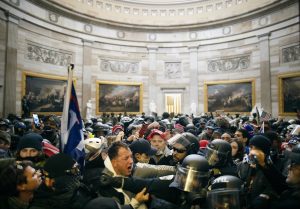
Five years after the glass was shattered and the floors of the U.S. Capitol were stained with blood and pepper spray, the legacy of the January 6th insurrection has morphed from a singular moment of national trauma into a central battlefield of American memory. Today, January 6, 2026, the seat of American power remains profoundly divided, not just by policy, but by an active, state-sponsored campaign to replace the evidentiary record with a “politics of eternity” that reframes an attempted self-coup as a “day of love”.
The Anatomy of an Insurrection: January 6, 2021
The assault on the Capitol was the violent climax of a multi-part plan by then-President Donald Trump to subvert the results of the 2020 election. Central to this scheme was the “Big Lie”—a persistent, knowingly false claim of widespread fraud disseminated to provoke a base that eventually viewed any obstacle to Trump’s power as an enemy of the state.
The attack was not a spontaneous riot but an orchestrated tactical strike. Documents like “1776 Returns” and the creation of the Proud Boys’ “Ministry of Self-Defense” provided the scaffolding for a coordinated breach. On the morning of the 6th, while thousands gathered at the Ellipse, approximately 100 plainclothes Proud Boys assembled at the Washington Monument, assessing the Capitol’s defenses for weaknesses.
The initial breach occurred at 12:53 p.m. at the Peace Circle, where rioters, goaded by Joe Biggs, overran a sparse line of police. Inside the building, the violence was “absolutely brutal,” resulting in assaults on approximately 140 law enforcement officers and eventually claiming the lives of seven individuals, including three officers. For 187 minutes, President Trump remained a passive observer in the White House dining room, ignoring pleas from family and staff to intercede while instead calling senators to urge further delays in the certification process.
The 2025 Rupture: Clemency as Retribution
The return of Donald Trump to the presidency in January 2025 inaugurated a period of systemic historical erasure. On his first day in office, Trump signed a sweeping proclamation granting relief to nearly 1,600 people charged in connection with the attack. This blanket clemency included full pardons for individuals convicted of violent assaults on police and commutations for high-level conspirators like Stewart Rhodes and Enrique Tarrio.
Legal experts and counterterrorism researchers characterized these pardons as a “green light” for future political violence, signaling that crimes committed for the executive would be met with unconditional mercy rather than justice. The move effectively unraveled the Justice Department’s largest-ever criminal investigation. To further institutionalize this revisionism, the administration ordered the Justice Department to purge press releases regarding the arrests and convictions of rioters, and critical video evidence began disappearing from public access.
The Revisionist Engine: Fictions and Purges
The ongoing efforts to rewrite the history of January 6th extend beyond pardons into the cultural and bureaucratic infrastructure of the nation. In mid-2025, the Smithsonian was ordered to remove explicit references to Trump’s impeachments from its exhibits, part of a broader mandate to excise “divisive, race-centered ideology” from national museums.
Furthermore, the Justice Department has been transformed into an instrument of retribution. The appointment of loyalists with zero prosecutorial experience—such as Ed Martin as D.C. U.S. Attorney and Alina Habba as interim U.S. Attorney for New Jersey—was followed by the firing of dozens of career prosecutors who had worked on January 6th cases. Under Attorney General Pam Bondi, the creation of a “weaponization working group” has shifted the focus of law enforcement toward investigating the very people who originally investigated Trump. Candidates for top intelligence positions are now reportedly screened for ideological conformity, including their belief that January 6th was an “inside job”.
The Legacy in 2026: A Defunct Consensus
As we mark this fifth anniversary, there is no official national memorial for the events of January 6, 2021. The official plaque intended to honor the police who defended the Capitol has never been hung, with House Speaker Mike Johnson claiming the statute is “not implementable”.
The competing hearings held today illustrate the fractured reality of the current moment: while House Democrats convene unofficially to warn against an “Orwellian project of forgetting,” a new Republican subcommittee focuses on security lapses and fringe theories designed to shift blame away from the President.
The enduring legacy of the insurrection is the collapse of a shared factual reality. By portraying rioters as “hostages” and “martyrs,” the administration has normalized a worldview where the rule of law is subordinate to the will of a single leader. As historians of totalitarianism warn, the speed of this devolution is startling; when the government has the power to define reality by executive fiat, the “ship of state” is no longer merely taking on water—it is actively sinking into an abyss of unreality.