

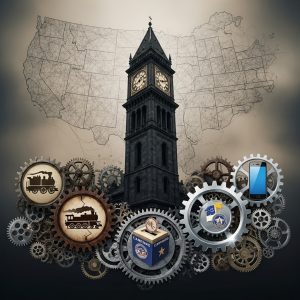
The history of lobbying in America is a rich and often contentious chronicle of how paid advocacy by special interests has consistently sought to shape lawmaking, affecting every level of government from local authorities to the federal sphere. It is a story distinct from an individual’s right to petition the government, characterized by evolving definitions of what constitutes acceptable influence versus corruption, and a persistent tension between private interests and public good.
Early Beginnings and the 19th Century Landscape: In the early days of the Republic and throughout the 19th century, lobbying was primarily conducted at the state level, as the federal government handled fewer economic matters than state governments. This activity was often “practiced discreetly” with little or no public disclosure. State governments, however, criminalized lobbying and courts frequently voided contracts for lobbying services, viewing the sale of personal, informal access as a corruption of petitioning. This reflects an early understanding that lobbying was a political process, often conducted privately, differing significantly from transparent public petitioning where petitions were read and considered in public sessions.
Despite legal skepticism, railroad moguls were prominent early lobbyists, seeking state and federal support for incorporation, track placement, cheap loans, subsidies, and land grants. While some of their demands were legitimate and necessary for private funders to invest, many railway projects were accompanied by allegations, often true, of legislators being swayed by conflicts of interest rather than conviction. For example, Alonzo Mack, a powerful lobbyist for Illinois Central in 1869, was known for using various modes of persuasion and presided over a “table for corruptibles” at a popular political hotel, where individuals signaling a readiness to “listen to proposals” would gather. This illustrates how the concept of “corruption” in America drew on old traditions focused on the moral orientation of citizens and representatives, emphasizing love for the public and the dangers of unrestrained self-interest. The problem of “placemen,” where individuals sought office not to represent the public but to secure well-paying jobs, was a significant concern for figures like Benjamin Franklin.
More intense lobbying at the federal level emerged between 1869 and 1877 during President Grant’s administration, near the beginning of what Mark Twain dubbed the Gilded Age. Key influential lobbies at this time focused on railroad subsidies and wool tariffs. In the Reconstruction South, lobbying was also intense, especially concerning railroad subsidies and even gambling, as seen with Charles T. Howard of the Louisiana State Lottery Company actively lobbying for a license.
The Progressive Era and Shifting Definitions of Corruption: From the 1880s to the 1920s, during the Progressive Era, reformers frequently blamed lobbyists for corrupting politics. The idea that lobbying should be more exposed began to take hold. This period saw a shift in how corruption was understood; the earlier “systematic corruption,” where elites used valuable privileges (like bank charters) to consolidate power, was largely eliminated by mid-19th century state constitutional revisions. Instead, a growing concern emerged over “venal corruption”—the “discovery that business corrupts politics”. This involved big business interests corrupting politics in pursuit of special privileges, leading to a flurry of reforms, particularly campaign finance laws.
Despite the negative perception, powerful lobbyists emerged, such as Colonel John Thomas Taylor, the chief lobbyist for the American Legion. Between 1919 and 1941, Taylor successfully pushed 630 veterans’ bills through Congress, benefiting ex-servicemen by over $13 billion. President Herbert Hoover even described a “locust swarm of lobbyists” haunting Congress in 1932, with Taylor named as one of the agents paid handsomely for their influence.
The early 20th century witnessed significant changes in the regulatory landscape, with new government agencies and reforms responding to the public’s perception of corruption stemming from the rise of large corporations and merger movements. The Tillman Act of 1907, for instance, prohibited federally-chartered corporations from contributing to election campaigns, and all corporations from contributing to congressional and presidential campaigns. Many states also passed laws regulating lobbying and limiting corporate political contributions. However, these early “corrupt practices” laws were relatively weak and didn’t cover all ways private interests might influence public officials.
The Mid-20th Century: Quiet Transformation and the First Amendment: Despite a large body of law that had historically treated paid lobbying as against public policy, these laws were never directly overturned but were “gradually shunted aside”. State courts began reclassifying lobby contracts as agreements for “professional” rather than “personal” influence, defaulting towards assuming their legitimacy. Judicial attitudes shifted from viewing themselves as providing public subsidies that shouldn’t be used for activities against public policy to becoming “neutral arbiters” agnostic to contract content.
This transformation coincided with a changing view of the First Amendment and the Supreme Court’s growing prominence. While cases like United States v. Rumely and United States v. Harriss didn’t directly address the constitutionality of lobbying, they strongly hinted at a constitutionally protected right, narrowly reading Congress’s power to mandate disclosure by lobbyists to avoid constitutional issues. This implication was significant because it didn’t confront the conflict with earlier cases that clearly treated paid lobbying as outside constitutional protection. Registration laws, like those enacted in Massachusetts in 1890, helped professionalize lobbying, making it harder to argue that non-lawyers couldn’t lobby without offering personal services. The growing power of the industry and legitimization of its key players likely made it seem less distasteful to courts, leading to the classification of private informational meetings as “professional services”.
The Modern Era: Escalation and the Revolving Door: The late 20th and early 21st centuries have seen a marked rise in lobbying activity, particularly at the federal level, becoming “Washington’s biggest business”. The number of business lobbyists in Washington, D.C., escalated sharply during the Bill Clinton administration. This period is characterized by the concept of the “revolving door,” where individuals move between government positions and well-paying lobbying jobs. This practice is seen as one of the most effective ways to influence legislation, as a job offer from a lobbying firm can effectively “own” a decision-maker on Capitol Hill, corrupting them even before they leave office. This “principal source of corruption” (in the Jeffersonian sense of a “rottenness” beginning in conduct when one “casts a longing eye on offices”) transforms intimate friendships and trust into marketable items.
The influence of money in politics also became more systematic through legal business donations via Political Action Committees (PACs). The Supreme Court’s decisions, particularly Citizens United (2010), further amplified this, allowing unlimited corporate and union money into elections. While these rulings didn’t directly overturn the old lobbying cases, they essentially validated a framework where spending money on elections is a protected First Amendment right, and combatting corruption is one of the few justifications for limiting this right. This has led to concerns that political campaigns are effectively “bought and sold” and that the possibility of campaign money can dictate a politician’s agenda, potentially prioritizing foreign doctors over local concerns like credit card interest rates or gas prices.
Today, the lobbying industry is vast, with tens of thousands of lobbyists often working for a relatively small number of large companies. This concentration of power means that the “grammar” of private interest maximization can bleed into the public political sphere, leading to a mistrust of public arguments and weakening the sense of obligation to the public good. The ongoing concerns about lobbying reflect a long-standing American tradition of debating the proper relationship between corporate self-governance and government, and the pervasive challenge of corruption in shaping policy.