

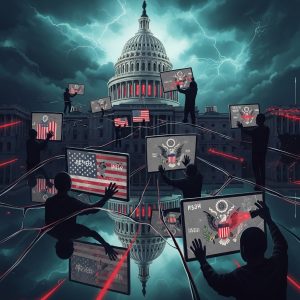
It is indeed a critical inquiry that brings us to the very heart of contemporary democratic life: the pervasive, yet often unacknowledged, influence of political campaigns, lobbyists, and far-right media through the deliberate manipulation of language and information. While many sincerely believe that the threats of propaganda and manipulation are relics of mid-20th century totalitarian regimes, the truth, as revealed by a clear-eyed examination of history and current events, demands a more urgent and attentive focus. It is imperative to understand how these forces operate subtly, how they erode the foundational ideals of democratic deliberation and equality, and how this quiet subversion echoes the damage inflicted upon democracies of the past.
The prevailing complacency regarding propaganda in modern liberal democracies often stems from a deeply ingrained “end of history” ideology. This belief, popularized after the fall of communism, suggested that liberal democracy had achieved its final, superior form, rendering it immune to the authoritarian backsliding witnessed elsewhere. This narrative fosters a dangerous sense of American exceptionalism, reassuring citizens that fascism or tyranny “can happen elsewhere but not here”. Consequently, when democratic ideals are invoked, such as “freedom,” it is often assumed that whatever current practices exist must align with this concept, leading to a “narrowed” definition of liberty that can, ironically, mask authoritarian realities. This uncritical acceptance means that the public often fails to recognize propaganda precisely because it is presented as the embodiment of these cherished liberal democratic ideals.
However, the mechanisms of modern propaganda are anything but benign. Political campaigns, fueled by exorbitant sums, have become central conduits for this manipulation. The Supreme Court’s decisions, particularly Buckley v. Valeo (1976), Citizens United (2010), and McCutcheon (2014), have systematically dismantled campaign finance regulations, allowing “big money” from wealthy individuals and corporations to flood the political arena. This creates a “mandatory gift economy” where candidates are compelled to spend a significant portion of their time fundraising, becoming beholden to the interests of their major donors rather than the broader public. The result is a political system where the “preferences of the average American appear to have only a minuscule, near-zero, statistically non-significant impact upon public policy”. This reality is obscured by rhetoric that pretends politicians represent the common good, even as they serve multinational corporations and wealthy patrons.
Beyond direct financial influence, the insidious nature of modern propaganda lies in its linguistic and ideological subtlety. Far-right media, exemplified by commentators on platforms like Fox News, actively engage in a “propaganda feedback loop” that intensifies societal polarization and systematically attacks democratic institutions, including the media, universities, and the judiciary. This creates an “asymmetric media system” where facts are often secondary to narratives that “stoke fear, anxiety and outrage”. Concepts like “critical race theory” are weaponized, inaccurately applied to a range of ideas, and used to create “moral panics” that distract from systemic issues and justify legislative attacks on education. Such “educational gag orders” are a “full-frontal attack on academic freedom,” aiming to suppress the “honest chronicle of the American past” and cultivate an “ignorant populace”. The goal is to undermine the very “democratic competence” needed for informed citizenship.
Propaganda in a liberal democracy, unlike in totalitarian states where it is overtly managed by a “ministry of propaganda,” functions by being “masked” and going largely “unnoticed”. It operates by presenting itself as reasonable while subtly eroding the ideals of public reason. This often involves exploiting “flawed ideologies” – beliefs that are resistant to evidence and prevent individuals from recognizing contradictions or their own true interests. For instance, terms like “welfare” or “job creator” carry implicit social meanings that can trigger long-standing racist stereotypes or economic biases, making rational deliberation about policy virtually impossible. This deliberate, or even unintentional, use of language to “undermine credibility” or bias debate, even in legal settings like the Supreme Court, is a characteristic form of “demagogic propaganda”.
The most profound damage inflicted by this pervasive propaganda is on the twin pillars of democratic deliberation and equality. Democratic deliberation requires shared understanding and a willingness to consider diverse perspectives based on reason and empathy. Propaganda, however, bypasses rational deliberation by appealing to emotions and pre-existing flawed ideologies, leading to “acclamation” rather than genuine voting. It “sabotage[s] discourse” and creates an “unreality” that makes a common basis for truth impossible. This erosion of rational discourse is often tied to the undermining of equality. By consistently portraying certain groups as “unworthy of empathy” or respect, or by legitimizing unjust hierarchies through myths of meritocracy, propaganda makes it difficult for their perspectives to be heard or for their interests to be addressed in policy-making. When policy is continually misaligned with public opinion, citizens lose faith, leading to cynicism and disengagement, and making them “lose faith that democracy can solve their problems and seek out personalistic or authoritarian leaders”.
This battle is not new to the American experience. The Founding Fathers themselves, drawing lessons from ancient Greece and Rome, were acutely aware that demagogues could exploit free speech to become tyrants and that inequality could bring instability. They sought to establish a system of checks and balances to prevent “tyranny”. Yet, early in the republic, the Sedition Act of 1798 directly abridged free speech. Historically, “charges of corruption” have been a powerful force in American political transformations, with Andrew Jackson’s campaign even using anti-corruption rhetoric to rally against incumbents and insiders. The Progressive Era, while ostensibly curbing big business, saw powerful financial interests use government “coercion” to establish cartels under the guise of “opposing monopoly,” aided by intellectuals who provided “a smoke screen of ideology”.
Later, Walter Lippmann, reflecting on the post-World War I era, despaired that democracy was “unworkable” because the public could be so easily manipulated by symbols and propaganda. By the 1920s, antidemocratic and even racist ideas gained increasing consensus among the intelligentsia. The “revolution of ideas” in the 1970s, driven by figures like Aaron Director and his “Chicago School” colleagues, deliberately “altered language itself,” co-opting terms like “liberty” and “markets” to serve corporate power and effectively “reorient[ing] the elitist liberal brain, rewiring it for plutocracy without liberals even knowing”. This ongoing historical tension, as A People’s History of the United States illustrates, is an “unresolvable conflict of American life” between “securing democracy against privilege” and “securing privilege against democracy”.
The parallels to historical authoritarianism are chilling. The “rise of soft authoritarianism globally” is consistent with how the commercial sphere has developed since the 1970s, making citizens “at the mercy of distant forces, our livelihoods dependent on the arbitrary whims of power”. Comparisons are drawn to fascist tactics, including attacks on the press, universities, and courts, and the “regular and repeated obvious lying” of leaders who normalize the unthinkable. When citizens are told that the country’s deepest problems stem from “illegal aliens” or “lazy criminals,” rather than systemic issues of wealth concentration, it is a tactic that “preys on the deepest anxieties” and simplifies human existence into an “us and them” narrative. Such tactics, historically, have made “normal diplomatic relations” impossible by demonizing perceived enemies.
In conclusion, the belief that propaganda and manipulation are not significant problems in contemporary American democracy is a dangerous illusion. The subtle and pervasive nature of modern propaganda, fueled by big money in politics and amplified by partisan media, actively undermines democratic deliberation and equality. It distorts truth, erodes trust in vital institutions, and polarizes the populace by cultivating “us vs. them” narratives. History provides ample warning: from the Founding Fathers’ fears of demagogues to the Progressive Era’s co-optation of reform, and from early 20th-century disillusionment to the post-1970s “revolution of ideas” that reshaped language and economic power. The “battle for America’s soul” is indeed ongoing, demanding that citizens recognize these subtle forms of subversion, scrutinize political rhetoric, and actively engage in the defense of democratic institutions and the pursuit of a genuinely informed, equitable public sphere. Only by telling and confronting this truth can we hope to secure the future of our republic.