

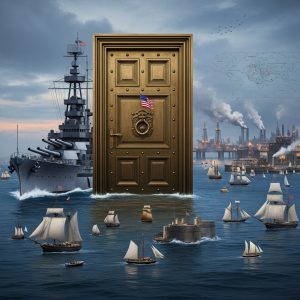
In a 1907 lecture at Columbia University, Woodrow Wilson—then still a university president—uttered a line that would serve as the unvarnished mission statement for American foreign policy in the twentieth century: “Concessions obtained by financiers must be safeguarded by ministers of state, even if the sovereignty of unwilling nations be outraged in the process… the doors of the nations which are closed must be battered down”. While Wilson is often remembered as the high-minded architect of “self-determination,” his 1912 campaign rhetoric was even more explicit about the economic engines of statecraft, asserting that because domestic markets no longer sufficed, the United States required a “righteous conquest of foreign markets” to absorb its massive surplus. This “Open Door” logic was not merely a diplomatic strategy for China; it was the foundational requirement for an American capitalist system that equated national survival with global commercial expansion.
The Closing Frontier and the Birth of the “Informal Empire”
By the late nineteenth century, a crisis of confidence gripped the American elite. In 1890, the U.S. Census declared the internal frontier closed, sparking fears that the “regenerating force” of American life had vanished. This coincided with a severe depression in 1893, leading policymakers and financiers to conclude that overseas markets were the only remedy for chronic underconsumption at home. Senator Albert Beveridge captured this zeitgeist in 1897, declaring that “Fate has written our policy for us; the trade of the world must and shall be ours”.
This imperative drove the United States into the Spanish-American War of 1898. While popularly framed as a humanitarian mission to liberate Cuba, the conflict was an incident of a general movement of expansion rooted in an industrial capacity that far outstripped domestic consumption. Strategic outposts like the Philippines were seized not for their own resources, but as “stepping stones” to the “illimitable markets” of China. This birthed what historians call the “informal empire”—a sophisticated model of imperialism that sought “equality of access for goods and capital” through an “Open Door” rather than the messy, expensive administrative burdens of traditional colonialism.
Wilsonianism: Financing the “New Freedom” Abroad
Woodrow Wilson’s administration refined this synthesis of politics and finance. Despite his “New Freedom” rhetoric, Wilson’s foreign policy was designed to ensure that the doors of “weaker countries” remained open to an “invasion of American capital and American enterprise”. By 1914, U.S. private foreign investments had reached $3.5 billion, and the onset of World War I bound American prosperity to an Allied victory.
Wilson’s Secretary of State, William Jennings Bryan, initially resisted this trend, arguing that “money is the worst of contrabands because it commands everything else”. However, the administration quickly tacking toward the Allies, recognizing that U.S. economic stability now depended on foreign loans and exports. By the end of the war, the House of Morgan—acting as the purchasing agent for Britain and France—had booked $30 million in fees and handled $3 billion in supplies, effectively integrating the American industrial machine into a global military-commercial complex.
The Cold War and the Globalized Marketplace
Following World War II, the “Open Door” was globalized to prevent another 1930s-style economic collapse. The Marshall Plan, while humanitarian in presentation, had the explicit economic aim of building up European markets for American exports. As late as 1953, the National Security Council was remarkably candid, noting that “Economic expansion is the driving force upon which U.S. strength is based, and is basic to our concept of successfully coping with the Soviet Union”.
President Eisenhower’s articulation of the “domino theory” was deeply rooted in this economic anxiety. In 1953, he warned that the fall of Indochina would mean the loss of vital materials—”tin and tungsten”—and the closure of the “rich empire of Indonesia” to the free world. By this logic, foreign interventions were not merely about ideology but about ensuring that the “triangular trade” that bolstered global capitalism remained unencumbered by “hostile hegemons”. This was later formalized by modernization theorists like Walt Rostow, who envisioned U.S. military power as a “ruthless projection” necessary to protect the “natural” path of capitalist takeoff in the Third World.
The Marketplace as Proxy for Sovereignty
As we moved into the late twentieth century, the “Open Door” evolved into a push for neoliberal globalization. The Clinton administration’s foreign policy focused on “enlargement”—expanding the world’s community of market democracies to ensure Americans could trade across borders. This included leveraging the U.S. military to secure energy security in Central Asia, where the administration sought big oil and gas deals to bypass Russian and Iranian control.
From the “gunboat diplomacy” of the 1920s to the trade agreements of the 2000s, the consistent through-line of U.S. foreign policy has been the belief that America’s national experiment depends on its international reach. The “battering down” of closed doors has been facilitated by the fact that American diplomacy rarely accepts the status quo; instead, it seeks a “New Order of the Ages” where market access is the ultimate arbiter of international legitimacy. As Wilson predicted, the “ministers of state” have indeed remained the eternal guardians of the “concessions obtained by financiers,” making the pursuit of profit indistinguishable from the pursuit of national security.