

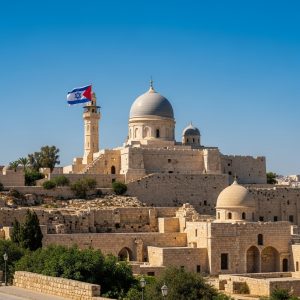
To understand how the modern state of Israel came to exist, one must delve into a complex historical narrative, marked by ancient ties, shifting imperial controls, and intense political and ideological aspirations. It is a truth that demands careful, fact-based examination, ensuring that we do not lie about the past in our interpretation.
The roots of modern Israel can be traced back to ancient times, with the Israelites establishing a united kingdom around 1020 BCE. This kingdom later divided into Israel in the north and Judah in the south. Following these ancient periods, the Jewish diaspora spread across the Mediterranean and beyond, though a Jewish presence remained in Palestine throughout subsequent centuries. Control of the region shifted among various empires, including the Umayyad and Abbasid Caliphates, the Crusaders, and the Mamluks, until the Ottomans took over in 1517 and ruled until the end of World War I.
The late 19th and early 20th centuries saw the rise of Zionism, a movement that sought to establish a national homeland for the Jewish people in Palestine. The Basel Program officially defined Zionism’s goal as “the creation of a home for the Jewish people in Palestine secured under public law”. Between 1882 and 1903, the First Aliyah saw approximately 25,000–30,000 Jews, mainly from Eastern Europe, immigrate to Palestine and establish agricultural settlements.
A pivotal period began with the British Mandate of Palestine, spanning from 1920 to 1948. Following World War I, Britain was allowed to control much of the Middle East, including Palestine, under a mandate from the League of Nations. Crucially, in 1917, Britain had endorsed a plan for a homeland for the Jewish people in Palestine through the Balfour Declaration, which became official British policy after the war and was included in the peace treaty between Britain and Turkey. However, the declaration also stipulated that the rights of existing non-Jewish communities in Palestine should not be prejudiced. From the outset, the British faced significant challenges in balancing the aspirations of both Jewish and Arab communities.
Jewish immigration to Palestine increased during the 1920s and 1930s, driven by Zionist aspirations and the dire situation for Jews in Europe, particularly with the rise of Nazism. By 1939, as many as half a million Jews lived in Palestine, mostly in independent settlements. Arab hostility towards the Jews intensified, leading to Jewish settlements becoming “armed camps” for protection. In response to the escalating tensions, Britain issued policy statements like the 1930 Passfield White Paper and the 1939 White Paper, which aimed to limit Jewish immigration and land purchases, with the latter proposing an independent Palestine governed jointly by Arabs and Jews within ten years. The 1937 Peel Commission recommended the partition of Palestine into separate Jewish and Arab states, but this was rejected by both Arab and Jewish leaderships.
After World War II, increased pressure was put on Britain to open Palestine to Jewish refugees displaced by the war, but the British continued to keep the door closed. In response, Jewish militants in Palestine began an insurgency against the British occupiers. Given the complexities and escalating tensions, Britain decided to refer the issue to the United Nations in 1947.
The UN formed a Special Committee on Palestine (UNSCOP), which investigated the situation and recommended a solution. UNSCOP proposed the partition of Palestine into separate Jewish and Arab states, with Jerusalem under international administration due to its religious significance. This plan, formally known as Resolution 181, aimed to address the conflicting national aspirations but divided the territory so that the proposed Jewish state would comprise roughly 56% of Palestine, even though Jews constituted only about one-third of the population. The proposed section for Israel included much of the coastal plain and the Negev desert.
The Arab rejection of the partition plan immediately led to civil conflict between Jewish and Arab communities in Palestine. On May 14, 1948, the Israeli Declaration of Independence was proclaimed. This declaration immediately sparked military intervention by neighboring Arab states, initiating the 1948 Arab-Israeli War, also known as the War of Independence. Despite being outnumbered and facing significant logistical challenges, Israel not only defended its territory but expanded its borders beyond those proposed in the UN Partition Plan. The war concluded in 1949 with a series of armistice agreements between Israel and its neighboring states, establishing borders often called the Green Line, which left Israel with approximately 78% of the territory of Mandatory Palestine.
A profound consequence of the 1948 war for the Palestinian people was expulsion and flight from the land that the State of Israel came to control, leading to half of Palestine’s Arabs becoming refugees. This event is known to Palestinians as the Nakba, or “catastrophe”. Simultaneously, waves of Jewish immigration from other parts of the Middle East followed the establishment of Israel. In its early years, Israel sought to maintain a non-aligned position between the superpowers but shifted its stance after antisemitic public trials in Moscow and Czechoslovakia and its exclusion from the Bandung Conference. Egypt’s closure of the Suez Canal to Israeli ships and commerce in 1950, and the rise of Abdel Nasser, further shaped the regional dynamics, as the United States pursued close relations with Arab states, while Israel sought alliances with newly independent African states and France.
The post-1948 period saw continued conflicts and evolving relationships. The Suez Crisis of 1956, triggered by Nasser’s nationalization of the Suez Canal, involved an invasion by Israel, Britain, and France, leading to a UN Emergency Force intervention and marking the end of West European dominance in the Middle East. The Suez Canal remained closed to Israeli shipping. In 1967, the Six-Day War erupted, resulting in Israel’s capture and occupation of the Golan Heights from Syria, the West Bank from Jordan, and the Gaza Strip and Sinai Peninsula from Egypt. This victory granted Jews access to holy sites in Jerusalem, Hebron, and Bethlehem, and made Israel self-sufficient in energy through the Sinai oil fields. The Soviet bloc, with the exception of Romania, broke off relations with Israel after this war, which also spurred a wave of Soviet Jews to apply for emigration to Israel due to increased Soviet antisemitism.
The Yom Kippur War in 1973 began with an attack by Egypt on the Israeli-occupied Sinai Peninsula. Subsequent efforts towards peace led to the Camp David Accords in 1979 and the signing of the Egypt-Israel Peace Treaty. While a success for Israel and Egypt, this isolated Sadat from other Arab states, and significant differences regarding Palestine and occupied territories remained unresolved. The early 1980s saw the 1982 Lebanon War. The First Intifada, a Palestinian uprising against Israeli occupation, emerged in the late 1980s.
The Oslo Accords in 1993, an agreement between Israel and the Palestine Liberation Organization, led to the establishment of the Palestinian National Authority. In 1994, the Israel-Jordan Peace Treaty was signed. However, the Second Intifada commenced in 2000 following a visit by Israeli opposition leader Ariel Sharon to the Al-Aqsa compound, which was followed by the destruction of Joseph’s Tomb by Palestinians. In 2005, Sharon formed a new party, Kadima, which accepted the peace process leading to a Palestinian state. Yet, Hamas won the 2006 Palestinian legislative election, and its leaders rejected all agreements with Israel, refused to recognize Israel’s right to exist, and refused to abandon terror, even occasionally claiming the Holocaust was a Jewish conspiracy. The status of Gaza remained unclear, with Israel asserting it was no longer an occupying power despite controlling air and sea access, while Egypt insisted it was still occupied and refused to open border crossings.
More recently, the United States formally recognized Jerusalem as the capital of Israel in 2017 and the Golan Heights as part of Israel in 2019. The “Great March of Return” protests along the Gaza-Israel border also commenced in 2018. In 2020, several Arab nations, including the UAE, Bahrain, Sudan, and Morocco, normalized ties with Israel through the Abraham Accords. The ongoing conflict continues, including the “ongoing war with Hamas, Hezbollah and Iran”. Indeed, some historical narratives about the creation of Israel, such as the claim of an “empty land,” are described in the sources as attempts to legitimize colonialist practices and erase the Palestinian past.
The historical evolution of both Israel and Palestine is a continuous process of interactions, conflicts, and attempts at resolution, demonstrating how complex geopolitical forces, ideological commitments, and human actions intertwine to shape the present reality.