

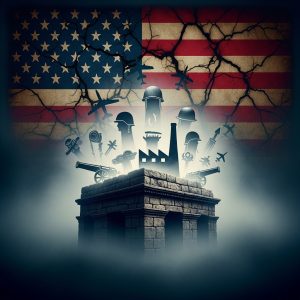
“War is the health of the state,” the radical writer Randolph Bourne famously observed during the First World War, signaling how conflict allows a government to flourish while simultaneously stilling the fires of domestic class struggle. Historical analysis suggests that whenever the American political order has seemed imperiled by internal tension, a sudden crisis has been used to summon a tremendous exertion of national energy that transforms the social landscape. This process functions as a “primal act of self-survival” for the executive, as any government facing a challenge to its legitimacy will sacrifice the sanctity of its laws and the prosperity of its citizens to maintain the external necessity of its rule. Throughout the history of the United States, foreign adventures have been utilized to deflect rebellious energy away from domestic strikes and protest movements and toward a common external enemy. The psychology of patriotism, combined with the lure of a moral crusade, works effectively to dim class resentment against the rich and powerful and turn that anger against a demonized “other”.
The American Civil War provides one of the earliest modern examples of this phenomenon, where the aura of a moral mission was used to convert a divided public into a “national near-unanimity” described as an obedient flood of energy. During the late nineteenth century, the political and financial elite concluded that overseas markets and the “mere joy of fighting” might relieve the problem of underconsumption and prevent the economic crises that frequently brought about class war. This logic reached a peak in the twentieth century, when the “Good War’s” ideological mobilization created a template that made it possible to inculcate a polarizing mind-set and justify the massive use of force. Wartime mobilization also serves a vital economic function as a massive “demand shock” that mopps up excess workers who might otherwise fuel radical domestic movements. For instance, the serious recession that began in the United States in 1914 was ended by over $2 billion worth of war orders for the Allies, binding the nation’s prosperity to a “fateful union of war”.
By the middle of the twentieth century, the system had learned that war production could be used to ensure high profits and economic stability, leading to the institutionalization of what Charles E. Wilson, the president of General Electric, called a “permanent war economy”. This paradigm, often referred to as “Military Keynesianism,” treats defense spending and Pentagon procurement as a primary tool for business-cycle stabilization. The idea of peacetime military expansion was systematically sold to Congress and local officials on the basis that military bases and contracts would bring high-paying jobs and resources to their communities. This linkage between international objectives and domestic social welfare became a central political integument that supported an increasingly active federal commitment to economic programs. However, this “military-industrial-academic complex” also meant that defense budgets were often influenced not by national need, but by what served the economic interests of the suppliers.
The “Report from Iron Mountain,” a government-sponsored think-tank study released in 1966, offered a more cynical view, arguing that the war system is indispensable to a stable political structure because no government can long remain in power without a sense of external necessity. The report concluded that war-making is a “principal political stabilizer” because it enables a society to maintain necessary class distinctions while ensuring the subordination of citizens to the state. Under this logic, the production of weapons is functionally equivalent to a system of “planned waste” that prevents the masses from becoming “too intelligent” or too comfortable with their standard of living. In practice, this requires a chronic shortage of the necessities of life to increase the importance of small privileges and magnify the distinction between the ruling group and the subjects. The Cold War era successfully established this climate of fear—a perpetual state of emergency that permitted more aggressive actions abroad and more repressive actions at home.
In the twenty-first century, this “war on terrorism” has functioned as a “Cold War redux,” utilizing the same rhetoric of wickedness and the same “Axis of Evil” imagery to justify the concentration and abuse of power. This permanent state of war ensures that executive power can be asserted and concentrated while secrecy is used to shield the power elite from democratic checks and balances. Modern leaders have learned that when they act in the name of a crisis, they can “create their own reality” and leave the citizens with no role other than to study the actions of the state. Ultimately, if the history of the “Greatest Generation” and the conflicts that followed it has any lesson, it is that war remains a purely internal affair waged by a ruling group against its own subjects to keep the structure of society intact. The “hideous enginery of war” remains a hit, much like crack, that allows the establishment to manage a people torn by internal conflict while they “scare the hell out of the rest of the world”.