

Today, we’re going to pull back the curtain on an event that, while often relegated to a footnote in conventional narratives, speaks volumes about the very foundations of power, resistance, and the mechanisms of control in what would become the United States. We’re talking about the New York slave revolt of 1712. It’s a moment brimming with the raw, unsettling truths that challenge the comforting myths of our past, and as a historian committed to peeling back layers of official history, I assure you, it’s a story worth dissecting.
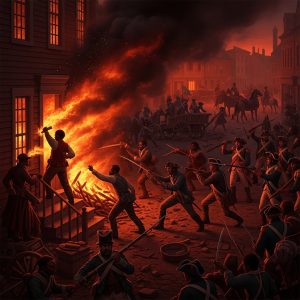
In April of 1712, a fire broke out in New York City. This was no accident; it was a deliberate act, ignited by a group of twenty-five enslaved Black individuals and two Native Americans. When white colonists rushed to the scene, nine of them were killed. This was a direct, violent eruption against the deeply ingrained system of bondage. The response from the authorities was swift and brutal. Twenty-one of the rebels were captured and subjected to horrific executions, with some being burned alive over a slow fire, a gruesome spectacle intended to “serve notice to other slaves”.
This event, though localized, underscores several critical aspects of early American society. First, it lays bare the sheer profitability and brutal practicality of the institution of slavery. Masters could profit immensely from enslaved labor, often spending very little on their upkeep. This economic engine, particularly in the South, necessitated an intricate system of control—psychological and physical—designed to break the spirit of enslaved people, reinforce their perceived inferiority, and suppress their individual needs. It was a system built on hard labor, the deliberate fracturing of families, and the pervasive threat of violence, including whipping, mutilation, and death.
Yet, the 1712 revolt, like countless other acts of defiance, reminds us that submission was never complete. From quiet noncooperation and running away to organized insurrections, enslaved people continually asserted their humanity and agency. The fact that two Native Americans joined this revolt highlights a profound fear that haunted the colonial elite: the fear that discontented white servants, enslaved Black people, and Native Americans might make common cause to overthrow the existing order. This fear was not unfounded, as sources show instances of cooperation and conspiracy between these groups dating back to the 17th century. Colonial officialdom, in its ingenious system of control, actively worked to alleviate this danger by fostering division, for instance, by pushing landless whites westward to create a buffer against Native American populations, or by granting white servants limited privileges over enslaved blacks. This strategy of turning “the 99 percent against one another” to obscure their common plight remains a potent tactic for elites to maintain control, even today.
This incident also serves as a stark example of how official histories are constructed and, often, how uncomfortable truths are erased or minimized. Traditional accounts, eager to emphasize “progress” and the “heroism” of figures like Columbus, tend to bury the stories of genocide and atrocity, presenting them as an unfortunate but necessary price for civilization. The narrative of “American exceptionalism,” which posits an “unbroken, ineluctable progress of freedom and equality,” can actively discourage a critical examination of these violent foundational acts. It’s a compelling illusion, one that seeks to ensure compliance by narrowing our very definition of freedom.
When we see educational policies today that seek to forbid teaching that America has “more culpability” for slavery or that emphasize a “negative account” of the nation’s history, we are witnessing a continuation of this deliberate erasure. This is not merely about “biased” interpretations; it’s about eliminating the events themselves and the patterns they form, preventing students from understanding the deep roots of issues like mass incarceration or ongoing systemic inequalities. As historians, our responsibility is to challenge this “ignoble value of forgetting” and to bring to light the perspectives of those who have been marginalized and silenced.
The 1712 New York slave revolt was not an anomaly; it was a testament to the continuous struggle between dominators and dominated, a conflict that has shaped, and continues to shape, the very fabric of American society. By understanding the “hidden transcripts” of resistance and the mechanisms of power employed to suppress them, we can gain a far more accurate and critical understanding of our past, and by extension, our present. This truth-telling, however uncomfortable, is essential if we are to truly grapple with the complexities of our nation and work towards a more just future.