

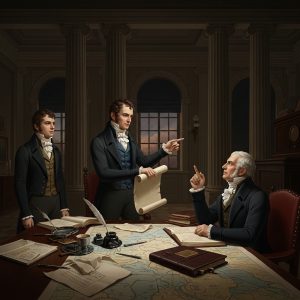
Let us now turn our attention to the pivotal year of 1824, a moment that stands as a critical juncture in the evolution of American political discourse. This year witnessed a fiercely contested presidential election, a struggle not just for power, but for the very soul of the burgeoning republic, with its central theme becoming nothing less than the stark accusation of “corruption”.
The contenders in this significant election were William Crawford, John Quincy Adams, Henry Clay, and Andrew Jackson. What makes this particular contest so illuminating is not just the multi-candidate field, but the potent weapon wielded by Andrew Jackson: the charge of corruption, which became the very foundation of his campaign.
Jackson’s rhetoric was sharp, aiming directly at the perceived decay within the nation’s capital. He lamented a spectacle where “corruption is springing into existence, and fast flourishing” in Washington, with presidential candidates “electioneering and intriguing” to gain the confidence of Congress members who would then “dictate to the people what is right”. This was not merely a political tactic; it reflected a deep concern about the integrity of self-governance.
The most enduring legacy of this election, indeed, was the infamous accusation of a “corrupt bargain”. Here’s precisely how it unfolded: while Andrew Jackson secured a plurality of both the popular vote and the electoral votes, he failed to achieve the required majority in the Electoral College. Consequently, the responsibility for electing the president fell to the House of Representatives, where Henry Clay served as Speaker. In a move that would forever alter the political landscape, Clay, exercising his considerable influence, threw his support behind John Quincy Adams. The outcome was Adams’s victory, and in a move that immediately fueled outrage, Adams subsequently appointed Clay as his Secretary of State.
Jackson’s supporters did not hesitate, immediately denouncing this alliance as a “corrupt bargain.” Jackson himself, with characteristic vehemence, publicly declared, “so you see, the Judas of the West [Clay] has closed the contract and will receive thirty pieces of silver. His end will be the same. Was there ever witnessed such a bare faced corruption in any country before?”. This powerful accusation served as the driving force behind Jackson’s subsequent campaign for the 1828 election, framing the contest as a fundamental struggle between “democracy and corruption,” with Jackson embodying the former against the “incumbents and insiders”.
This era saw “corruption rhetoric” dominate the political grammar, a theme deeply rooted in American history. The Democratic Party, forged by Martin Van Buren and Andrew Jackson, made competitive party politics a permanent fixture, yet this also raised the “specter of corruption, faction, and party”. Jackson, much like earlier founders who warned against unchecked power, portrayed corruption as antithetical to liberty, stating in his 1837 farewell address that a “corrupt public” would become “easier victims to tyranny”.
Jackson’s concern about corruption was not confined to political maneuvering alone. His philosophical stance was rooted in the belief that corruption stemmed from the misuse of governmental powers to create powerful economic interests, which then subverted the very process of government and threatened citizens’ liberties. This conviction underpinned his fierce opposition to the Second Bank of the United States. In the 1832 presidential campaign, the Bank’s future became the primary issue. Jackson argued that the Bank was an instrument of “systematic corruption,” enabling a small group, like its head Nicholas Biddle and Henry Clay, to wield government power for private gain, creating “monopoly rents” that subverted the government and threatened liberty. He articulated a clear distinction between “real value and true worth” (represented by gold) and the “rag money” issued by banks, which he saw as a tool for “swindlers to corrupt and cheat an innocent and virtuous public”.
This broader concept of “systematic corruption” — where elites control government to award valuable privileges and consolidate power — became a “most salient issue for American voters” during the ongoing struggle between the Democrats and the emerging Whig party, led by Henry Clay. The debates revolved around “executive usurpation,” “monied conspiracy,” corporations, and the appropriate role of government in economic development.
Furthermore, it was during Jackson’s presidency (1829-1837) that the “spoils system” became entrenched in the federal civil service. While presented as an anti-elitist measure to dismantle established power structures and ensure “rotation in office”, this expansion of partisan control over government appointments inadvertently created “fertile ground for pervasive corruption”. Critics saw it as a “deadly element” that rendered the U.S. political system “so exquisitely vicious” it “worked to corruption by an irresistible necessity,” with “office-holder synonymous with the word sneak”.
The 1824 election, and the “corrupt bargain” narrative that emerged from it, fundamentally shaped American politics, catalyzing the transformation of the party system and embedding the theme of corruption deeply into the national consciousness. It laid the groundwork for future political battles, where accusations of corruption, whether venal or systemic, would continue to be powerful forces in shaping public debate and driving reform movements.