

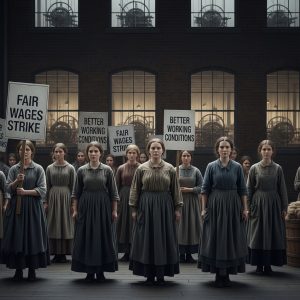
Our journey through the nascent American republic now brings us to 1834, a mere decade after the pioneering actions in Pawtucket, and to another crucible of early industrial life: Lowell, Massachusetts. Here, a singular event sparked a powerful, if ultimately constrained, eruption of defiance that further illuminated the evolving struggle for labor rights and women’s place in a rapidly industrializing nation.
The context of Lowell was one of burgeoning textile mills, which by this time employed women as 80 to 90 percent of their operatives, most often aged between fifteen and thirty years old. While the “Lowell system” was initially presented as a benevolent escape from the drudgery of domestic work, its reality soon became one of severe exploitation. Workdays stretched from “five until seven o’clock, with one hour only to attend to the wants of nature”. Wages were meager, with thousands earning as little as 25 cents a day for twelve to sixteen hours of labor, in conditions that were poorly lit, badly ventilated, intensely hot in summer, and damp and cold in winter.
It was within this oppressive atmosphere that, in 1834, a wage cut spurred the Lowell women to strike. The specific spark for this particular “turnout,” as it was called then, was the firing of a young woman. This act of corporate control, arbitrary and unjust in the eyes of her peers, was met with an immediate and powerful response: other girls “left their looms” in solidarity.
But what truly made this moment resonant was a remarkable act of public defiance. One of these young women, her spirit aflame, climbed atop the town pump and delivered what a newspaper reporter described as a “flaming Mary Wollstonecraft speech on the rights of women and the iniquities of the ‘moneyed aristocracy'”. This was no mere grumble; it was an articulate and impassioned declaration, invoking the very principles of women’s rights that had begun to circulate more widely since the Revolutionary War, influenced by the reprinting of Wollstonecraft’s A Vindication of the Rights of Women in the United States.
The speaker’s words struck a deep chord with her audience, producing a “powerful effect” that led them to declare their determination “to have their own way, if they died for it”. This moment underscored the growing consciousness among working women, for whom the “cult of domesticity,” with its emphasis on passivity, purity, and submission, was increasingly at odds with the harsh realities of their factory lives. While ideology sought to keep women “more easily controlled” in the home, the collective experience of shared hardship in the mills inadvertently “created a common consciousness of their situation and forged bonds of solidarity among them”.
The strike itself, though immediate gains were limited, was a significant step in the continuum of labor resistance. The sources indicate that these early New England “turnouts” were often unsuccessful, with the threat of replacement workers usually driving the women back to work at reduced wages and leading to the firing of their leaders. Indeed, the 1834 strike in Lowell saw its leaders fired. However, the determination born from such experiences led to further organization; the young women, resolved to learn from this, formed a Factory Girls’ Association, which led a subsequent strike in 1836 against raised boardinghouse charges. An eleven-year-old Harriet Hanson, later recalling her participation, spoke with pride of leading a walkout, demonstrating the remarkable courage of these girls in challenging “oppression”.
These acts of resistance, whether spontaneous or organized, highlight a fundamental truth: the burgeoning industrial system of the 19th century, while creating immense wealth for a few, also spawned profound inequalities and class conflict. The “moneyed aristocracy” denounced in the Lowell speech was a tangible reality for these workers, echoing earlier sentiments against the wealthy elite who often controlled political power and economic benefits.
Ultimately, the Lowell strike of 1834, fueled by an act of defiance and articulated through the burgeoning language of women’s rights, stands as a testament to the enduring spirit of working people. It demonstrated that women, despite facing unique societal and economic oppressions, were indeed capable of collective action and fierce resistance, laying critical groundwork for the broader labor and feminist movements that would follow.