

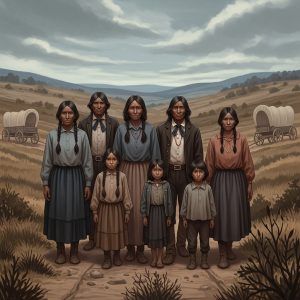
Friends, colleagues, and fellow seekers of truth in the annals of history, let us now confront a sobering chapter in the unfolding narrative of the United States: the forced removal of the Cherokee Nation, and specifically, the harrowing events of 1834, where 700 Cherokees, worn down by relentless pressure, agreed to move west, only for 81 of them to perish en route. It is imperative that we confront the unvarnished truth of these events, for to do otherwise would be to disservice the historical record and the human experience it represents.
To truly comprehend the gravity of this moment, we must understand the preceding context. By the early nineteenth century, the Cherokee Nation, whose lands spanned parts of Tennessee, Alabama, North Carolina, and Georgia, was a formidable presence. Far from being “savage hunters” as some white leaders portrayed them, the Cherokees had made “a stupendous effort” to adapt to and emulate aspects of white American society. They became farmers, blacksmiths, carpenters, and masons, owning property, cattle, horses, swine, looms, spinning wheels, wagons, plows, sawmills, grist mills, blacksmith shops, and even cotton machines and schools. Their chief, Sequoyah, invented a written language, which thousands learned, leading to the establishment of the Cherokee Phoenix, a newspaper published in both English and Cherokee. They adopted a constitution modeled on the U.S. Constitution and were, as their principal chief John Ross explained to the U.S. Senate, “like the whiteman in manners, morals and religion”. This strategy was a direct challenge to the government’s rhetoric, calling their bluff: if they were “civilized” by white society’s own rules, shouldn’t their land claims be respected?
However, these efforts at adaptation and appeals to justice were met with relentless white land hunger. The population of Georgia alone grew by more than half during the 1820s, intensifying pressure for expansion. This was further exacerbated by the burgeoning Southern cotton boom and, crucially, the discovery of gold in Cherokee territory in Georgia in 1829. Thousands of whites invaded the Cherokee lands, destroying property and staking claims. Andrew Jackson, upon becoming president in 1829, explicitly adopted a policy of “Indian Removal,” declaring that an Indian nation within state boundaries “would not be countenanced”. He framed removal as not only “liberal, but generous,” arguing that “Philanthropy could not wish to see this continent restored to the condition in which it was found by our forefathers”.
Jackson ignored existing federal treaties and laws, like the 1802 Indian Trade and Intercourse Act which mandated land cessions only by treaty with a tribe, and instead supported state actions against the Cherokees. He ordered federal troops to remove white miners from Cherokee lands but then removed the troops, allowing whites to return, claiming he “could not interfere with Georgia’s authority”. State laws were passed to abolish the tribe as a legal unit, outlaw tribal meetings, and deny Cherokees the right to vote, bring suits, or testify in court against whites. Their land was divided up for distribution by state lottery, and whites were openly encouraged to settle on it. Cherokees who advised others against migration faced imprisonment. This was a tactic designed to make staying impossible, compelling removal without direct “force” from the federal government.
It was within this maelstrom of legal stripping of rights, violent encroachment, and systemic harassment that the desperate choice to move west emerged for some Cherokees. The year 1834 saw seven hundred Cherokees, “weary of the struggle,” agree to go west. This journey, however, proved fatal for many. Eighty-one of them died en route, including forty-five children, largely from measles and cholera. Those who survived arrived at their destination only to face a cholera epidemic, with half of them dying within a year.
This tragic episode foreshadowed the larger, more infamous “Trail of Tears.” In 1835, a small faction of elite Cherokee men, many of whom were enslavers, bypassed the elected tribal government of Chief John Ross and signed the fraudulent Treaty of New Echota. This treaty ceded the remaining Cherokee land in the Southeast for new land west of the Mississippi. Despite a campaign of legal and political resistance organized by Ross and supported by hundreds of white Northerners petitioning Congress, the Senate ratified the treaty.
While around two thousand Cherokees left voluntarily after this treaty, the majority, some sixteen thousand, refused to abandon their ancestral homes. In May 1838, General Winfield Scott, with five regiments of regulars and four thousand militia and volunteers, began rounding them up at bayonet point and imprisoning them in stockades. The incarcerated Cherokees were then forcibly relocated to present-day Oklahoma. This brutal forced march, known as “Nunna daul Isunyi,” or the “Trail of Tears,” was marked by starvation, cold, disease, and violence, leading to the deaths of thousands. Estimates indicate that during confinement or on the march, approximately four thousand Cherokees died. One Georgia militiaman who was present described it as “the cruelest work I ever knew”. The population resurgence the Cherokees had experienced in the early nineteenth century was obliterated, with their numbers knocked down by a third or half of what they would have been.
The suffering was exacerbated by the government’s decision to hand over the organization of the trek to “private contractors” who were incentivized to charge the government as much as possible while providing the Indians with as little as possible. Everything was disorganized, food disappeared, and hunger became rampant. Old, rotting steamboats were crowded beyond capacity for river crossings, leading to further deaths.
This historical episode vividly illustrates the deep-seated issues of land greed, the “moneyed aristocracy”, and systemic corruption that plagued American expansion. Andrew Jackson’s policies and actions, including his willingness to ignore Supreme Court rulings that favored the Cherokees, ensured the “dispossession” of Native peoples. The rhetoric of “progress of civilization and improvement” and the denunciation of “savages” served as justifications for actions rooted in the desire for land and wealth. The 1834 migration, with its devastating death toll, was but one tragic segment in a larger, brutal process that cleared the land for white settlement and the expansion of the cotton kingdom, a process described by historians as “the war the slaveholders won”. It is a stark reminder of the immense human cost extracted by the nation’s drive for expansion and profit.