

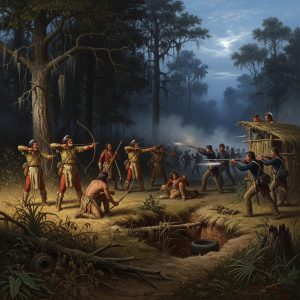
Our exploration of American history now leads us to a specific and deeply troubling moment in the long, violent saga of Native American removal: the Seminole War, and in particular, the period around 1836 and 1837, when Major General Thomas Jesup entered the conflict with a substantial force against the resilient Seminoles.
To understand the intense conflict that Jesup was tasked with confronting, we must recall the context of the Seminole Nation. Unlike the Cherokee Nation, which, as we discussed, pursued a strategy of adaptation and non-violent legal resistance against overwhelming pressure, the Seminoles made a resolute choice to fight for their lands. Their territory in Florida, after the United States acquired it in 1819 through a process that began with Andrew Jackson’s military campaigns, became a target for land-grabbers. The 1823 Treaty of Camp Moultrie had already pushed many Seminoles into the interior swamps of central Florida, lands so inhospitable they “could not grow food, where even wild game could not survive”.
A crucial and often overlooked element that inflamed the conflict was the Seminole villages’ role as havens for escaped black slaves. While some Seminoles did hold black slaves, their practice differed significantly from the brutal chattel slavery of cotton plantations, often allowing slaves to live in their own villages and intermarry with Indians, thus creating mixed communities. This fluidity and refuge for freedom-seeking individuals deeply alarmed Southern slaveowners, who viewed it as a direct threat and a “lure to their own slaves”. This aspect underscores how the Seminole War was not just a conflict over land, but also entangled with the deeply entrenched institution of slavery and the South’s pervasive fear of slave uprisings.
The immediate prelude to Jesup’s deployment in 1837 was the escalation of violence following attempts to enforce a fraudulent removal treaty. In 1834, an Indian agent managed to coerce a small number of chiefs and subchiefs into signing a removal treaty, which the U.S. Senate swiftly ratified. However, the majority of the Seminole Nation did not recognize this treaty. Resistance coalesced around figures like the young Seminole chief Osceola. After Osceola’s wife was “delivered into slavery” and he himself was imprisoned and chained, he emerged as a powerful leader. In December 1835, when the Seminoles were ordered to assemble for migration, “no one came”. Instead, they launched a series of “guerrilla attacks on white coastal settlements,” striking with surprise and destruction. This included the dramatic killing of the Indian agent Thompson by Osceola himself, and a devastating attack on a column of 110 soldiers, leaving all but three dead. This was indeed “the classic Indian tactic against a foe with superior firearms”.
It was into this volatile and dangerous landscape that Major General Jesup led his ten-thousand-strong army in the spring of 1837. The challenges faced by the American forces were immense. The Seminoles, masters of their environment, simply “faded into the swamps, coming out from time to time to strike at isolated forces”. This form of warfare, where the enemy could blend into the local landscape, strike, and then “melt into the countryside” before conventional forces or air support could arrive, was remarkably effective, akin to the later challenges faced by American armies in Vietnam. It imposed a profound “fatigue” on the American soldiers, who grappled with the “mud, the swamps, the heat, the sickness, the hunger” of fighting in such unfamiliar terrain. The toll on morale and manpower was so severe that in 1836, before Jesup’s arrival, 103 commissioned officers had already resigned from the regular army, leaving only forty-six.
The Seminole War proved to be a protracted and costly endeavor for the United States, lasting a grueling eight years, consuming $20 million, and resulting in 1,500 American lives lost. The conflict was also marked by acts of profound betrayal. Osceola, a key leader of the resistance, was seized by American forces in 1837 while under a flag of truce, a universally recognized symbol of safe passage for negotiations. He subsequently died of illness in prison, a stark reminder of the “scruple or mercy” that the English, and by extension their American successors, often lacked in their “way of war” with Native peoples.
This brutal conflict, driven by expansionist desires for land and the pervasive anxieties surrounding slave rebellions, stands as a testament to the fierce determination of the Seminoles to defend their homes and their unique social structure that offered freedom to black people. It also underscores a consistent pattern in American expansion: the use of “sheer force” against Native populations perceived as obstacles, leading to immense suffering and loss of life that, as our sources poignantly note, “cannot be accurately measured” and is often “pass[ed] quickly over” in historical accounts. The Seminole War, with Jesup’s large army struggling against an elusive and determined foe, was a stark illustration of the human cost exacted by the relentless “quest for more land” and the violent expansion of the American empire.