

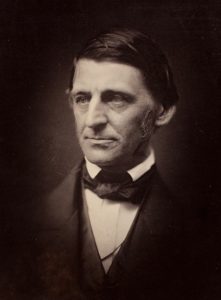
It is indeed a profound moment in American history when a voice of conscience like Ralph Waldo Emerson rises to challenge the actions of the state. Your topic brings us to April 1838, when Emerson addressed an open letter to President Martin Van Buren, expressing his indignation over the Cherokee removal treaty. This deeply felt protest stands as a stark testament to the moral dilemma and the brutal reality of Indian Removal, a policy that had been a consistent, violent thread through American expansion.
To fully grasp the weight of Emerson’s indignation, we must acknowledge the backdrop against which his letter was penned. The Cherokee Nation, unlike some other tribes who chose armed resistance, had pursued a path of adaptation and legal challenge to protect their lands. They had, in a “stupendous effort,” begun to resemble the very “civilization” white men spoke about, adopting farming, blacksmithing, carpentry, masonry, and private property ownership. They even welcomed missionaries and Christianity, with some Cherokees owning over a thousand slaves, emulating the slave society around them.
However, the truth, as history unequivocally shows us, was that none of these adaptations made the Cherokees “more desirable than the land they lived on”. Andrew Jackson, whose Indian policy was often glossed over in historical accounts, had made his position clear as early as 1829, informing the “Indians inhabiting parts of Georgia and Alabama that their attempt to establish an independent government would not be countenanced… and advised them to emigrate beyond the Mississippi or submit to the laws of those States”. The Indian Removal Bill, passed narrowly by Congress, though it did not explicitly mention force, effectively left tribes “without protection, without funds, and at the mercy of the states” if they refused to move.
The Cherokee Nation’s resistance against this relentless pressure was largely nonviolent. They sought justice through legal channels, famously culminating in the 1832 Supreme Court case Worcester v. Georgia. Chief Justice John Marshall, for the majority, declared that the Georgia law seizing Cherokee land violated treaties, which the Constitution made binding on the states, and he ordered missionary Samuel Worcester freed. Yet, in an act that laid bare the true nature of executive power in this era, President Jackson brazenly “refused to enforce the court order,” and Georgia proceeded to put Cherokee land on sale, crushing any signs of resistance.
The immediate trigger for Emerson’s letter in 1838 was the enforcement of what was fundamentally a fraudulent agreement: the Treaty of New Echota. Signed in 1835 by a mere fifteen chiefs and subchiefs, it was ratified by the U.S. Senate despite the overwhelming majority of the seventeen thousand Cherokees not recognizing its legitimacy and only fewer than five hundred appearing to sign it in 1836. This was, in essence, another instance in the long and tragic history where the United States government signed treaties with Native Americans—over four hundred of them—and proceeded to violate “every single one”. The Senate’s ratification was a concession, a “yielding… to ‘the force of circumstances'”.
It was in this context that Martin Van Buren, having succeeded Jackson, ordered Major General Winfield Scott in April 1838 to move into Cherokee territory and use “whatever military force was required to move the Cherokees west”. General Scott’s address to the Cherokees was chillingly direct, warning them that “before another [full moon of May] shall have passed every Cherokee man, woman, and child… must be in motion to join their brethren in the far West”. He emphasized that his troops already occupied many positions, and “thousands and thousands are approaching from every quarter, to render resistance and escape alike hopeless”.
The consequence of this directive was the forced rounding up of seventeen thousand Cherokees, who were then “crowded into stockades”. On October 1, 1838, the first detachment embarked on what would forever be known as the Trail of Tears. The journey westward was a horrifying ordeal of “sickness, of drought, of the heat, of exposure,” and thousands perished. Grant Foreman, a leading authority on Indian removal, estimated that “four thousand Cherokees died” during their confinement or on the march.
The tragic irony, and a testament to the government’s deliberate obfuscation of truth, came in December 1838, when President Van Buren reported to Congress with chilling detachment: “It affords sincere pleasure to apprise the Congress of the entire removal of the Cherokee Nation of Indians to their new homes west of the Mississippi. The measures authorized by Congress at its last session have had the happiest effects”. This statement, proclaiming “happiest effects” while thousands lay dead from the forced march, stands as a stark example of the official narrative designed to sanitize brutal realities.
Emerson’s indignation, therefore, was not merely a philosophical lament; it was a deeply moral protest against a “base and diabolical scheme” that, as one Alabama newspaper noted regarding the Second Creek War, was “devised by interested men, to keep an ignorant race of people from maintaining their just rights, and to deprive them of the small remaining pittance placed under their control”. It was a protest against the “progress of civilization and improvement” touted by figures like Lewis Cass, which in reality served as a pretext for “burning villages and uprooting natives”. The refusal of Native leaders to abandon their ancestral lands, stating “We would not receive money for land in which our fathers and friends are buried,” illuminates the depth of the spiritual and cultural connection being forcibly severed.
Emerson’s open letter, then, speaks volumes about the truth that some Americans, like Senator Frelinghuysen who questioned whether “the obligations of justice change with the color of the skin,” understood the immense injustice at play, even as the nation was swept up in a relentless “quest for more land”. It highlights the persistent, yet often ultimately silenced, voices of dissent against the violent expansion of the American empire and the profound human cost it exacted.