
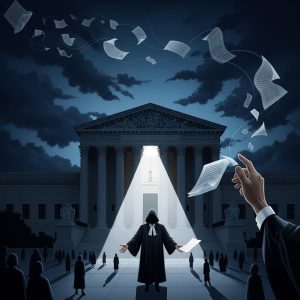
The United States Supreme Court was designed to be a deliberative body, issuing rulings only after rigorous public briefing, transparent oral arguments, and the publication of detailed, signed opinions. However, over the past decade, the Court has increasingly bypassed this traditional process in favor of the “shadow docket”—a secretive, unaccountable apparatus used to decide highly consequential and politically charged cases. **A recent, unprecedented leak of 16 pages of internal Supreme Court memoranda to *The New York Times* has laid bare the exact origins of this shadow docket, exposing how Chief Justice John Roberts and the conservative majority circumvented regular judicial order to advance an ideological agenda**.
The leak centers on a pivotal five-day period in February 2016 concerning President Barack Obama’s signature environmental policy, the Clean Power Plan. At the time, Republican-led states and industry groups rushed to the Supreme Court seeking an emergency stay to halt the environmental regulations before the lower appellate courts even had a chance to fully review their legality. In normal circumstances, the Supreme Court rarely interferes with a lower court’s ongoing review.
However, the leaked internal communications reveal that Chief Justice Roberts was in a tremendous rush to block the policy. Roberts circulated a memo to his colleagues declaring his vote to grant the stay, arguing that the Clean Power Plan would cause a “substantial irreversible reordering of the domestic power sector”. He made this claim even though the plan did not actually require full compliance until 2030, meaning there was no immediate, irreparable harm to the industry. Furthermore, Roberts appeared personally motivated by political animus; his memos reveal he was angered by an EPA official’s blog post that downplayed a prior Supreme Court ruling, and he used this as justification to strike back at the agency. In doing so, Roberts laid the early groundwork for the “major questions doctrine,” asserting that agencies should face “high hurdles” when trying to enact transformative regulations.
The internal pushback from the Court’s liberal wing was fierce but ultimately futile. Justice Stephen Breyer urged a pragmatic middle ground, explicitly warning the Chief Justice that “it is unusual for this court to issue a stay of an agency’s order during the time that the court of appeals is considering its lawfulness”. Justice Elena Kagan echoed this concern, stating that granting the stay without the benefit of full briefing or a prior judicial decision would be “unprecedented”. Kagan also dismantled Roberts’s premise of an emergency, pointing out that the rule imposed no immediate requirement for any power plant to shut down.
In response, the conservative justices resorted to hyperbole. Justice Samuel Alito wrote a memo claiming that failing to stay the rule would threaten the Court’s “institutional legitimacy” and render their ability to provide meaningful judicial review a “nullity”. Finally, Justice Anthony Kennedy provided the deciding fifth vote in a cursory, four-line memo, simply agreeing with the Chief Justice that the stay should be granted “in fairness to the parties”. **With a single, unexplained paragraph issued to the public, five conservative justices froze a major presidential regulatory framework on a nationwide basis, entirely short-circuiting the normal judicial process**.
This 2016 intervention officially birthed the modern era of the shadow docket. **Its defining and most dangerous feature is opacity: the Supreme Court issues sweeping, unsigned orders that alter the lives of millions without providing any public explanation or legal reasoning**. Because the Court does not explain its rationale, lower court judges are left completely in the dark, unable to apply the law consistently. As U.S. Circuit Judge James Wynn complained, “A system in which unexplained orders silently control future cases is not one of uniformity but of opacity”. Other federal judges have vented that the Supreme Court’s terse, sweeping shadow docket rulings undermine their meticulous fact-finding and leave them “thrown under the bus”.
The historical context of the shadow docket reveals a stark and highly partisan double standard. During the Obama administration, Chief Justice Roberts cited the “irreparable harm” to Republican-led states to justify halting a major environmental regulation. But when Donald Trump assumed the presidency, the Court weaponized the shadow docket to act as a shield for the executive branch. The Roberts Court has used the shadow docket to greenlight Trump administration policies that had been thoroughly blocked by lower courts at least 25 times. Without full briefing or public argument, the Supreme Court allowed President Trump to refuse to spend mandatory foreign aid, kick transgender service members out of the military, and aggressively deport immigrants to third countries where they faced the threat of torture.
In cases of life and death, such as the deportation of detainees to foreign prisons without notice, Justice Sonia Sotomayor has issued blistering dissents against the shadow docket’s use. She has warned that the Court is rewarding lawlessness and acting unconstrained by established law, noting that deviating from standard judicial processes “substantially increases” the risk of catastrophic error.
**Ultimately, the leak regarding the Clean Power Plan exposes a Supreme Court that has fundamentally abandoned institutional restraint in favor of partisan instrumentalism**. By retreating to the shadows to issue edicts based on the justices’ pre-determined political grievances rather than rigorous public deliberation, the Supreme Court has transformed itself into an unaccountable super-legislature. The shadow docket is not merely a procedural shortcut; it is a mechanism of anti-democratic power that actively erodes the transparency and legitimacy upon which the American rule of law depends.