

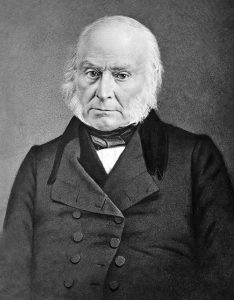
To understand the modern American political landscape—characterized by an imperial presidency that wages undeclared wars, a political culture drowning in disinformation and partisan smear campaigns, the criminalization of dissent, and a bitter ideological war over the role of the federal government—one must study the life of John Quincy Adams. As the sixth president of the United States, and the only president to subsequently serve in the House of Representatives, Adams’s career serves as both a mirror and a profound warning for the current era. He was a visionary who believed the federal government should be an active engine for human progress, but his presidency was paralyzed by a ruthless, fact-free populist movement that birthed the modern machinery of political destruction.
The Architect of Restraint vs. The Imperial Presidency Before his presidency, John Quincy Adams was arguably the most accomplished diplomat in American history, serving as minister to the Netherlands, Prussia, Russia, and Great Britain. As James Monroe’s Secretary of State, Adams was the primary architect of what became known as the Monroe Doctrine.
Today, the executive branch frequently invokes the Monroe Doctrine to justify American global hegemony, military interventions, and unilateral strikes. Yet, Adams’s original vision was the exact opposite of modern American imperialism. In his famous July 4, 1821 address, Adams explicitly laid out the limits of American power. He celebrated America’s dedication to liberty, but issued a stark warning against interventionism: “She goes not abroad, in search of monsters to destroy. She is the well-wisher to the freedom and independence of all. She is the vindicator only of her own”.
Adams prophetically warned that if America began intervening in foreign wars, the fundamental maxims of her policy would change “from liberty to force”. She might become “the dictatress of the world,” but in doing so, “she would no longer be the ruler of her own spirit”. As modern presidents bypass Congress to launch missile strikes and dictate the internal politics of sovereign nations, they have fulfilled Adams’s darkest prophecy, transforming the republic into the very dictatress he feared.
The “Corrupt Bargain” and the Invention of the Smear Campaign Adams’s ascent to the presidency in the election of 1824 provides crucial context for understanding the modern weaponization of political disinformation. The election was a four-way contest between Adams, Andrew Jackson, William H. Crawford, and Henry Clay. Because no candidate won a majority of electoral votes, the election was thrown to the House of Representatives. Clay threw his support behind Adams, securing Adams’s victory; subsequently, Adams appointed Clay as Secretary of State.
Jackson and his supporters immediately fabricated the myth of a “corrupt bargain,” accusing Adams of trading the office for votes. As Adams well knew, what was actually a normal political alliance was successfully branded as a dastardly crime by a burgeoning populist propaganda machine. Jackson’s operatives flooded the newspapers with slander, falsely depicting Adams as a monarchist elitist who had sold out American interests, while portraying Jackson—a violent, insubordinate general—as the savior of the people.
This historical episode highlights the profound hypocrisy of modern corruption. In 1824, Adams was politically destroyed by the mere allegation of a corrupt bargain, despite his administration experiencing “no scandal or corruption” and his absolute refusal to use the federal spoils system to reward his friends. Today, we see an executive branch that openly creates billion-dollar, taxpayer-funded slush funds to reward loyalists and grants blanket legal immunity to the president’s family, yet faces no accountability from its populist base. Jackson’s destruction of Adams proved that in American politics, a manufactured scandal can be far more devastating than actual, brazen corruption.
The Visionary State vs. The Forces of Nullification As president, Adams possessed a breathtaking vision for the United States. In his first annual message to Congress in 1825, he proposed a massive, federally funded infrastructure program: a national university, a naval academy, exploration of the continent, and the building of astronomical observatories (which he famously called “lighthouses of the skies”). He argued that the constitutional mandate to “promote the general welfare” meant the government was obligated to use its resources for the “moral, political, and intellectual improvement” of its citizens. For Adams, “liberty is power,” and an active, investing government was essential to national unity.
His proposals were met with furious, paralyzing opposition from Southern states-rights advocates and Jacksonian populists. Southern politicians deeply feared that if the federal government possessed the power to build roads and universities, it also possessed the power to abolish slavery. This dynamic remains a foundational conflict in American politics. The same ideological forces that mocked Adams’s “American System” to protect the institution of slavery evolved into the modern political factions that relentlessly starve public infrastructure, defund education, and dismantle federal regulatory power.
The Warrior in the House and the Criminalization of Dissent Defeated by Jackson in 1828, Adams returned to his home in Quincy, believing his public life was over. Yet, in 1830, he was elected to the House of Representatives, where he served for the final seventeen years of his life. It was here that Adams became the nation’s most ferocious defender of civil liberties and the right to dissent.
As the Southern “Slave Power” consolidated its control over the federal government, it instituted the infamous “gag rule” in the House of Representatives, automatically tabling any citizen petition against slavery without discussion. Adams waged a relentless, years-long war against the gag rule, arguing that the right of petition was sacred and that silencing public debate was the hallmark of tyranny. He stood practically alone against furious Southern congressmen who repeatedly attempted to censure him, threaten him with assassination, and silence his speech.
In 1841, Adams took his fight to the Supreme Court, successfully defending the Amistad Africans who had mutinied against their slavers. He merged his legal defense with a soaring appeal to the Declaration of Independence, arguing that freedom was the birthright of every human being, regardless of race.
Today, as the government criminalizes anti-ICE protesters with draconian conspiracy charges and fabricates indictments against journalists and dissidents, Adams’s lonely battle in the House is deeply resonant. He understood that when the state begins suppressing petitions and gagging debate to protect a corrupt institution—whether it be chattel slavery in the 1830s or the deportation-industrial complex today—the fundamental liberties of the republic are in existential peril.
Conclusion On February 21, 1848, the eighty-year-old Adams collapsed at his desk on the floor of the House of Representatives. Carried into the Speaker’s office, his final words were, “This is the end of earth. I am composed”. He died two days later, literally in the halls of the democratic institution he had fought so fiercely to protect.
John Quincy Adams was not a flawless man; he struggled with depression, self-righteousness, and a cold demeanor that alienated the public. Yet, his life provides an indispensable historical lens. He understood that a republic cannot survive merely on the mechanics of voting; it requires an educated public, a government dedicated to the general welfare, and leaders who prioritize institutional integrity over personal ambition. His defeat by the Jacksonian political machine signaled the terrifying reality that American democracy is endlessly vulnerable to demagogues who utilize grievance and fabricated outrage to seize power. But his defiant final act as a congressman proves that the fight against authoritarianism and the defense of constitutional rights is the eternal, unforgiving burden of the American citizen.