

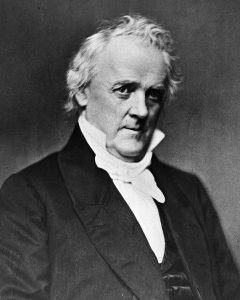
When James Buchanan was elected the fifteenth president of the United States in 1856, he arrived with the most impressive resume of any chief executive since James Madison. He had spent more than thirty-five years in public life as a state legislator, a U.S. congressman, a senator, a foreign minister to Russia and Great Britain, and secretary of state. As the leader of the Democratic Party—the only remaining truly national institution in a rapidly fracturing country—Buchanan was widely viewed as a seasoned, steady hand who could heal the deepening divide between the North and the South.
Four years later, he left office in utter disgrace, having actively destroyed his own political party, overseen a catastrophic level of executive corruption, and pursued a course of partisan appeasement that directly precipitated the bloodiest conflict in American history.
As modern Americans confront a political landscape defined by intense hyper-partisanship, a radically politicized judiciary, the purging of government officials for ideological disloyalty, and leaders who demonize their political opponents as un-American, James Buchanan’s presidency provides a profound, chilling lesson in avoidance. He represents the ultimate danger of an executive whose arrogant, uncompromising use of power serves only a radicalized faction rather than the nation.
The Illusion of Restraint and the Subversion of the Courts Throughout his career, Buchanan fiercely maintained that he was a “strict constructionist” who believed in states’ rights and a limited federal government. Yet, in practice, his presidency was characterized by an astonishing expansion of executive prerogatives whenever doing so served his political base: the slaveholding South. He became one of the most aggressive, hawkish chief executives in American history, attempting to unilaterally assert the right to use military force overseas before Congress even acted. As a diplomat, he had helped author the infamous Ostend Manifesto, which brazenly declared that the United States would be justified “by every law human and Divine” in wresting Cuba away from Spain by military force if Spain refused to sell the island.
But Buchanan’s most egregious abuse of power occurred just before his inauguration, when he secretly subverted the separation of powers to manipulate the Supreme Court. At the time, the Court was deliberating the infamous Dred Scott case. Buchanan wanted a sweeping, definitive ruling that would permanently end the national debate over slavery in the territories, allowing his administration to focus on expanding the American empire southward.
In a shocking violation of constitutional propriety, the president-elect exchanged secret letters with Justice John Catron and pressured Justice Robert Grier—a fellow Pennsylvanian—to join the southern justices in a comprehensive ruling. Because of Buchanan’s illicit intervention, Grier joined the majority in Chief Justice Roger Taney’s decision, which decreed that Black Americans could not be citizens and that Congress had no constitutional power to restrict slavery in the territories. Buchanan then stood on the inaugural platform and disingenuously told the nation that the issue of territorial slavery was pending before the Supreme Court, and that he would “cheerfully submit” to whatever the justices decided—fully aware that he had already helped rig the outcome.
Partisan Purity and the Destruction of a Party A defining hallmark of a failed, authoritarian-leaning presidency is the demand for absolute partisan loyalty and the willingness of an executive to destroy his own political coalition to enforce ideological purity. Buchanan achieved exactly this during the crisis over “Bleeding Kansas.”
Proslavery forces in Kansas had drafted the Lecompton Constitution—a fraudulent document that protected slavery and established a draconian slave code. It was violently opposed by the vast majority of Kansas residents, who boycotted the rigged referendums. Even southern governors of the territory warned Buchanan that the document was a travesty of democracy.
Yet Buchanan, acting as an intellectual and electoral hostage to the South, ruthlessly attempted to force the Lecompton Constitution through the U.S. Congress. When northern Democrats, led by Senator Stephen A. Douglas, rebelled against this blatant subversion of popular will, Buchanan weaponized the executive branch against them. He initiated a massive political purge, firing northern officials and replacing them with doughfaces (northerners who favored the South). By choosing the appeasement of southern extremists over democratic realities, Buchanan fatally fractured the national Democratic Party. This deliberate split directly paved the way for the election of the Republican candidate, Abraham Lincoln, in 1860.
Corruption and the Criminalization of the Opposition While Buchanan was purging independent voices, he shielded the staggering corruption within his own cabinet. The president had surrounded himself with southern loyalists, including Secretary of War John Floyd and Secretary of the Treasury Howell Cobb, who were engaged in gross financial mismanagement and ethical abuses. A congressional investigation led by the Covode Committee exposed how the administration utilized federal patronage, contracts, and money to buy votes and buy off the press. Yet Buchanan refused to police his subordinates, terrified that firing his corrupt southern friends would provoke the South.
Simultaneously, Buchanan abandoned the historic democratic tradition of a “loyal opposition.” He publicly castigated the emerging Republican Party as a “dangerous party” of disunionists and fanatics whose views on slavery threatened the “domestic fireside” of the South. In his communications, the president essentially legitimized southern paranoia, painting Black men as potential rapists and abolitionists as architects of terror, thereby feeding the very hysteria that made secession inevitable.
The Paralysis of Appeasement The ultimate tragedy of James Buchanan’s presidency arrived in the winter of 1860. Following Lincoln’s election, South Carolina initiated the process of secession. Faced with the disintegration of the republic, the activist president who had ruthlessly wielded power to enforce the Lecompton Constitution suddenly claimed he was powerless.
In his annual message to Congress, Buchanan delivered an extraordinary contradiction: he declared that secession was entirely illegal, but argued that the federal government possessed no constitutional authority to coerce a state into remaining in the Union. While he clung to this crabbed, paralyzing legalism, Buchanan met with seditious southern commissioners as private gentlemen and allowed his treasonous cabinet secretaries, who were already in communication with the forming Confederacy, to dictate policy. He refused to reinforce the besieged federal troops at Fort Sumter, buying the secessionists precious time to seize federal arsenals, organize a government, and arm their militias.
As modern observers note how the modern executive branch navigates crises of insurrection and the peaceful transfer of power, Buchanan’s behavior stands as a stark warning. His failure was not born of feebleness, senility, or a lack of understanding. His failure was rooted in his arrogant belief that he could save the country exclusively by appeasing a radical faction. By elevating his ideological prejudices above his oath of office, James Buchanan drew the wind for southern sails, making the American Civil War a devastating reality.