
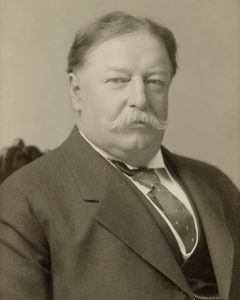
To understand the deepest fault lines of the modern American constitutional order—the battle over the “unitary executive,” the tension between populist demagoguery and the rule of law, the role of the Supreme Court, and the question of whether a president’s authority derives from the Constitution or directly from the passions of the masses—one must examine the unique, often misunderstood career of William Howard Taft.
Today, Taft is most commonly, and unfairly, remembered as a punchline: the heaviest president in American history who purportedly got stuck in the White House bathtub. Yet, this cartoonish legacy obscures one of the most consequential constitutional figures in American history. Taft remains the only person to have served as both President and Chief Justice of the United States. He approached the presidency not as a politician, but as a judge, and his administration serves as a profound historical mirror for an era grappling with the dangers of unchecked executive power and mob rule.
The Judicial President vs. The Stewardship Theory Before entering the White House, Taft’s career was defined by legal and administrative excellence: he was a federal circuit court judge, the civil governor of the Philippines, and Secretary of War. His idol was the Constitution, and he possessed a deep, Madisonian fear that without institutional filters, America would degenerate from a representative republic into a direct democracy ruled by demagogues who flattered the mob.
This philosophy placed him on a direct collision course with his predecessor and patron, Theodore Roosevelt. Roosevelt had radically expanded the presidency through his “stewardship theory,” claiming it was his right and duty to do anything the nation demanded unless the Constitution explicitly forbade it.
Taft flatly rejected this imperial view. “The true view of the Executive functions is, as I conceive it, that the President can exercise no power which cannot be fairly and reasonably traced to some specific grant of power,” Taft argued. Once in the White House, he dedicated himself to placing Roosevelt’s sweeping executive orders on firm legislative and constitutional footing, insisting that the president could only operate within the strict boundaries of the law. He stubbornly refused to exert popular leadership or pander to the press, viewing the president as a chief magistrate whose job was to foster calm deliberation, not to inflame public sentiment. As he proudly told his aide Archie Butt, “I will not play a part for popularity”.
The Hidden Progressive Record Because Taft lacked Roosevelt’s flair for public relations—and because he suffered from severe sleep apnea that frequently caused him to fall asleep in public meetings—he was often unfairly branded as a lazy, reactionary “stand-patter”. In reality, Taft’s administrative efficiency produced a more aggressively progressive record than Roosevelt’s.
During his single term, Taft slashed federal expenses, turning a massive $89 million budget deficit into an $11 million surplus. He extended federal environmental protection to more land than Roosevelt had, and he was a far more rigorous trust-buster. While Roosevelt brought forty-four antitrust cases in nearly eight years, the Taft administration brought almost seventy cases in less than four years, successfully dismantling the Standard Oil and American Tobacco monopolies. Furthermore, despite intense pressure from his own party and the press, Taft exercised supreme constitutional restraint in foreign policy, refusing to unilaterally send troops across the Mexican border without congressional authorization, noting that the Constitution vests the power to declare war exclusively with Congress.
The Pinchot-Ballinger Affair and the Rupture of 1912 Taft’s presidency unraveled due to a combination of his strict judicial approach and his profound lack of political tact. The defining scandal of his administration occurred over conservation. When a dispute erupted between his Secretary of the Interior, Richard Ballinger, and Gifford Pinchot, the progressive head of the U.S. Forest Service, Taft approached it like a judge reviewing a case. He reviewed the evidence, found Ballinger innocent of wrongdoing, and fired Pinchot and another whistleblower for insubordination.
Taft’s demand for administrative discipline ignited a political firestorm. Progressives flocked to Theodore Roosevelt, convincing the former president that Taft was a reactionary traitor. Roosevelt returned to politics preaching his “New Nationalism,” directly attacking the independence of the judiciary and arguing that the people should have the power to overturn court decisions by popular vote.
For Taft, Roosevelt’s rhetoric was terrifyingly autocratic. He viewed the election of 1912 not as a mere political contest, but as a holy war to protect the Constitution from a power-hungry demagogue. As Roosevelt split the Republican party by running as the “Bull Moose” candidate, Taft accepted his inevitable defeat with grace, believing that preserving the independence of the judiciary was worth losing the presidency. He ultimately finished third behind Woodrow Wilson and Roosevelt.
The Presidential Chief Justice and the Unitary Executive Liberated from the political office he loathed, Taft shed 70 pounds, curing his sleep apnea and returning to a state of sharp, vigorous health. In 1921, his ultimate dream was realized when President Warren G. Harding appointed him Chief Justice of the United States.
As Chief Justice, Taft was a visionary administrator. He successfully lobbied Congress for the creation of an independent Supreme Court building, finally moving the Court out of the cramped basement of the Capitol to symbolize the judiciary as a fully co-equal branch of government.
Most significantly for modern constitutional law, Taft authored the landmark 1926 decision in Myers v. United States. As we explored in the recent Supreme Court rulings regarding independent agencies, modern executives rely heavily on the “unitary executive theory.” It was Chief Justice Taft who enshrined this concept, ruling that the Constitution grants the president the absolute, unconstrained power to remove executive branch subordinates without the consent of the Senate. Taft argued that to ensure the faithful execution of the laws, the president must have complete confidence in his officers and the authority to fire them without delay. While Taft believed the president’s powers were strictly limited by the Constitution, he also believed that within the executive branch, the president’s authority was supreme and unitary.
Conclusion William Howard Taft was fundamentally a man of the law who found himself trapped in a political era that demanded theatrical, populist leadership. He represents the ultimate test of the Madisonian system: a leader who deliberately chose to sacrifice his own political survival rather than pander to the transient passions of the crowd. Today, as populist forces once again threaten the independence of the courts and the stability of democratic institutions, Taft’s insistence on “voluntary self-restraint,” his reverence for constitutional checks and balances, and his profound belief in the rule of law stand as an inspiring, prophetic warning to the American republic.