

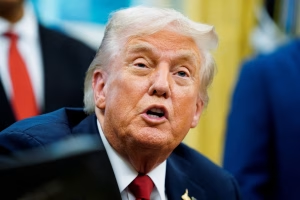
To comprehend the profound transformations defining contemporary American politics—the rise of right-wing national populism, the aggressive expansion and testing of executive authority, the erosion of traditional governing norms, the polarization of the electorate, and the ongoing constitutional friction between the executive branch, Congress, and the judiciary—one must examine the career and presidencies of Donald John Trump. A real estate developer and reality television personality who built a political movement around the “Make America Great Again” (MAGA) slogan and an “America First” platform, Trump disrupted decades of established political consensus. His political rise, two non-consecutive terms in the White House, two impeachments, extensive legal entanglements, and unprecedented use of unilateral executive power have fundamentally altered the mechanics of American governance and global diplomacy.
The 2016 Campaign and First-Term Governance
Trump entered national politics by capturing the 2016 Republican nomination and defeating Democratic nominee Hillary Clinton in an electoral victory that shattered conventional political expectations. Campaigning on a platform of anti-establishment populism, strict immigration restrictions, trade protectionism, and a critique of globalist alliances, Trump tapped into deep economic and cultural anxieties across working-class America. Once in office, his administration enacted a sweeping domestic and foreign policy agenda. In 2017, he signed major budget legislation that delivered massive tax cuts primarily benefiting corporations and high-income earners, significantly increasing the national debt while implementing deep reductions in federal social safety net spending. Concurrently, Trump executed a historical transformation of the federal bench, appointing hundreds of conservative lower-court judges alongside three Supreme Court Justices—Neil Gorsuch, Brett Kavanaugh, and Amy Coney Barrett—which fundamentally reoriented American jurisprudence on issues ranging from regulatory authority to reproductive rights. In foreign policy, Trump withdrew the United States from the Paris Climate Accord, renegotiated trade agreements like NAFTA, imposed aggressive tariffs on foreign trade partners, and pursued hardline border security measures, including the construction of a southern border wall and stringent travel restrictions.
Impeachments, the 2020 Election, and the January 6 Capitol Attack
Trump’s first term was repeatedly marked by intense constitutional battles and legal scrutiny. In December 2019, the House of Representatives impeached Trump for abuse of power and obstruction of Congress. The charges stemmed from an official July 2019 telephone call with Ukrainian President Volodymyr Zelenskyy, during which Trump conditioned nearly $391 million in congressionally approved military assistance and an Oval Office meeting on Ukraine publicly announcing investigations into political rival Joe Biden, his son Hunter Biden, and discredited theories regarding the 2016 election. Although acquitted by the Senate in early 2020, Trump faced a national crisis months later with the outbreak of the COVID-19 pandemic and economic slump. Following his defeat in the November 2020 presidential election to Joe Biden, Trump refused to concede, promoting widespread, false allegations that the election had been stolen through systemic fraud—a narrative termed the “Big Lie”. Despite his own Justice Department officials, campaign aides, and dozens of federal and state courts finding no evidence of outcome-altering fraud, Trump exerted intense pressure on state election officials—such as asking Georgia Secretary of State Brad Raffensperger to “find 11,780 votes”—orchestrated a plan involving uncertified “fake electors”, and badgered Vice President Mike Pence to unilaterally reject certified electoral slates during the congressional count.
These post-election maneuvers culminated on January 6, 2021, when Trump delivered an incendiary address at the “Save America” rally on the Ellipse, urging thousands of assembled supporters to march to the U.S. Capitol and “fight like hell”. A violent mob subsequently stormed the Capitol, breaching security perimeters, assaulting law enforcement officers, disrupting the certification of the electoral vote, and forcing the evacuation of Vice President Pence and members of Congress. In the aftermath of the attack, the House of Representatives impeached Trump a second time for incitement of insurrection, making him the only chief executive in U.S. history to be impeached twice. Although the Senate acquitted him following the conclusion of his term, the events of January 6 sparked extensive federal criminal investigations led by Special Counsel Jack Smith into election obstruction and the handling of classified documents at Mar-a-Lago.
The 2024 Election Return and Second-Term Governance
Demonstrating unprecedented political resilience, Trump navigated multiple state and federal indictments to secure the 2024 Republican presidential nomination, ultimately defeating Democratic Vice President Kamala Harris to win a non-consecutive second presidential term. Returning to office in January 2025 alongside United States Government trifecta majorities in Congress, Trump launched an immediate “shock and awe” executive campaign aimed at restructuring the federal administrative state. On his first day in office, Trump signed a record number of executive actions, establishing the Department of Government Efficiency (DOGE) headed by billionaire Elon Musk to oversee mass federal workforce reductions, spending freezes, and regulatory rollbacks. To solidify executive control, Trump issued directives making it easier to fire non-political civil servants, purged seventeen independent federal Inspectors General, granted sweeping executive pardons and commutations to roughly 1,500 defendants convicted in connection with the January 6 Capitol attack, and issued executive orders attempting to restrict birthright citizenship guaranteed under the Fourteenth Amendment.
Domestically, the second Trump administration deployed aggressive trade protectionism, imposing broad tariffs on foreign imports from China, Canada, Mexico, and global trade partners. Utilizing emergency declarations, the White House deployed federalized military forces and National Guard units into major metropolitan areas, directed mass immigration enforcement operations and detention facility expansions, and initiated the physical demolition of the historic East Wing of the White House to construct a massive new state ballroom funded in part through private donations. In foreign affairs, Trump asserted an aggressive, unilateral posture, executing military strikes in Venezuela that resulted in the capture of President Nicolás Maduro, while ordering Operation Midnight Hammer—a series of precision U.S. air and missile strikes that destroyed Iranian nuclear infrastructure—without seeking prior authorization or formal declarations from Congress.
Constitutional Debates, Corruption Allegations, and Historical Context
Trump’s second term has intensified legal and constitutional debates regarding the boundaries of presidential power and accountability. Legal scholars and critics have pointed to severe ethical controversies and conflicts of interest, including Trump’s launching of commercial cryptocurrency and meme coin ventures on the eve of his inauguration, his filing of Form 278-T financial disclosures revealing extensive personal stock trading while in office, his administration’s creation of a $1.8 billion “weaponization” settlement fund that shielded his family and business entities from legal claims, and his acceptance of a luxury jumbo jet gift from the Qatari government. Furthermore, his administration engaged in unprecedented litigation against news organizations—such as suing The Wall Street Journal over coverage of his past relationship with convicted sex trafficker Jeffrey Epstein—and repeatedly flirted with the idea of serving a third presidential term in 2028, despite the explicit term-limit restrictions imposed by the Twenty-Second Amendment of the U.S. Constitution.
Donald Trump’s political trajectory represents a defining watershed in the history of the American republic. By consolidating executive authority, challenging constitutional checks and balances, reshaping the federal judiciary, and mobilizing a loyal populist base, Trump has re-engineered the mechanics of modern presidential power. Whether viewed through the lens of economic deregulation and judicial conservatism or through the critical warnings of democratic backsliding, judicial subversion, and executive overreach, the presidency of Donald Trump stands as an essential historical blueprint for understanding the contemporary struggles over the rule of law, national identity, and the future of American constitutional democracy.