
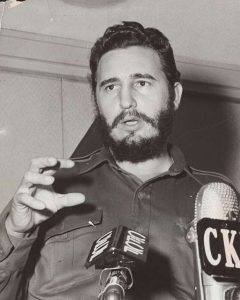
The humiliation of the Bay of Pigs invasion in April 1961 left the administration of President John F. Kennedy severely bruised but intensely focused on Cuba. Having rejected advice to deploy direct American military force to rescue the doomed exile brigade, Kennedy was nevertheless determined to dismantle the regime of Fidel Castro. By the autumn of 1961, as the Berlin Wall crisis began to stabilize, the president and his advisers shifted their focus back to the Caribbean, expressing renewed concern about removing Castro “in some way or other… from the Cuban scene”. On November 3, 1961, this intense focus culminated in the formal authorization of Operation Mongoose, a highly classified, multi-layered campaign designed to undermine and ultimately overthrow the Cuban government.
To ensure the operation received direct, aggressive executive oversight, President Kennedy designated his brother, Attorney General Robert “Bobby” Kennedy, to lead the effort. For Bobby, bringing down Castro was not merely a foreign policy objective; it was “the top priority in the United States Government—all else is secondary”. His operational blueprint was straightforward and relentless: they would “stir things up on the island with espionage, sabotage, general disorder, run & operated by Cubans themselves”. To execute the day-to-day coordination of this “subterranean” war, the administration recruited General Edward Lansdale as the chief of operations. Lansdale, who had built a formidable national reputation for successfully crushing communist insurgencies in the Philippines, was viewed by the Kennedys as the perfect, unconventional warrior to wage a covert counterinsurgency campaign.
Under Lansdale’s guidance, the Special Group on Cuba developed a plan to destabilize Castro’s regime by building a “nucleus of anti-Castro Cubans” within the country to foment an internal revolt. Lansdale characterized the project as a long-term, highly complex political effort. However, the campaign was quickly bogged down by bureaucratic friction and a persistent inability to dent Castro’s domestic popularity. Frustrated by the lack of progress, Bobby Kennedy adopted an increasingly aggressive posture. During a tense meeting in October 1962, the Attorney General berated Lansdale and CIA Director John McCone for failing to execute successful acts of sabotage. He demanded “more dynamic approaches,” insisting on the mining of Cuban harbors, the destruction of infrastructure, and the capture of Cuban military officers.
Parallel to these official acts of sabotage lay the most controversial element of the anti-Castro campaign: the CIA’s secret plots to assassinate Fidel Castro. Although Mongoose was officially structured around political and paramilitary subversion, the CIA had been actively plotting to eliminate Castro since the closing months of the Eisenhower administration. Investigations by Senator Frank Church’s Select Committee in 1975 later exposed at least eight distinct assassination schemes hatched between 1960 and 1965. These plots relied on a highly sensitive, deniable alliance between the CIA and organized crime figures. Underworld syndicates, having lost their highly lucrative Cuban gambling, prostitution, and narcotics monopolies when Castro overthrew Fulgencio Batista, were eager partners.
This collaboration created an astonishing moral paradox within the New Frontier. While Attorney General Robert Kennedy was publicly spearheading a massive national crusade against organized crime, the CIA was secretly utilizing those exact same mob bosses—such as Sam Giancana and Santos Trafficante—to recruit assassins. The Technical Services Division (TSD) of the CIA, under scientists like Sidney Gottlieb, engineered a bizarre array of lethal gadgets. These included botulinum-poisoned cigars, a ballpoint pen containing a microscopic hypodermic needle, and a diving suit contaminated with tuberculosis and chronic skin-rot fungus. The agency even brainstormed ludicrous, non-lethal schemes, such as dusting Castro’s shoes with thallium salts to make his iconic beard fall out, hoping to destroy his charisma.
The unravelling of Operation Mongoose was accelerated by the Cuban Missile Crisis in October 1962. In the midst of the hair-trigger nuclear standoff between the United States and the Soviet Union, William Harvey, the CIA’s Mongoose coordinator, unilaterally authorized covert reconnaissance teams to slip into Cuba. This rogue action, which risked igniting a catastrophic global conflict, provoked a furious, shouting match between Harvey and Bobby Kennedy. The confrontation shattered whatever remaining trust existed between the White House and the operational heads of Mongoose. In January 1963, the administration officially dissolved Operation Mongoose, replacing it with the Interdepartmental Coordinating Committee (ICC) on Cuban Affairs, which theoretically subjected Cuban operations to tighter, more coordinated diplomatic control.
For the modern reader, the legacy of Operation Mongoose stands as a cautionary study in the perils of the imperial presidency and the moral hazards of asymmetric warfare. In their obsessive pursuit of Castro, the executive branch and the intelligence community routinely bypassed statutory restraints and entered into unholy alliances with organized crime, hiding these operations to maintain “plausible deniability”. The campaign ultimately failed to achieve its objectives, instead driving Cuba deeper into the Soviet sphere and precipitating the closest near-miss of the nuclear age. Mongoose remains a premier historical example of what intelligence agencies term “blowback”—proving that when a democratic nation chooses to fight in the shadows using the tools of subversion and assassination, it risks compromising its own constitutional principles and unleashing unpredictable, destabilizing forces across the globe.