
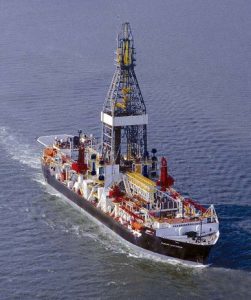
During the height of the Cold War, the Central Intelligence Agency (CIA) initiated one of the most audacious maritime espionage operations in American history: a secret project to salvage a sunken Soviet ballistic submarine, K-129. Six years after the submarine sank sixteen thousand feet to the floor of the North Pacific, far from its home base of Vladivostok, United States intelligence agents determined that the vessel lay ripe for retrieval. In 1971, the CIA contracted with Howard Hughes’s Summa Corporation to construct a specialized, six-hundred-foot floating drill ship platform capable of raising the lost submarine intact. Hughes’s famous personal eccentricities provided the perfect, highly plausible cover story for the venture. The ship, named the Glomar Explorer, was officially presented to the public as a commercial, deep-sea mining vessel built to extract manganese nodules from the ocean’s crust.
The massive project carried an extraordinary $350 million price tag, a cost that intelligence officials considered more than justified by the strategic military assets within the wreck. Specifically, the United States hoped to recover critical Soviet nuclear secrets, including highly classified code books and nuclear missiles. During the first days of President Gerald Ford’s administration, the Glomar Explorer was deployed to the North Pacific, hovering three miles directly above its undersea target.
The recovery operation was conducted under incredibly delicate and tense conditions. While the Glomar Explorer worked, a Soviet trawler closely shadowed the American ship from a short distance. Because the American salvage vessel was completely unarmed to maintain its peaceful industrial cover story, the crew would have been unable to provide more than token resistance if the Soviets grew suspicious and attempted to board. Despite these extreme security risks, President Ford accepted the danger and ordered the mission to proceed.
Initially, the mechanics of the operation functioned as planned. The spy ship’s massive, crablike pincers successfully closed around the hull of the K-129 and began raising the submarine to the surface so that it could be quietly secreted inside the Glomar Explorer’s hull. Throughout the long, grueling ascent, the shadowing Soviet trawler kept its distance. However, at a depth of nine thousand feet, the Hughes-designed claws suffered a major structural malfunction. The submarine broke apart under the strain, causing two-thirds of the K-129 to fall back to the ocean floor.
Despite this catastrophic mechanical failure, the CIA did not consider the mission a complete loss. The salvage team successfully recovered a pair of nuclear-tipped torpedoes alongside other sensitive intelligence finds. Additionally, they retrieved the physical remains of half a dozen Soviet sailors. These deceased mariners were subsequently accorded a formal military funeral and a burial at sea.
Although the secret of the Glomar Explorer initially held, the truth eventually leaked to the public. Fraying relations between Washington and Moscow, coupled with a Soviet grudge over Western trade and congressionally mandated emigration levels, had already stalled post-Vladivostok arms control negotiations. In this tense diplomatic climate, a major embarrassment ensued on March 18 when columnist Jack Anderson broke the previously embargoed story of the Glomar Explorer, following a fragmentary report that had already appeared in the Los Angeles Times. Keenly aware of the prolonged “diplomatic ice age” that had been triggered in May 1960 when President Dwight D. Eisenhower publicly acknowledged the downed U-2 spy plane, President Ford adopted a policy of strict silence, refusing to either confirm or deny the daring mission.