
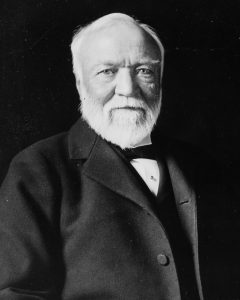
Andrew Carnegie’s rise from a poor Scottish immigrant child to the architect of the world’s most formidable steel empire is the classic, yet highly contested, blueprint of Gilded Age capitalism. After beginning his career as a seventeen-year-old telegraph clerk, Carnegie became the secretary to the head of the Pennsylvania Railroad, and subsequently a Wall Street broker who accumulated a massive personal fortune by selling railroad bonds for lucrative commissions. Like many Gilded Age elites, Carnegie avoided military service during the American Civil War by paying a three-hundred-dollar fee to secure a substitute soldier. In 1872, during a trip to London, Carnegie witnessed the groundbreaking Bessemer process of steel production, which could harden iron into steel in fifteen minutes rather than days. Recognizing its transformative potential, Carnegie returned to the United States and erected a million-dollar steel plant. Shielded from foreign competition by high protective tariffs conveniently enacted by Congress, Carnegie’s operation grew at an unprecedented rate. By 1880, Carnegie was producing ten thousand tons of steel per month, yielding over one and a half million dollars in annual profits. By 1900, his annual earnings skyrocketed to an astronomical forty million dollars.
The rapid expansion of Carnegie’s steel monopoly was not merely a triumph of technological efficiency; it was driven by the aggressive, often predatory tactics characteristic of the Gilded Age “Robber Barons”. Carnegie, alongside contemporary monopolists like John D. Rockefeller and Cornelius Vanderbilt, actively squeezed out commercial rivals and ran roughshod over democratic processes to build the foundations of America’s industrial might. To preserve their dominance, these titans regularly established political influence, ran their own slates of candidates for public office, and bribed pliant legislators with cash. This political leverage ensured that federal policies, such as the protective tariff regime, remained highly favorable to monopoly interests. Carnegie’s plants benefited directly from these artificially high, government-protected prices. For example, when Secretary of the Navy Josephus Daniels attempted to purchase armor plate for the battleship Arizona in 1913, Carnegie Steel colluded with competitors Bethlehem and Midvale to submit identical, inflated bids, a monopoly practice that was only disrupted when the Navy threatened to contract with a British steel consortium.
Behind the glittering facade of Carnegie’s wealth lay a brutal system of labor exploitation. To maintain high profit margins, Carnegie Steel worked its massive labor force for twelve hours a day, seventy-two hours a week, under exhausting conditions of intense heat. This exploitation culminated in the infamous Homestead Strike of 1892 at Carnegie’s western Pennsylvania works. While Carnegie was in Europe, his ruthless business partner, Henry Clay Frick, was left in charge of the plant and resolved to crush the Amalgamated Association of Iron and Steel Workers and break their union. Frick prepared for a violent showdown by erecting a three-mile-long, twelve-foot-high fence topped with barbed wire and outfitted with rifle peepholes around the mill. When the workers rejected the pay cut, Frick laid off the entire workforce of 3,800 men and hired the armed Pinkerton detective agency to protect imported strikebreakers. Although only a fraction of the workers belonged to the union, the workforce voted overwhelmingly to strike. The ensuing conflict turned into a bloody, militarized confrontation. Frick utilized the state militia to break the strike, and the union was eventually destroyed after the anarchist Alexander Berkman infiltrated Frick’s office, shooting and stabbing him. This legacy of violence and greed prompted future President Harry Truman to remark that Carnegie’s philanthropic libraries were ultimately “steeped in the blood of the Homestead steelworkers”.
The final chapter of Carnegie’s direct monopoly over steel arose from a fierce, high-stakes clash with the king of Wall Street finance, J.P. Morgan. Morgan had engineered massive roll-ups of downstream steel fabricators, most of whom purchased their raw materials from Carnegie. When Morgan went a step too far by organizing an upstream steel-producing firm to bypass Carnegie’s mills, Carnegie reacted with gleeful hostility. He announced massive, retaliatory expansions designed to completely destroy Morgan’s steel interests. Facing an industrial catastrophe and unable to compete with the world’s most efficient steel manufacturer, Morgan sought a buyout. At a dinner party in 1900, Carnegie agreed to sell his entire steel concern. The details of the transaction remain a subject of historical debate: Carnegie reportedly scribbled a price of 492 million dollars on a note, or penciled 480 million dollars on a scrap of paper, while other records show the final sale was completed in 1901 for 303 million dollars. Regardless of the exact figure, Carnegie retired as one of the wealthiest men in human history, while Morgan combined Carnegie’s plants with other entities to form the U.S. Steel Corporation, the world’s first billion-dollar conglomerate.
The creation of U.S. Steel successfully consolidated the monopoly framework pioneered by Carnegie, but it did so at the expense of technical innovation and workers’ rights. The newly formed trust controlled roughly sixty percent of the American steel market. Under the leadership of Elbert H. Gary, the corporation actively disciplined the industry through the famous “Gary dinners” to fix prices and suppress “destructive” competition. The legacy of Carnegie’s original empire continued to affect American life for decades, marked by persistent labor struggles, such as the massive 1919 steel strikes where 350,000 workers walked out to protest grueling twelve-hour shifts. Decades later, during World War II, the systemic pressures of the U.S. Steel monopoly manifested in a major quality-control scandal. At the Carnegie-Illinois rolling mill in West Mifflin, Pennsylvania, plant managers were caught systematically altering quality tests and falsifying records to deliver brittle, substandard steel plate to the Navy. Ultimately, Andrew Carnegie’s steel monopoly demonstrated that the construction of America’s industrial core was forged not only through technological breakthrough, but through a calculated strategy of market control, political manipulation, and severe human cost.