

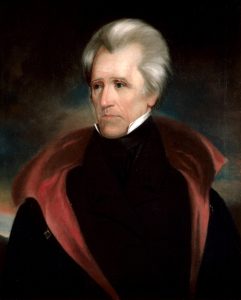
To understand the defining political crises of our modern era—a president who claims absolute immunity, defies the courts, purges the civil service for political loyalists, and weaponizes the government against marginalized populations while claiming to be the sole voice of the “forgotten American”—one must look to the seventh president of the United States. Andrew Jackson fundamentally rewrote the script of American public life. Before Jackson, power in Washington was carefully diffused among coordinate branches of government. By the time Jackson left office, he had birthed the modern, imperial presidency, proving that a leader armed with mass populist appeal could bulldoze the Constitution’s checks and balances.
The Invention of the “Direct Representative” Jackson’s ascent to the presidency in 1828 was a political earthquake. Orphaned at fourteen and scarred for life by the sword of a British officer whose boots he refused to shine, Jackson was the ultimate self-made man. He was the first president to come from the common people rather than the educated elite, and he harbored a deep, abiding resentment toward the established political and financial classes.
When Jackson took power, he introduced a terrifying new constitutional theory that remains the bedrock of authoritarian populism today: he claimed that the President of the United States was the “direct representative of the American people”. None of his predecessors had ever dared to assert that the executive embodied the popular will more legitimately than Congress. Armed with this mandate, Jackson believed that he alone was the protector of the public, and that his personal will and the will of the nation were indistinguishable.
This allowed him to radically expand executive power. He was the first president to use the veto as a political weapon rather than just a constitutional safeguard, rejecting legislation simply because he disagreed with it. When faced with coordinate branches of government that opposed him, Jackson declared that the President was independent of both Congress and the Supreme Court, and that he was bound to support the Constitution only as he understood it, not as it was understood by others. His opponents were horrified; Senator Daniel Webster thundered that no president had ever advanced such a claim to “despotic power,” and his critics quickly dubbed him “King Andrew the First”.
The Spoils System and the “Deep State” Modern efforts to purge independent civil servants and replace them with ideological loyalists—such as Schedule F or the creation of partisan slush funds—trace their direct lineage to Jackson’s presidency. Convinced that Washington was suffering from a crisis of corruption and that entrenched bureaucrats were thwarting the will of the people, Jackson instituted what became known as the “spoils system”.
Upon taking office, he systematically fired hundreds of federal officials, replacing them with his own political partisans. He claimed this was a necessary “reform” to cleanse the government of a bureaucratic complex that ignored the unconnected. In reality, Jackson was building a massive political machine, surrounding himself with a “Kitchen Cabinet” of private advisers and loyalists who operated outside of official, Senate-confirmed channels. He even created the first administration-run newspaper, the Globe, to act as a propaganda arm, bypassing traditional press outlets to broadcast his personal grievances and dictates directly to his followers.
The Bank War: Populism Over Stability Jackson’s war against the Second Bank of the United States provides vital historical context for how populist leaders use manufactured crises to consolidate power. Jackson hated the Bank, viewing its president, Nicholas Biddle, and its wealthy investors as an arrogant aristocracy that corrupted elections and controlled the economy.
To destroy the Bank, Jackson bypassed Congress and unilaterally withdrew federal deposits, distributing the nation’s wealth into pet state banks. When his own Treasury Secretary refused to execute this legally dubious order, Jackson simply fired him and replaced him with someone who would. To justify this massive executive overreach, Jackson embarked on the first direct public relations campaign by a president, telling crowds that the Bank was a monster and proclaiming, “The people! The people, sir, are with me”.
The Senate was so appalled by his assumption of unconstitutional power that it took the unprecedented step of censuring the President. Yet Jackson refused to bow, responding with a blistering protest that he was accountable only to the voters. While he successfully killed the Bank and won his political war, his reckless financial maneuvering—including demanding that public lands be bought only with gold and silver—ultimately plunged the nation into the devastating Panic of 1837.
The Tyranny of the Majority: Minorities and the Courts The darkest legacy of Jackson’s populism is his demonstration that “majority rule” can easily become a mechanism for state-sanctioned terror against the vulnerable. Jackson championed freedom and democracy, but exclusively for white men.
His most infamous policy was the Indian Removal Act of 1830, which aimed to expel Native American tribes from their ancestral lands in the South to territories west of the Mississippi. Jackson framed this expulsion as an act of national security and progress, arguing that the continent should not be left to “savages”.
When the Supreme Court ruled in Worcester v. Georgia that the state could not impose its laws on Cherokee land, Jackson famously—though apocryphally—is said to have declared, “John Marshall has made his decision; now let him enforce it”. While he may not have uttered those exact words, the reality was just as chilling: Jackson actively supported Georgia’s defiance of the Supreme Court and refused to send federal marshals to enforce the ruling. By ignoring the judiciary, Jackson effectively nullified the rule of law, leading directly to the Trail of Tears, where thousands of Native Americans were marched to their deaths.
Furthermore, as an unrepentant slaveholder who offered bounties to anyone who would whip his runaway slaves, Jackson aggressively protected the institution of slavery. When abolitionists attempted to mail anti-slavery pamphlets to the South, mobs burned the mailings. Rather than protect the First Amendment and the federal postal service, Jackson and his Postmaster General allowed the mail to be censored, calling the abolitionist tracts a “wicked plan” and prioritizing the suppression of dissent over the rule of law.
Conclusion Andrew Jackson was a man of intense contradictions. He genuinely loved the United States and threatened to wage a bloody war against South Carolina to prevent them from nullifying federal tariffs, viewing the preservation of the Union as his sacred duty. Yet his presidency laid the blueprint for democratic subversion.
Jackson taught future generations that a charismatic leader can shatter constitutional guardrails simply by claiming that they alone speak for the masses. He proved that the public will tolerate, and even celebrate, the persecution of minorities, the defiance of the courts, and the purging of the government, so long as the president convinces them that he is destroying an elite, corrupt establishment on their behalf. When modern politicians harness popular rage to elevate themselves above the law, they are wielding the very sword that Andrew Jackson forged.