

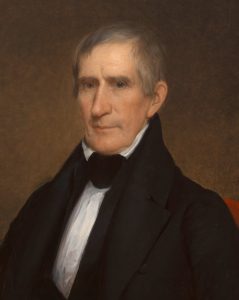
William Henry Harrison’s thirty-one-day presidency is frequently dismissed as a piece of historical trivia—a cautionary tale about the dangers of delivering a two-hour inaugural address in freezing rain. Yet, his ascent to the White House in the election of 1840 provides profound historical context for understanding the current crises of American democracy. In an era where modern politicians frequently deploy armies of consultants to fabricate relatable personas, and where wealthy elites don the costume of the anti-establishment populist to capture working-class votes, we are living in the political reality that Harrison’s campaign invented. He was America’s first manufactured populist.
The Aristocrat as the “Common Man” To understand the sheer audacity of Harrison’s 1840 presidential campaign, one must look at the reality of his life. Harrison was not a humble frontiersman. He was born in 1773 into the highest echelons of the Virginia aristocracy; his father, Benjamin Harrison, was a wealthy plantation owner, a governor of Virginia, and a signer of the Declaration of Independence,. Unlike his predecessor Andrew Jackson, or the tavern-keeper’s son Martin Van Buren, William Henry Harrison was raised on the sprawling Berkeley plantation and educated in the classics at Hampden-Sydney College,,.
When Harrison eventually moved west to Ohio and Indiana, he did not live in a modest log cabin. He resided in a sixteen-room, clapboard mansion situated on a 3,000-acre estate known as The Point, which featured a formal garden, a massive brick oven, and an elegant circular walnut staircase imported over the Allegheny Mountains,,. He was a man of the elite class who fought desperately to maintain a standard of living that allowed him to consume an entire ham a day and entertain guests lavishly,. Furthermore, while he sometimes publicly claimed to dislike slavery, he was a former slaveowner who actively tried to circumvent the Indiana Territory’s anti-slavery laws by bringing in enslaved Black workers disguised under the legal fiction of “indentured servants”,,.
As the governor of the Indiana Territory for twelve years, Harrison’s primary historical impact was the aggressive acquisition of millions of acres of Native American land for the federal government at the cost of mere pennies per acre,. He achieved this through highly questionable treaties, utilizing “pecuniary advances” and withholding annuities to coerce desperate, disparate tribes into selling lands they did not entirely own. His national fame rested heavily on the 1811 Battle of Tippecanoe, a relatively minor skirmish where Harrison’s failure to fortify his camp resulted in disproportionately high American casualties,. Despite this, the battle was successfully spun into a legendary military triumph, catapulting him to national prominence,.
The Log Cabin and Hard Cider Campaign By 1840, the Whig Party was desperate to unseat the Democrats, but they were deeply fractured over issues like the national bank, tariffs, and slavery. Realizing they could not unite behind a coherent policy platform—in fact, the party chose not to have a platform at all—Whig operatives like Thurlow Weed decided to market Harrison purely on image,.
The defining moment of the campaign occurred when a Democratic newspaper mockingly suggested that if Harrison were given a pension and a barrel of hard cider, he would happily sit out the remainder of his days in a log cabin,. Rather than take offense, the Whigs brilliantly co-opted the insult, transforming the wealthy Virginia aristocrat into the rugged “Log Cabin and Hard Cider” candidate.
This was the birth of modern, image-based political marketing. The Whigs flooded the country with campaign songs, log cabin floats, and hard cider rallies, deliberately painting the incumbent Martin Van Buren as a corrupt, champagne-sipping elitist who ate off gold plates, while falsely presenting Harrison as a humble farmer who shared the sufferings of the poor,,. As one Whig newspaperman brazenly claimed, Van Buren had lived in luxury while Harrison had been “from youth on the frontier, a soldier enduring hardship and privation”.
The Invention of the Campaign Trail Harrison’s campaign shattered the established norms of American democracy. Prior to 1840, it was considered entirely undignified for a presidential candidate to actively solicit votes or electioneer for himself,. Harrison broke this taboo, becoming the first presidential candidate to take to the campaign trail,,. He stumped across the country, giving energetic, hours-long speeches to crowds that sometimes reached 100,000 people.
His campaign also pioneered the mass mobilization of the electorate. The Whigs introduced aggressive grassroots organizing, campaign merchandise, and the unprecedented integration of women into political rallies, recognizing that emotional pageantry could drive voter turnout far more effectively than dry policy debates,. The result was staggering: voter turnout in 1840 exploded to 80.2 percent, a massive leap from the 58 percent turnout just four years prior.
The Age Issue and the Ultimate Irony During the campaign, Democrats ruthlessly attacked Harrison’s age and fitness for office, labeling the 67-year-old a “superannuated and pitiable dotard,” a “coward,” and “a living mass of ruined matter”,,. To counteract this narrative, Harrison’s handlers took the unprecedented step of releasing a public report from his doctor, certifying his “youthfulness of feelings” and physical vigor—a political tactic that remains a staple of modern elections.
Tragically, Harrison’s desire to prove his virility proved fatal. On Inauguration Day in March 1841, he refused to wear an overcoat or hat in the freezing rain and delivered a rambling, two-hour inaugural address. The exposure led to pneumonia, and he died just one month later, plunging the young nation into its very first presidential succession crisis and handing the presidency to John Tyler, a man whose politics were the exact opposite of the Whig agenda,,.
The Echoes in the Present William Henry Harrison’s legacy is not defined by what he did in office, but by how he attained it. His 1840 campaign proves that the modern public’s frustration with “fake” politicians, content-free campaigns, and the manipulation of the electorate is rooted deep in American history. The Whig party successfully engineered a blueprint that continues to dominate our elections: they realized that a candidate’s actual record, wealth, and elite status can be completely erased if a political machine builds a compelling enough narrative of populist grievance. When voters today are seduced by billionaires who claim to uniquely understand the plight of the working class, they are drinking from the exact same barrel of hard cider that intoxicated the nation over 180 years ago.