

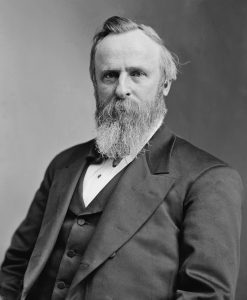
To understand the deepest anxieties of modern American democracy—the nightmare of a highly contested presidential election, the manipulation of the Electoral College, the battle over the “deep state” and civil service, and the tragic reality that political stability is often purchased at the expense of marginalized minorities—one must examine the crisis of 1876 and the presidency of Rutherford B. Hayes. As historians have noted, the election of 1876 possesses an eerie, almost farcical parallel to modern contested elections, complete with allegations of missing ballots, voter intimidation, and a winner ultimately decided by a partisan commission.
Hayes entered the White House bearing the derisive nicknames “His Fraudulency” and “Rutherfraud B. Hayes,” his legitimacy forever stained by what many considered the “fraud of the century”. Yet, the true tragedy of the Hayes administration is that this monumental democratic crisis revolved around a man who was, by all accounts, one of the most decent, honest, and moderate politicians of the Gilded Age.
The Honest Man in a Corrupt Age Unlike the manufactured populists or corrupt political bosses of his era, Rutherford B. Hayes possessed an impeccable resume. Born in Ohio in 1822, he became a successful lawyer who, despite originally harboring moderate views on slavery, actively defended fugitive slaves in court prior to the Civil War. When the Civil War erupted, he did not hesitate to volunteer. Hayes proved to be an exceptionally brave combat officer, participating in fifty engagements, having four horses shot from under him, and sustaining four wounds—one of them serious. When Ohio political operatives suggested he take a furlough from the army to campaign for a seat in Congress, Hayes fiercely replied that an officer who abandoned his post to electioneer “ought to be scalped”. He won the congressional seat anyway and mustered out of the army as a brevet major general.
Following the war, Hayes served three terms as the governor of Ohio. He was a steadfast supporter of the Fourteenth and Fifteenth Amendments, advocating for the civil and voting rights of newly freed Black Americans. Because of his “stainless character” and lack of scandalous baggage, the Republican Party turned to him in 1876 as a safe, unifying candidate who could distance the party from the rampant corruption of the outgoing Ulysses S. Grant administration.
The Disputed Election and the Partisan Commission On election night in November 1876, Hayes went to bed cheerfully believing he had lost the presidency to his Democratic opponent, New York Governor Samuel J. Tilden. Tilden had swept the popular vote by a margin of more than 250,000 ballots and appeared to have secured the Electoral College.
However, ruthless Republican operatives, including party chairman Zachariah Chandler, realized that if they could claim the electoral votes of three disputed southern states—Florida, Louisiana, and South Carolina—Hayes would win the Electoral College by a razor-thin margin of 185 to 184. Claiming widespread Democratic voter intimidation and violence against Black voters in the South (which was historically accurate), Republican-controlled returning boards in those states threw out thousands of Democratic ballots and certified the states for Hayes.
With the nation facing the terrifying prospect of a second civil war over the paralyzed election, Congress created an unprecedented, fifteen-member Electoral Commission to decide the winner. The commission ultimately consisted of eight Republicans and seven Democrats. In a stark display of party loyalty over objective adjudication, every single disputed state was awarded to Hayes by an invariable 8-to-7 partisan vote.
The Compromise of 1877 and the Betrayal of Reconstruction Hayes’s peaceful inauguration was secured not merely by the commission, but by a chilling backroom political bargain. Behind the scenes, Hayes’s allies negotiated with Southern Democratic leaders in what became known as the Compromise of 1877. Southern conservatives agreed to drop their filibuster and accept Hayes as president in exchange for massive concessions: the federal government would subsidize southern infrastructure (like the Texas and Pacific Railroad), and, most importantly, Hayes would withdraw the last remaining federal troops from the South.
This agreement effectively ended Reconstruction. While Hayes naively extracted empty promises from Southern Democrats that they would protect the rights of Black citizens, the reality was catastrophic. The withdrawal of federal protection allowed white supremacist “Redeemer” governments to reclaim total control of the South. They quickly instituted the Jim Crow laws, utilizing poll taxes, literacy tests, and gerrymandering to systematically strip Black Americans of their newly won voting rights.
As the great Black historian W. E. B. Du Bois later summarized the tragedy of this era: “The slave went free; stood a brief moment in the sun; then moved back again toward slavery”. While historians note that Hayes was somewhat a captive of larger events—Congress had already cut military funding, and the Northern public was weary of Reconstruction—he nonetheless presided over the formal abandonment of the moral victories of the Civil War to secure his own political peace.
Crushing Labor and Purging the “Deep State” Once in office, Hayes faced domestic crises that mirror modern executive struggles. He fought a bitter war against the “spoils system” and the political machines that controlled government patronage. In a bold move that shocked Washington, Hayes directly challenged the powerful Republican Senator Roscoe Conkling by firing Conkling’s loyalists from the corrupt New York Custom House—one of those dismissed being future president Chester A. Arthur. By demanding that civil servants be appointed by merit and forbidding them from participating in partisan electioneering, Hayes laid the early groundwork for the modern, non-partisan civil service.
Yet, his presidency was also defined by a brutal response to domestic unrest. During the Great Railroad Strike of 1877, desperate workers protesting severe wage cuts paralyzed the nation’s rail network. Facing mass riots, Hayes deployed the U.S. Army to Maryland, Pennsylvania, West Virginia, and elsewhere to violently crush the strikes and protect corporate railroad bosses. Former President Grant bitterly noted the irony: the public and the press had decried the use of federal troops in the South to protect the constitutional lives of Black citizens, yet they wildly cheered the deployment of the military to suppress desperate American workers on behalf of corporate wealth.
Conclusion Having pledged in his acceptance letter to serve only a single term, Rutherford B. Hayes voluntarily retired in 1881. He left office having restored a measure of dignity and financial stability to the government, untouched by personal scandal. Yet, his legacy serves as a profound historical warning. Hayes’s ascent to power proves that the mechanics of American democracy can be ruthlessly manipulated by political operatives, and that extreme national polarization is frequently “resolved” by sacrificing the civil rights of the most vulnerable.