

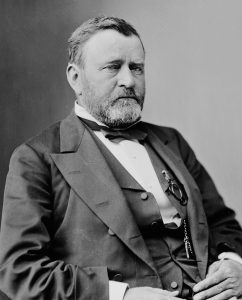
To understand the deepest fault lines of modern American politics—the federal government’s role in combating white supremacist domestic terrorism, the struggle to protect minority voting rights, the corrupting influence of billionaire oligarchs on the executive branch, and the value of international diplomacy over unilateral war—one must look closely at the eighteenth president of the United States. For over a century, the historical memory of Ulysses S. Grant was systematically degraded. Southern apologists and cynical historians dismissed him as a butcher on the battlefield and a bumbling, drunken incompetent in the White House.
But this caricature is a profound historical injustice. In reality, Grant was the single most important figure behind Reconstruction, the president who deployed the full might of the federal government to crush the Ku Klux Klan and protect the newly won rights of four million freed Black Americans. Yet, his presidency also serves as a blaring warning about the Gilded Age: it proves that even a chief executive of impeccable personal honesty can be disastrously undermined when he places too much trust in the ruthless, self-serving billionaires of his era.
The Reluctant Politician and the Defense of Democracy Before the Civil War, Grant was an apolitical man who had experienced little but business failure and grinding poverty. In fact, the only presidential vote he ever cast before the war was for the disastrous Democrat James Buchanan in 1856. But the crucible of the Civil War transformed him. Working closely with Abraham Lincoln, Grant evolved from a mere soldier into a leader with a profound ideological commitment to emancipation.
When the war ended, Grant initially hoped to remain above the partisan fray. However, as he watched Andrew Johnson actively sabotage Reconstruction and empower the unrepentant white South, Grant realized that the results of the Civil War were in existential peril. He concluded that “it would have been better never to have made a sacrifice of blood and treasure to save the Union than to have the democratic party come in power now and sacrifice by the ballot what the bayonet seemed to have accomplished”. Realizing that the survival of the republic required an executive who would enforce civil rights, Grant accepted the Republican nomination in 1868.
Crushing the Ku Klux Klan: The War on Domestic Terror The imperishable story of Grant’s presidency is his relentless campaign to destroy the Ku Klux Klan. Following the Civil War, white supremacists effectively launched a massive, coordinated domestic terrorism insurgency designed to overturn the war’s outcome, murder Black and white Republicans, and restore the racial hierarchy of the South. Local southern sheriffs refused to arrest the hooded night riders, and southern juries refused to convict them.
Faced with a total collapse of law enforcement and a campaign of mass murder, Grant did not appease the terrorists or rely on states’ rights rhetoric. He threw the immense weight of his office behind the Fifteenth Amendment, which granted Black men the right to vote, calling its ratification “the most important event that has occurred, since the nation came into life”.
To protect those voters, Grant oversaw the creation of the Department of Justice in 1870, with its very first duty being to bring thousands of anti-Klan indictments. When the terror continued, he championed and signed the Ku Klux Klan Act of 1871. This landmark legislation made it a federal crime to conspire or go in disguise upon the public highway to deprive any person of equal protection of the law. Armed with this act, Grant took the extraordinary step of suspending habeas corpus in parts of the South and deploying federal troops to hunt down the disguised marauders and break up their bands. By 1872, the Klan had been effectively destroyed.
When modern Americans debate whether the federal government should intervene when states refuse to protect their marginalized citizens or prosecute right-wing domestic terrorists, Grant’s administration provides the definitive answer. As Frederick Douglass proudly noted, Grant was “the vigilant, firm, impartial, and wise protector of my race” who successfully stamped out the murderous Ku Klux Klan.
The Naïve Executive and the Billionaire Oligarchs If Grant’s civil rights record represents his greatest triumph, his handling of the economy and executive appointments represents his greatest vulnerability. Grant presided over the dawn of the Gilded Age, an era of explosive corporate growth, unbridled Wall Street greed, and systemic political corruption.
Grant was a man of extreme personal integrity—he once admonished a White House servant who tried to cover for him, declaring, “I never lie for myself and do not want anybody to lie for me”. But because he was “the soul of honor himself,” he possessed a fatal naïveté about human nature, assuming that the wealthy, successful men who courted him were as sincere and patriotic as he was.
This credulity made him an easy mark for the buccaneering tycoons of his day. In 1869, the ruthless Wall Street speculators Jay Gould and James Fisk Jr. initiated a massive, shadowy campaign of seduction aimed at the president. They sought to corner the gold market and actively manipulated Grant’s associates to ensure the federal government would not intervene. While Grant eventually realized the scam and ordered the Treasury to sell gold to break the ring, the resulting “Black Friday” financial panic devastated the market and permanently tarnished the administration.
The “Gold Corner” set the pattern for a presidency plagued by scandal. Grant’s administration illustrates a terrifying modern reality: when an executive lacks deep political experience and places blind trust in wealthy tycoons, the machinery of the state will inevitably be hijacked by plutocrats seeking to enrich themselves at the public’s expense.
The Peace Policy and the Limits of Good Intentions Grant also brought his sympathy for the underdog to the plight of Native Americans. Unlike the generals who believed in exterminating the indigenous population, Grant told Congress that “a system which looks to the extinction of a race is too abhorrent for a Nation to indulge in”. He instituted a “Peace Policy,” attempting to replace corrupt Indian agents with pacifist Quakers and seeking to assimilate Native Americans onto reservations with absolute protection.
Yet, this policy highlights the tragic limits of executive goodwill when pitted against the relentless machinery of American capitalism. Grant’s humane intentions were ultimately crushed by the unstoppable westward tidal flow of white settlers, miners, and the transcontinental railroads, which led to the butchery of the buffalo herds and the inevitable destruction of the Native American way of life.
Vindication Through Diplomacy While modern presidents frequently bypass Congress to launch unilateral military strikes, Grant, a man who had seen the supreme horrors of war, prized diplomacy. His administration achieved a historic triumph by peacefully settling the Alabama claims with Great Britain. During the Civil War, Britain had allowed Confederate commerce raiders to be built in its shipyards. Rather than pursuing a disastrous war of retaliation, Grant’s administration successfully utilized international arbitration, resulting in a Geneva tribunal that awarded the United States $15.5 million. This obscure but monumental event proved that international institutions and diplomacy could resolve explosive disputes between global superpowers.
Conclusion After leaving the presidency, Grant was swindled out of his life savings by a corrupt investment partner. Destitute and dying of agonizing throat cancer, the old general summoned a superhuman exertion of willpower to write his Personal Memoirs. Enduring unimaginable pain, he finished the manuscript just one week before his death, ensuring his wife Julia would be financially secure.
Ulysses S. Grant was a common man raised to a higher power, a leader who united the country by winning the Civil War and then fought desperately to secure its moral promise during Reconstruction. His presidency stands today as a vital historical testament: it proves that the American executive possesses the power to crush domestic terrorism and protect the most vulnerable citizens, but it also warns that democracy remains endlessly fragile when leaders allow the government to be exploited by the unchecked greed of the ultra-wealthy.