

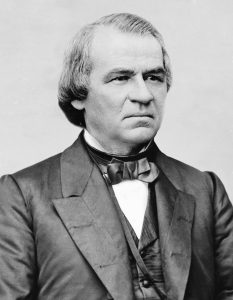
On March 4, 1865, the great abolitionist Frederick Douglass stood in the crowd at the U.S. Capitol to witness the inauguration of Abraham Lincoln’s second term. While there, Douglass caught the eye of the new vice president, Andrew Johnson of Tennessee. Douglass noted that the first expression on Johnson’s face was “one of bitter contempt and aversion,” followed quickly by “the bland and sickly smile of the demagogue”. Turning to a companion, Douglass accurately prophesied, “Whatever Andrew Johnson may be, he is no friend of our race”.
At the time, Johnson’s hostility seemed like a manageable, if repulsive, footnote; Lincoln was safely at the helm. But just weeks later, an assassin’s bullet transferred the fate of a shattered nation and four million newly freed Black Americans into the hands of a man who was spectacularly unsuited for the task.
To understand the most toxic elements of modern American politics—the weaponization of working-class resentment, the abuse of executive discretion to sabotage established laws, the endurance of white supremacy, and the agonizing debates over the true purpose of presidential impeachment—one must stare directly into the abyss of the Andrew Johnson administration. He was not merely a failed president; he was an executive who actively deployed the power of his office to undo the moral victories of the Civil War.
The Manufactured Populist and the Revenge Fantasy Andrew Johnson embodied the ultimate American political cliché: he was actually born in a log cabin and rose from grinding poverty as an illiterate tailor’s apprentice. He taught himself the mechanics of politics and fashioned his identity entirely around being the champion of the “common man” against the wealthy, aristocratic elites.
Yet, Johnson’s populism was fundamentally rooted in personal insecurity and a profound fear of being proven wrong. His famous, lifelong hatred for the wealthy Southern planter class was not driven by a principled objection to their exploitation of human beings, but by deep envy. He resented the fact that they looked down on him.
When the Civil War ended, President Johnson was presented with a choice: he could dismantle the power of the former slaveholding elite to foster a new, egalitarian South, or he could capitulate to them to maintain the racial hierarchy. He chose the latter. In a move that stunned observers, Johnson set up a system where the disgraced Confederate grandees had to personally petition him for pardons. He made a grand show of their supplication, and then—having fulfilled what resembled a “high school revenge fantasy”—he quickly pardoned them, effectively restoring the traitors who had taken up arms against the United States back to their former positions of power.
“A Government for White Men” Unlike Lincoln, who possessed the pragmatism to grow and eventually advocate for Black enfranchisement, Johnson was rigidly, obsessively racist. He did not view Reconstruction as an opportunity to build an equitable society; he sought only a “Restoration” of the pre-war status quo, minus chattel slavery.
Black empowerment was Johnson’s nightmare. “This is a country for white men, and by God, as long as I am President, it shall be a government for white men,” he declared.
To enforce this vision, Johnson used the executive branch to systematically sabotage the economic and physical security of the freedmen. During the war, Union General William T. Sherman had issued an order granting newly freed families “forty acres” of confiscated Confederate land so they could achieve independence. Johnson immediately overturned Sherman’s order, confiscating the land from Black families and handing it back to the very Confederates who had started the war.
By empowering conservative Southern governments, Johnson facilitated the creation of draconian “Black Codes,” which effectively criminalized Black existence by demanding proof of employment, forbidding them from leaving jobs, and even making hunting and fishing illegal to force them back into dependent plantation labor. When Johnson sent investigator Carl Schurz to the South, Schurz returned with horrifying reports of mass violence and hunting parties slaughtering Black men—yet the President callously ignored the bloodshed, refusing to intervene.
Executive Obstruction and the Abuse of Discretion Recognizing that the President was actively endangering the republic, the Republican-led Congress attempted to strip control of Reconstruction from him. When Congress passed civil rights legislation, Johnson vetoed it. When Congress overrode his vetoes, Johnson resorted to a sinister tactic that plagues the modern administrative state: the abuse of executive discretion.
As legal scholar John Norton Pomeroy warned during Johnson’s era, a president can subvert democracy not only by breaking a specific law, but by refusing to faithfully execute it. Johnson routinely used his appointment powers and executive discretion to place individuals in power who he knew would ignore or sabotage the civil rights laws Congress had passed. He proved that a rogue executive can paralyze a nation simply by ordering the bureaucracy to stand down in the face of injustice.
The Failure of Impeachment To stop Johnson from purging his cabinet of officials who actually wanted to enforce Reconstruction, Congress passed the Tenure of Office Act, restricting his ability to fire cabinet members without Senate approval. When Johnson brazenly fired Secretary of War Edwin Stanton, the House of Representatives finally impeached him in 1868.
However, the impeachment of Andrew Johnson offers a chilling historical lesson about the limits of congressional accountability. Rather than impeaching Johnson on the “broad view”—highlighting his systemic abuse of power, his sabotage of Reconstruction, and his complicity in white supremacist violence—Congress chose a “narrow view,” focusing almost entirely on the technical violation of the Tenure of Office Act.
By reducing the President’s monumental betrayal of the country to a confusing, legally dubious dispute over a cabinet appointment, Congress doomed its own effort. Furthermore, moderate Republicans feared the man next in line for the presidency—the radical Senator Benjamin Wade, who horrified conservatives with his support for women’s suffrage and labor rights. Driven by political cowardice and a poorly framed indictment, the Senate acquitted Johnson by a single vote.
Conclusion Andrew Johnson survived his impeachment, and the nation paid an incalculable price. He successfully “preserved the South as ‘a white man’s country,'” delaying the promise of true American democracy for another century.
When we look at modern leaders who traffic in racial division, who leverage the grievances of their political base to attack marginalized communities, or who view the presidency not as a solemn trust but as an instrument for personal retribution, we are looking at the political descendants of Andrew Johnson. His presidency stands as a permanent, flashing warning: the American system is exceptionally vulnerable to an executive who is willing to exploit the darkest impulses of the electorate, and the constitutional guardrail of impeachment is largely useless if the legislature lacks the courage to hold a demagogue fully accountable for the destruction he has caused.