

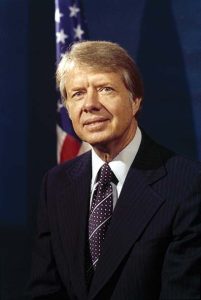
To understand the defining ideological and structural pivots of modern American politics—the transition from post-World War II New Deal liberalism to a market-driven conservative era, the tension between moral idealism and national interest in foreign policy, the challenge of managing global energy dependencies, and the struggle to maintain public trust in an age of systemic cynicism—one must examine the presidency of James Earl Carter, Jr.. Serving as the thirty-ninth chief executive from 1977 to 1981, Carter represented a unique political archetype. He was an Annapolis-trained naval nuclear engineer who studied under Admiral Hyman Rickover, a devout Southern Baptist, a Georgia peanut farmer, and a governor who boldly announced an end to racial discrimination in his 1971 inaugural address. Emerging from the national trauma of the Vietnam War and the Watergate scandal, Carter captured the White House as a populist outsider promising a “government as good as the American people” and pledging never to lie to the electorate. Yet, his four years in office became a pivotal testing ground for the limits of presidential power in a world of growing complexity and scarcity.
The Outsider’s Governance and Economic Deregulation
Carter assumed the presidency during an unprecedented economic crisis characterized by “stagflation”—a toxic combination of high inflation, stagnant economic growth, and rising unemployment exacerbated by global oil shocks. Rejecting traditional partisan dogmas, Carter approached domestic policy with an analytical, technocratic mindset that often alienated the liberal wing of his own party. Believing that rigid federal oversight artificially inflated consumer costs, Carter initiated the sweeping deregulation of key American industries, including commercial aviation, trucking, and railroads. This landmark deregulatory drive introduced market competition that lowered prices for millions of consumers, fundamentally restructuring the American economy.
Concurrently, Carter confronted the rampant inflation that threatened long-term economic stability. In 1979, in an act of extraordinary political courage, Carter appointed Paul Volcker as Chairman of the Federal Reserve. Carter knew that Volcker intended to tighten the money supply and raise interest rates dramatically to break the inflationary cycle—a painful policy that would induce a severe recession and jeopardize Carter’s own re-election prospects. Furthermore, Carter transformed the composition of the federal courts, appointing more women, African Americans, and Hispanics to the federal bench than all previous presidents combined, quietly revolutionizing the American judiciary without statutory quotas.
Energy Conservation and the “Crisis of Confidence”
For Carter, the nation’s severe dependence on foreign oil was both an economic danger and a profound moral test. He declared the energy crisis “the moral equivalent of war,” pushing a massive National Energy Act through Congress that created the Department of Energy, subsidized renewable energy research, imposed fuel-efficiency standards on automobiles, and initiated the gradual decontrol of domestic oil and natural gas prices. Demonstrating symbolic leadership, Carter installed thirty-two solar panels on the White House roof to model environmental stewardship. He also enacted the historic Alaska National Interest Lands Conservation Act, placing over 150 million acres of pristine wilderness under federal protection.
However, the 1979 Iranian Revolution triggered a second global oil shock, resulting in widespread gasoline shortages and massive lines at service stations across the country. In July 1979, after retreating to Camp David for ten days to consult with civic, religious, and political leaders, Carter delivered a somber, televised address to the nation. In what became known as the “Malaise Speech”—though he never used the word “malaise”—Carter diagnosed a deeper national crisis, warning that a “crisis of confidence” was threatening the spirit of the country and criticizing an unbridled consumerism that equated personal happiness with material goods. While the speech initially received strong public approval, subsequent cabinet dismissals and political pushback turned the address into a symbol of an administration struggling to project optimistic national leadership.
Human Rights and Foreign Policy Breakthroughs
In foreign affairs, Carter broke sharply with Cold War realpolitik, declaring that “our commitment to human rights must be absolute” and establishing human rights as the explicit foundation of American diplomacy. Under this mandate, the administration curtailed military aid to repressive dictatorships in Latin America and elsewhere, using diplomatic pressure to secure the release of political prisoners. Facing intense domestic criticism from political hardliners, Carter successfully negotiated and secured Senate ratification of the Panama Canal Treaties, transferring control of the waterway to Panama and eliminating a long-standing source of anti-American resentment across the postcolonial world. He also achieved formal diplomatic normalization with the People’s Republic of China under Deng Xiaoping, integrating China into the global economic order.
Carter’s crowning diplomatic triumph occurred in September 1978 at Camp David. For thirteen grueling days, Carter personally mediated between Egyptian President Anwar Sadat and Israeli Prime Minister Menachem Begin. Through relentless, single-minded negotiation, Carter forged the Camp David Accords, which led directly to the 1979 Egypt-Israel Peace Treaty. The historic agreement ended thirty years of war between the two nations and secured the return of the Sinai Peninsula to Egypt, representing one of the most significant personal diplomatic achievements in modern presidential history.
The Iranian Hostage Crisis, Soviet Aggression, and Electoral Defeat
Despite these diplomatic successes, the final years of Carter’s presidency were overwhelmed by foreign policy crises. In November 1979, following the overthrow of the Shah and the U.S. decision to admit the exiled monarch for medical treatment, Iranian militant students stormed the U.S. Embassy in Tehran, seizing fifty-two American diplomats and citizens. For 444 days, the Iranian Hostage Crisis paralyzed the White House and dominated daily news broadcasts. Carter prioritized preserving the lives of the captives, stubbornly avoiding massive military retaliation that might result in their execution. However, in April 1980, a secret military rescue operation—Operation Eagle Claw—suffered a catastrophic mechanical failure and collision in the Iranian desert, resulting in the deaths of eight U.S. servicemen and further damaging public perception of American strength.
Simultaneously, the Cold War intensified dramatically when the Soviet Union invaded Afghanistan in December 1979. Carter responded forcefully, articulating the “Carter Doctrine,” which declared that any attempt by an outside force to gain control of the Persian Gulf region would be regarded as an assault on the vital interests of the United States. He suspended Senate consideration of the SALT II nuclear arms treaty, imposed a grain embargo on Moscow, reinstated selective service draft registration, and led a multi-nation boycott of the 1980 Summer Olympic Games in Moscow.
Domestically, Carter faced a formidable primary challenge from Senator Edward M. Kennedy, who attacked the president from the left for failing to pass national health insurance and cutting social spending. Though Carter successfully repelled Kennedy’s nomination challenge, the bruising party feud left the Democrats deeply fractured heading into the 1980 general election. Burdened by high inflation, sky-high interest rates, energy woes, and the ongoing hostage crisis, Carter was defeated in an electoral landslide by Republican nominee Ronald Reagan, who promised a sunny vision of American exceptionalism and tax cuts. In a final, painful twist, the fifty-two American hostages were released by Iran just minutes after Reagan took the oath of office on January 20, 1981, concluding Carter’s presidency.
The Unfinished Legacy
Following his departure from Washington, Jimmy Carter established what is universally regarded as one of the most impactful post-presidencies in global history. Refusing to join corporate boards or enrich himself, Carter returned to Plains, Georgia, and created the Carter Center in Atlanta. Through the center, he spent four decades monitoring over 110 democratic elections worldwide, mediating international conflicts, advancing human rights, and nearly eradicating ancient tropical diseases like Guinea worm disease. Alongside his active hands-on work building homes for Habitat for Humanity and authoring over thirty books, Carter was awarded the Nobel Peace Prize in 2002 for his “untiring effort to find peaceful solutions to international conflicts, to advance democracy and human rights, and to promote economic and social development”.
Jimmy Carter’s presidency remains a vital tipping point in American history. He was a pragmatic, moral leader who attempted to govern an increasingly polarized nation by confronting inconvenient truths: the physical limits of environmental resources, the dangers of foreign military entanglements, the necessity of fiscal discipline, and the imperative of racial and social justice. Though his insistence on telling the public unvarnished realities contributed to his short-term political defeat, his record on deregulation, economic policy, judicial diversity, environmental preservation, and global human rights established many of the foundational parameters that continue to define contemporary American democracy.