

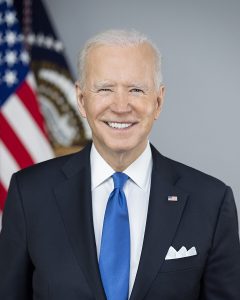
Joseph Robinette Biden Jr. was born on November 20, 1942, in Scranton, Pennsylvania, to Catherine Eugenia “Jean” Finnegan and Joseph Robinette Biden Sr., the eldest child in a Catholic family of predominantly Irish descent. After his father suffered business setbacks, his family moved to Claymont and Mayfield, Delaware, when he was ten years old. He earned a Bachelor of Arts degree from the University of Delaware in 1965 and a Juris Doctor from the Syracuse University College of Law in 1968, receiving student draft deferments during the Vietnam War era. Following brief work as a public defender and service on the New Castle County Council, Biden was elected to the United States Senate from Delaware in 1972 at age twenty-nine, becoming one of the youngest senators in American history. Weeks after his election in December 1972, tragedy struck when his first wife, Neilia, and their infant daughter, Naomi, were killed in an automobile accident, while his young sons, Beau and Hunter, survived. Biden took the oath of office at his sons’ hospital bedside and began commuting daily from Delaware to Washington. He married Jill Jacobs in 1977. During his thirty-six years in the Senate, Biden chaired the Judiciary Committee and the Foreign Relations Committee, drafting and leading passage of major legislation such as the Violent Crime Control and Law Enforcement Act of 1994 and the Violence Against Women Act. As Judiciary chairman, he oversaw contentious Supreme Court confirmation hearings for Robert Bork in 1987 and Clarence Thomas in 1991. In foreign policy, Biden opposed the 1991 Gulf War but voted in favor of the 2002 Iraq War Resolution. He mounted two unsuccessful campaigns for the Democratic presidential nomination in 1988 and 2008.
In 2008, Barack Obama selected Biden as his vice-presidential running mate, and the ticket won the general election, elevating Biden to serve two terms as the forty-seventh Vice President of the United States from 2009 to 2017. As vice president, Biden served as a key senior adviser and White House liaison to Congress, helping negotiate critical legislative packages including the American Recovery and Reinvestment Act of 2009, tax policy extensions, and debt-ceiling compromises. In May 2012, his public endorsement of same-sex marriage accelerated the administration’s official policy evolution ahead of nationwide legalization. Tragic loss struck his family again in May 2015 when his eldest son, Beau, died of brain cancer at age forty-six, a loss that heavily influenced Biden’s decision not to enter the 2016 presidential primaries. After leaving office in 2017, Biden became an honorary professor at the University of Pennsylvania, established the Penn Biden Center for Diplomacy and Global Engagement, published his memoir Promise Me, Dad, and continued public advocacy.
Biden officially launched his 2020 presidential campaign in April 2019, framing his candidacy around restoring political decency, addressing economic inequality, and defeating incumbent President Donald Trump. Selecting California Senator Kamala Harris as his running mate, Biden won the 2020 presidential election with 306 electoral votes to Trump’s 232. Following the election, President Trump and his allies made false claims of widespread voter fraud, mounted dozens of legal challenges, sought to subvert state electoral counts, and pressured Vice President Mike Pence to reject electors. These tensions culminated on January 6, 2021, when a violent mob attacked the United States Capitol to halt certification; however, Congress reconvened and officially certified Biden’s victory in the early morning hours of January 7. Biden was inaugurated as the forty-sixth president on January 20, 2021, at age seventy-eight, becoming the oldest person to assume the presidency up to that point, the second Catholic chief executive in American history, and the first president from Delaware.
Upon taking office amid a severe public health and economic crisis, Biden signed the $1.9 trillion American Rescue Plan Act of 2021 to fund pandemic relief, direct stimulus payments, and community aid. He proceeded to secure major bipartisan legislative measures, including the Infrastructure Investment and Jobs Act, the CHIPS and Science Act to boost domestic semiconductor manufacturing, and the Honoring Our PACT Act to expand healthcare for veterans exposed to toxic burn pits. In 2022, he signed the Inflation Reduction Act, allocating substantial federal investments toward renewable energy, climate initiatives, and prescription drug price caps. Biden fulfilled a major campaign promise by appointing Ketanji Brown Jackson as the first Black woman to the Supreme Court, and he signed the Respect for Marriage Act requiring federal recognition of same-sex and interracial marriages. However, despite significant job growth and low unemployment rates, his domestic tenure was heavily shadowed by a global 2021–2023 inflation surge that sharply increased living costs and consumer prices, creating widespread public economic dissatisfaction. Simultaneously, his administration faced intense political scrutiny and mounting operational challenges regarding an influx of migrants along the U.S.-Mexico border.
In foreign affairs, Biden immediately re-entered the Paris Climate Agreement and enacted the New Atlantic Charter to rebuild alliances with traditional international partners. In August 2021, he executed the complete withdrawal of American military forces from Afghanistan, ending a twenty-year conflict; however, the chaotic evacuation and the swift collapse of the Afghan government to the Taliban drew intense domestic and international criticism. When Russia launched a full-scale invasion of Ukraine in February 2022, Biden led a unified international coalition, imposing severe economic sanctions on Moscow, providing extensive military and financial assistance to Kyiv, and supporting the historic expansion of NATO to include Finland and Sweden. Following the outbreak of the Gaza war in October 2023, Biden condemned Hamas and provided strong military and diplomatic support to Israel, while simultaneously delivering humanitarian assistance to the Gaza Strip and pushing for ceasefire agreements. His administration also conducted major diplomatic negotiations, including overseeing the 2024 Ankara prisoner exchange that secured the release of detained Americans, including journalist Evan Gershkovich.
In April 2023, Biden announced his candidacy for re-election in 2024 alongside Vice President Harris. Throughout his presidency, public scrutiny persisted regarding his age and health, as he was the first sitting chief executive to turn eighty while in office. These concerns escalated dramatically following his performance in the June 27, 2024 televised presidential debate against Donald Trump. Yielding to mounting pressure from within the Democratic Party and the public, Biden officially withdrew his candidacy on July 21, 2024, endorsing Kamala Harris, who subsequently lost the general election to Donald Trump. Biden concluded his presidential term on January 20, 2025, departing as the oldest person to have served as president. While contemporary public assessments of his tenure were predominantly negative due to inflation and economic frustration, historical and political science surveys—such as the 2024 Presidential Greatness Project—ranked Biden 14th among American presidents, acknowledging his significant legislative achievements despite the lack of wartime military victories.