

By February 1861, as President-elect Abraham Lincoln prepared for his journey to Washington, D.C., the national crisis over secession had rendered the border state of Maryland a tinderbox of political hostility. The city of Baltimore, in particular, was widely known as “Mobtown” due to its bloody legacy of partisan violence, epitomized by notorious nativist Know-Nothing clubs like the Blood Tubs and the Plug Uglies. Knowing that Lincoln’s scheduled route to the capital required him to pass directly through this highly volatile environment, federal authorities and private allies grew deeply concerned about potential security threats. While the railroad executive Samuel M. Felton and the prominent detective Allan Pinkerton were quietly amassing evidence of a sabotage and assassination plot along the railway tracks, a completely independent counter-intelligence operation was unfolding in the streets of Baltimore, spearheaded by a New York detective named David S. Bookstaver.
Under the authority of Colonel Charles P. Stone, the newly appointed inspector general of the District of Columbia, Bookstaver was sent on a covert mission to snoop around Baltimore for three weeks in February 1861. His primary objective was to gather intelligence on imminent dangers of violence or conspiracies to assassinate the president-elect during his transit. Moving through the city’s crowded taverns, public squares, and meeting halls, Bookstaver successfully infiltrated local secessionist networks and witnessed a alarming surge of hostility. On the morning of February 21, just as Lincoln was departing New York, Bookstaver communicated his urgent findings to Colonel Stone, warning that there was “serious danger of violence to and the assassination of Mr. Lincoln” if the exact schedule of his passage through Baltimore became public.
Bookstaver’s intelligence exposed a highly dangerous subterranean network of “banded rowdies” holding secret meetings to coordinate a violent reception. The detective documented explicit threats of mobbing and physical assault, reporting that he had personally overheard reckless men boast that if Lincoln were to be assassinated, “they would like to be the men” to commit the deed. While Bookstaver had initially doubted the existence of an organized threat during his first two weeks in the city, the rapid escalation of pre-operational planning in the final days of his mission forced him to conclude that the danger was both imminent and severe. Crucially, the detective warned that local Baltimore municipal authorities and police were entirely incapable of—or perhaps unwilling to—guard against the threat.
This assessment of local law enforcement was quickly corroborated by other independent intelligence streams. Captain George W. Hazzard, a member of Lincoln’s military escort who had spent years in Baltimore, warned the president-elect that Police Chief George P. Kane lacked personal integrity, supported secession, and could not be trusted to control the city’s violent partisan gangs. Pinkerton’s operatives had reached the same conclusion, gathering evidence that conspirators planned to assassinate Lincoln while he changed trains. Because the train depots of the Philadelphia, Wilmington, and Baltimore line and the Baltimore and Ohio Railroad were situated over a mile apart, secessionists intended to stage a localized disturbance to draw off the police force, allowing a hostile mob to surround Lincoln’s carriage and execute him in the ensuing chaos.
Faced with this mounting mountain of evidence, Bookstaver proposed a tactical countermeasure: rather than attempting to force a path through an armed and hostile city, the president-elect should quietly alter his travel arrangements to slip through Baltimore surreptitiously on a night train without any prior notice. This proposal was identical to the strategy advocated by Allan Pinkerton and William Henry Seward, who had dispatched his son, Frederick Seward, to Philadelphia to warn Lincoln of General Winfield Scott’s extreme alarm. Although Lincoln initially resisted the advice—fearing the public ridicule and charges of cowardice that would inevitably follow a surreptitious arrival—the striking agreement between Bookstaver’s findings and Pinkerton’s proofs ultimately convinced him to run no unnecessary risks. On the night of February 22, Lincoln secretly boarded a late-night sleeping car, successfully passing through Baltimore in the dead of night to arrive safely in Washington.
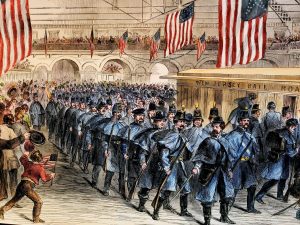
The wisdom of this sudden itinerary change was vindicated almost immediately. On February 24, Police Chief Kane retroactively confirmed the severity of the danger, admitting that a violent, uncontrollable riot would have erupted between rival political factions had the president-elect crossed the city as originally scheduled, during which Lincoln would have been “grossly insulted and probably killed”. Subsequent events in April 1861—when secessionist mobs in Baltimore rioted, burned railroad bridges, and attacked Union troops passing through the city—fully validated Bookstaver’s early, urgent warnings. David S. Bookstaver’s three weeks of snooping in Mobtown proved to be a vital link in the intelligence chain that preserved the life of Abraham Lincoln on the eve of the Civil War, illustrating the critical role that clandestine surveillance and proactive threat monitoring played in navigating the fractured, dangerous politics of the secession winter.