

The Looming Shadow of Stagflation and the Dollar Gold Drain
As the United States entered the 1970s, the postwar economic consensus that had underpinned three decades of unprecedented prosperity began to violently unravel. Under the Bretton Woods system established in 1944, the international monetary order relied on a fixed-exchange-rate system where the U.S. dollar served as the global reserve currency, pegged to gold at a set rate of $35 per ounce. While this framework had successfully anchored global trade, by 1970, the fiscal strain of funding the Vietnam War and the social programs of the Great Society had caused the American economy to overheat. To cool the economy, policymakers conventionally would have raised taxes, but political resistance delayed effective fiscal action.
This monetary expansion fueled a stubborn and unprecedented phenomenon that defied traditional Keynesian economics: stagflation, characterized by the simultaneous rise of both inflation and unemployment. Under the classic “Phillips curve” model utilized by the Federal Reserve and the Council of Economic Advisers, inflation and unemployment were supposed to be mutually exclusive; curing one was supposed to cause the other, but they were not supposed to coexist. Yet by 1970, inflation had climbed to 5.5 percent, and unemployment was rising alongside it, leaving policymakers in a state of analytical paralysis.
This domestic imbalance rapidly translated into an international crisis of confidence. Because of U.S. inflation and expansive monetary policies, American goods became less competitive overseas, dragging the nation’s trade balance into a steady decline. Concurrently, low domestic interest rates prompted a massive capital flight as investors shifted their assets to European markets where they could earn higher returns. The resulting balance-of-payments deficit meant that the volume of dollar liabilities held by foreign central banks far outstripped the physical U.S. gold stock. By 1970, liquid liabilities to foreigners were four times as large as the available U.S. gold reserves, creating a precarious situation where any sudden run on gold by foreign governments could completely exhaust the nation’s supply.
The May 1971 Currency Crisis and the Loss of Competitiveness
The fragile international monetary architecture reached a definitive breaking point in the spring of 1971. On May 3, 1971, a group of prominent West German economists publicly called for a revaluation of the West German mark—an action permitted under Bretton Woods to correct West Germany’s massive trade surplus. However, this announcement triggered a massive wave of speculative capital flight. Fearing an overvalued dollar and seeking to hedge against potential parity changes, corporate treasurers and speculative investors aggressively dumped dollars in favor of European currencies.
The German Bundesbank was flooded with dollars, forcing the West German government to abandon the fixed-rate system and allow the mark to float, while Switzerland and Austria revalued their currencies. Charles Coombs, the chief of foreign trading at the Federal Reserve Bank of New York, warned that global traders sensed a complete and irreversible breakdown in policy coordination between the United States and its partners.
This monetary instability was exacerbated by a devastating psychological blow to the American public and the markets: in the summer of 1971, the government reported that the U.S. merchandise trade balance had slipped into a deficit of $600 million. This marked the first U.S. trade deficit since 1893, offering stark, quantitative proof that the nation’s industrial supremacy had eroded in the face of rising competition from a rebuilt Western Europe and Japan.
With the dollar visibly overvalued and the balance of payments hemorrhaging, foreign central banks accelerated their demands to convert their dollar holdings into gold. During a single week in August, over $4 billion in speculative capital fled the United States, pushing the Treasury to the absolute brink of a market panic.
The Camp David Conclave: Unilateralism and the Nationalists’ Triumph
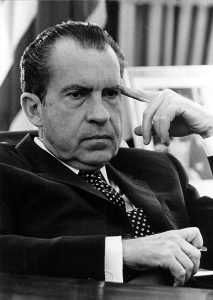
Recognizing that a systemic collapse was imminent, President Richard Nixon secretly convened his fifteen principal economic and national security advisers at the presidential retreat at Camp David on the afternoon of Friday, August 13, 1971. The atmosphere was highly charged and characterized by deep philosophical divisions within the administration.
- The Nationalists: Led by the formidable and politically astute Treasury Secretary John Connally, this faction championed a bold, aggressive “America First” strategy. Connally argued that the United States should stop trying to maintain the international system at its own expense and force its allies to share the burdens of global defense and trade.
- The Internationalists and Free-Marketeers: Advisers like OMB Director George Shultz favored transitioning to a system of floating exchange rates to let market forces determine currency values. Meanwhile, Federal Reserve Chairman Arthur Burns fiercely opposed unilateral action, arguing that severing the link between the dollar and gold would shatter American credibility, disrupt world trade, and hand a major psychological victory to America’s Cold War adversaries.
Connally’s preference for the “big play” ultimately won over the president, who was deeply preoccupied with his impending 1972 reelection campaign and wished to avoid any drag from high unemployment or a weak economy.
Over the course of the weekend, the team hammered out a sweeping package of radical measures designed to wage total war on all economic fronts. The primary pillars of this new strategy, which came to be known as the “Nixon Shock,” included:
- Suspending Gold Convertibility: The immediate closing of the “gold window,” ending the U.S. commitment to redeem paper dollars held by foreign central banks for physical gold.
- Wage and Price Freeze: A mandatory, ninety-day domestic freeze on all wages and prices across the United States to suppress inflationary expectations.
- Import Surcharge: The imposition of a temporary 10 percent surcharge on all imported goods to serve as a powerful bargaining lever to force foreign nations to revalue their currencies.
- Tax Initiatives: Reinstating the investment tax credit and eliminating the excise tax on domestically produced automobiles to stimulate immediate consumer spending.
Burns strenuously objected to the wage-price freeze and argued that excluding interest rates and dividends from the program would invite severe backlash from labor unions. To resolve this, Nixon appointed Burns as the chairman of a new Committee on Interest and Dividends, a role that career central bankers later warned created a flagrant conflict of interest, making the Fed highly reluctant to raise interest rates in 1972 out of fear of politically alienating the public.
“The Challenge of Peace”: Nixon’s Address to the Nation
On Sunday evening, August 15, 1971, Nixon delivered a highly choreographed, televised address from the Oval Office outlining his New Economic Policy, titled “The Challenge of Peace”. Leveraging his administration’s progress in winding down the Vietnam War, Nixon framed the economic package as a moral transition from the “artificial prosperity” of wartime spending to a stable, peacetime expansion.
To make the complex international currency issues digestible to the average citizen, Nixon utilized highly populist and nationalist rhetoric. He cast the crisis not as a failure of American policy, but as an external assault orchestrated by “international money speculators” who thrived on instability.
He assured the public that closing the gold window would protect the dollar’s integrity, famously declaring that for the overwhelming majority of Americans who bought American-made products, their dollar would be worth just as much tomorrow as it was today.
The immediate domestic reaction was characterized by widespread euphoria. On Monday, August 16, the stock market surged by 32 points, and public opinion polls indicated overwhelming support for the president’s decisive leadership.
In stark contrast, the unilateral announcement provoked deep anger, shock, and a sense of betrayal among America’s leading allies, particularly Japan. Japanese officials, who had loyally supported the dollar at great cost to their own reserves under the assumption that the U.S. would stand by the gold link, dubbed the event the “Nixon Shock”.
Western European finance ministers accused the United States of exporting its inflation and using its geopolitical leverage to force others to bear the costs of its domestic mismanagement.
The Road to Floating Rates and the Great Inflation
The decisions of August 15, 1971, permanently broke the backbone of the postwar financial system. In December 1971, the major economic powers convened at the Smithsonian Institution in Washington, D.C., to negotiate a temporary currency realignment.
The resulting Smithsonian Agreement devalued the dollar by 8.57 percent against gold and widened exchange-rate bands, a move Nixon grandly celebrated as the “most significant monetary agreement in the history of the world”. However, because the United States adamantly refused to restore gold convertibility, the agreement lacked any structural discipline and was widely viewed by traders as a fragile, short-term patch.
By early 1973, renewed speculative attacks and divergent economic fundamentals forced the complete abandonment of fixed parities. In March 1973, a new international monetary system informally took shape as Western European nations and Japan permanently allowed their currencies to float jointly against the dollar.
This marked the dawn of the modern era of unbacked, fiat currencies. While floating exchange rates granted governments greater freedom of domestic action, they also removed the external, gold-backed discipline that had historically constrained monetary expansion.
Ultimately, the 1971 crisis and the policy responses it triggered ushered in the “Great Inflation” that plagued the United States and the wider Western world throughout the remainder of the decade. The mandatory wage and price controls proved to be a catastrophic failure. While they temporarily masked inflation during the 1972 election year, they created severe structural distortions, supply shortages, and a massive, intrusive federal bureaucracy.
When the controls were finally phased out in 1974, repressed prices were unleashed, and inflation quickly soared into double digits. Combined with the massive OPEC oil shocks of 1973 and 1979, the systemic loss of monetary discipline established a permanent cycle of stagflation.
The 1971 crisis demonstrated that while unilateral executive action could deliver a powerful short-term political coup, tampering with orthodox economic mechanisms carried an incredibly high, long-term price that the global economy would spend more than a decade paying off.