

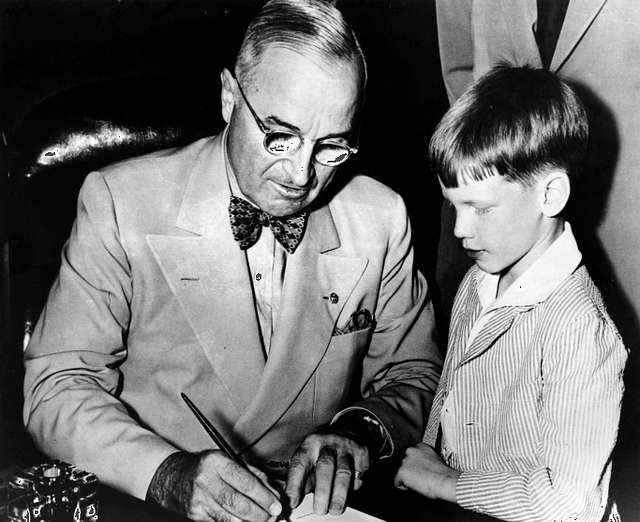
We will now discuss the pivotal moment of March 12, 1947, when President Harry S. Truman addressed a joint session of Congress, laying down the groundwork for the containment policy and requesting aid for Greece and Turkey. This was a defining moment, setting the course for American foreign policy in the nascent Cold War, and the sources provide rich detail on the context, motivations, and immediate impacts of this speech.
To truly grasp the significance of this address, we must first understand the complex landscape President Truman navigated in the years leading up to it. Taking office after the death of Franklin D. Roosevelt in April 1945, Truman found himself largely unprepared for the immense international challenges ahead, confessing to a friend that his foreign policy knowledge primarily stemmed from newspapers. He described feeling “like the moon, the stars, and all the planets had fallen on me”. Truman had only met with Roosevelt once or twice during his short vice presidency, and FDR had not kept him informed on critical international issues. This vacuum of experience meant Truman largely relied on Roosevelt’s advisors, many of whom, like Ambassador Averell Harriman, Chief of Staff William Leahy, and Secretary of the Navy James Forrestal, advocated a firm stance against the Soviet Union, fostering Truman’s own anti-Communist leanings.
Early actions under Truman foreshadowed the Cold War. His immediate decision to halt Lend-Lease aid to the Soviet Union in May 1945, just after Germany’s collapse, was seen by Stalin as diplomatic pressure and a “fundamental mistake,” deepening distrust. Furthermore, Truman’s decisive order to use the atomic bomb on Japan, while aimed at ending the war quickly and saving American lives, was also perceived by Stalin as an intimidation tactic, which Ambassador Harriman noted “must have revived their old feeling of insecurity,” leading the Soviets to accuse the U.S. of “atomic diplomacy”.
Domestically, Truman faced immense challenges that also shaped his foreign policy. The nation was grappling with the transition from a wartime to a peacetime economy, marked by fears of a return to the Great Depression despite a booming production in 1945. This period saw significant labor strikes, shortages, and rising inflation, which severely impacted Truman’s public approval, dropping him to a paltry 32 percent by mid-1946. The Democrats lost control of both houses of Congress in the November 1946 midterm elections for the first time since 1930, leaving Truman to face a “hostile Congress”. This created an imperative for the administration to foster a sense of national unity, especially around a strong foreign policy stance.
Into this volatile environment came crucial analyses of the Soviet Union. While George F. Kennan’s “Long Telegram” of February 1946 was immensely influential in Washington circles for its intellectual articulation of Soviet behavior, it was Senator Arthur Vandenberg’s speech, “What’s Russia Up to Now?”, that had a greater impact on general public thinking about the Soviets. Furthermore, the Clifford-Elsey report, completed in September 1946, presented an even “more alarming, even ominous, picture” of Soviet military power and subversion globally than Kennan’s narrative. Truman, upon reading this “hot” report, ordered it locked away, fearing its public release would jeopardize his efforts for peaceful resolution. This indicates a complex internal understanding within the administration of the Soviet threat that went beyond simple public rhetoric.
The immediate impetus for Truman’s March 1947 speech was a formal message, a “blue piece of paper,” from the British ambassador on February 21, 1947. The British, facing severe economic strain, declared they could no longer financially or militarily support Greece and Turkey, effectively handing “the job of world leadership” to the United States. Clayton, who had seen the end of the Lend-Lease loan to Britain, summarized the situation, stating that “the reins of world leadership” were “fast slipping from Britain’s competent but very weak hands,” leaving the U.S. or Russia to pick them up, with the latter foreseeing war.
President Truman, now relying on a more cohesive foreign policy team including Secretary of State George Marshall and Under Secretary Dean Acheson, moved quickly. Acheson, Marshall, and others worked tirelessly over the weekend of February 22-23 to assess the British note and outline the aid needs for Greece and Turkey. General George Marshall’s appointment as Secretary of State in January 1947 was crucial; Truman viewed him as a “wonderful ace in the hole” due to his reputation with Congress and ability to elevate foreign policy above partisanship. Senator Vandenberg, a key Republican, also emerged as a vital partner, aiming to bridge isolationist and internationalist views within his party.
On March 12, 1947, Truman stood before a packed House chamber. In a nineteen-minute speech, he portrayed Greece as a struggling nation threatened by a “militant minority led by Communists” and Turkey as crucial for stability in the Middle East. His objective was the “creation of conditions in which we and other nations will be able to work out a way of life free from coercion”. Truman’s speech presented a stark choice between two “alternative ways of life”: one based on the “will of the majority” with “free institutions,” and the other on the “will of a minority” imposed by “terror and oppression”. He declared, “I believe that it must be the policy of the United States to support free peoples who are resisting attempted subjugation by armed minorities or by outside pressures,” primarily through “economic and financial” means. He asked for $400 million in aid, comparing this “investment in a world of peace and freedom” to the $341 billion spent on World War II.
The crafting of this speech involved intense internal debate. While Truman liked “plain speaking”, his advisors strategically honed the message. Kennan worried strong language might provoke the Soviets, while Clark Clifford felt early drafts were “too weak”. Marshall saw “too much rhetoric,” but Clayton argued the president needed to “shock” the public into accepting world leadership, acknowledging that arguments sometimes needed to be “clearer than truth” to sway Congress. Interestingly, the speech mentioned “Communists” only once and never directly named the Soviet Union. This framing, which Lippmann understood as granting “license” for intervention, was a deliberate choice to focus on the ideological struggle and secure domestic support. The Truman administration also implicitly, and sometimes explicitly, weaponized religious imagery against “materialistic atheism” of Communism, portraying the conflict as one between those who believe in God and those who have “forsaken ethical and moral beliefs”.
The speech was a resounding success. Congress gave Truman a standing ovation. The bill for aid to Greece and Turkey passed overwhelmingly. Public opinion polls showed strong support, and Truman’s approval ratings “shot up ten points”. This initiative, known as the Truman Doctrine, became a guiding principle for the Cold War, committing the U.S. to aid anti-Communists globally.
The Truman Doctrine was quickly followed by other major foreign policy initiatives, fundamentally reshaping America’s role in the world:
- The Marshall Plan (European Recovery Program): Recognizing that “bad economic times can breed radicalism”, and that existing international agencies had failed, the U.S. moved to shore up European economies. The Marshall Plan, proposed by Secretary of State George Marshall in June 1947 and signed into law in April 1948, provided $16 billion in economic aid to Western Europe over four years. This was seen as a way to build markets for American exports and, politically, to counter strong Communist parties in Italy and France. It demonstrated “U.S. aid as a lever both to win economic reforms and to thwart communist imperialism”. Vandenberg played a crucial role in securing bipartisan support for the plan, ensuring its passage in Congress by emphasizing self-help and the survival of independent European nations. The Soviet Union rejected the aid, forcing Eastern European nations to do the same, and their strong reaction, including a coup in Czechoslovakia, spurred Congress to pass the ERP.
- The Berlin Blockade and Airlift (1948-1949): Stalin reacted to Western efforts to consolidate their occupation zones in Germany by blocking all surface routes to West Berlin in June 1948, effectively holding the city “hostage”. Truman, refusing to concede, ordered the Berlin Airlift, a massive operation that supplied West Berlin by air for nearly a year. This decisive action, supported by a belief that the nuclear threat would deter Soviet interference, became the “first major confrontation of the Cold War” and was largely seen by the world as the U.S. on “the right side of history”. The Soviets lifted the blockade in May 1949 after the West German basic law was approved and the NATO treaty was settled.
- The North Atlantic Treaty Organization (NATO) (1949): The logical next step after the Marshall Plan was a transatlantic security alliance to provide assurance against a renewed German threat and to counter hostile Soviet responses. Signed on April 4, 1949, NATO created a collective defense system, a profound “entangling” treaty for the U.S.. Vandenberg again played a critical role, ensuring broad Republican support for this alliance.
- The “Red Scare” and McCarthyism: The climate of fear surrounding Communism, fueled by the administration’s rhetoric, also intensified domestic anti-Communist measures. Truman himself initiated a loyalty program for federal employees in March 1947, leading to extensive investigations and dismissals, contributing to a “climate of fear—a hysteria about Communism” that allowed for steep military budget escalations. Senator Joseph McCarthy would later capitalize on this existing anti-Communist mood.
The period after 1946 saw a fundamental reorientation of U.S. foreign policy and the economy. The “permanent war economy” became a reality, with military spending significantly escalating from $12 billion in 1950 to $40 billion by 1955 and $80 billion by 1970, with major corporations profiting immensely from defense contracts. The “US project,” as some historians term the Cold War, was thus launched, justifying a global American engagement that would define its role for decades.
In essence, Truman’s March 12, 1947, speech was far more than a request for aid; it was a carefully constructed, ideologically charged declaration that provided a coherent framework for understanding the post-war world. It successfully garnered public and congressional support for an assertive, interventionist American foreign policy rooted in containment, profoundly shaping the trajectory of the Cold War and America’s global posture.