

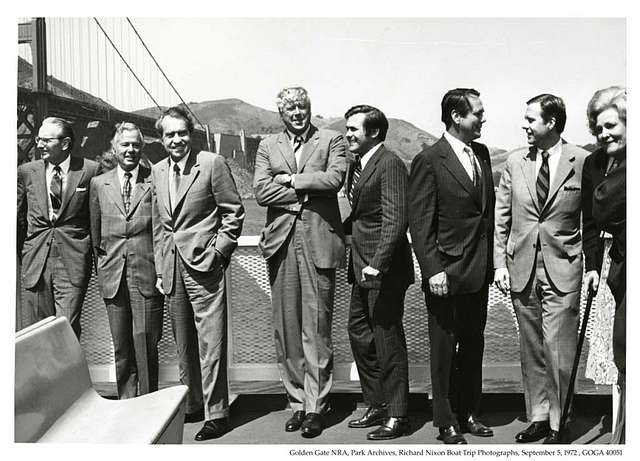
The year 1968 was, without a doubt, a tumultuous and profoundly transformative period in American history, characterized by deep societal divisions and a burgeoning sense of crisis. It marked a critical juncture in the nation’s political landscape with the U.S. Presidential Election, bringing Richard Nixon to power, and simultaneously saw the publication of a seminal environmental essay, “The Tragedy of the Commons,” by Garrett Hardin. These seemingly disparate events both illuminate the complex challenges and shifting paradigms of the late 1960s.
1968 U.S. Election: Richard Nixon and Spiro Agnew Ascend
The 1968 election unfolded against a backdrop of national turmoil, with the Vietnam War escalating and deeply dividing the country, urban riots, and violent student activism gripping cities and campuses. President Lyndon B. Johnson, burdened by the war and facing declining public approval, chose not to seek re-nomination. The Democratic Party, in particular, was severely fractured. The assassinations of Martin Luther King Jr. in April and Robert F. Kennedy in June, the latter just hours after winning the California primary, brought immense heartbreak and despair, further destabilizing the political climate.
The Democratic convention in Chicago that year became a highly disruptive spectacle, broadcast on television for all to see. Party insiders, backed by traditional organizations and union bosses, managed to nominate Vice President Hubert Humphrey, despite his unpopularity among anti-war delegates due to his association with Johnson’s Vietnam policies and the fact that he hadn’t run in a single primary. This “party-insider presidential selection system” was mortally wounded by the events in Chicago, particularly the “Battle of Michigan Avenue” where blue-helmeted police clashed violently with protesters, leading to bloodied individuals seeking refuge in hotels and even delegates being dragged from the convention floor on live television.
Against this backdrop of Democratic disarray, Richard Nixon, the Republican candidate, capitalized on the national mood. Having lost the presidential race in 1960 to John F. Kennedy and the California gubernatorial election in 1962, Nixon had painstakingly rebuilt his political career by stumping for various GOP candidates, including Barry Goldwater in 1964. He famously declared after his 1962 loss, “you won’t have Nixon to kick around anymore,” only to make a remarkable comeback.
Nixon successfully identified a strong desire for “order” among white voters across the nation. His campaign strategically focused on a “law and order” platform, using urban unrest to shift the conversation from social justice issues, despite the fact that incarceration rates had actually been declining in the 1960s. He promised an “honorable peace” in Vietnam, though his actual strategy was secretive and involved influencing South Vietnamese President Nguyen Van Thieu to avoid peace talks, promising a better deal under his presidency. Nixon also implemented a “southern strategy,” attracting white southerners and some northern urban ethnic voters who were alienated by Democratic civil rights programs and the radical left, building on a demographic shift that had begun with the Dixiecrat schism in 1948 and Goldwater’s 1964 campaign. This helped him forge a new conservative coalition that would significantly reshape the Republican Party.
In the popular vote, Nixon’s victory over Humphrey was narrow (43.4% to 42.7%), but he secured a commanding win in the Electoral College (302 to 191). George Wallace, running as an Independent, captured 13.4% of the popular vote and won five states in the Deep South, further fragmenting the electorate and demonstrating the conservative shift that was underway.
Upon his inauguration in 1969, Nixon inherited a nation grappling with multifaceted crises: a stalemate in Vietnam, a severe economic downturn, and challenges to American leadership not only from adversaries but also from key allies like Germany, Japan, and France, while the Soviet Union had achieved nuclear parity. He also faced a Congress controlled by the opposition. His administration, along with Henry Kissinger, would embark on a strategy of “realpolitik,” emphasizing national interest over ideology, leading to initiatives like détente, withdrawal from Vietnam, and the opening of relations with China. While he would later increase penalties for federal crimes and establish the Office for Drug Abuse and Law Enforcement, his initial shift toward building prisons at unprecedented rates was a direct response to his “law-and-order” mandate despite the prior trend of decarceration.
1968: Garrett Hardin Publishes “The Tragedy of the Commons”
In the same year that political and social systems appeared to be unraveling, Garrett Hardin published his influential essay, “The Tragedy of the Commons”. This work articulated a concept that resonated with growing environmental concerns and broader questions about collective behavior and shared resources.
Hardin’s central thesis, as explained in the sources, describes a scenario where individuals, each acting rationally in their own self-interest, ultimately deplete a shared, limited resource. He wrote, “Therein is the tragedy. Each man is locked into a system that compels him to increase his herd without limit—in a world that is limited. Ruin is the destination toward which all men rush, each pursuing his own best interest in a society that believes in the freedom of the commons. Freedom in a commons brings ruin to all”. This concept provided a powerful framework for understanding ecological degradation and resource depletion driven by individual, uncoordinated actions.
The publication of this essay occurred amidst a rising awareness of environmental issues. The first Earth Day was proclaimed on April 22, 1970, at a “Summit” meeting in Rio de Janeiro, where a widely circulated publication called the Environmental Handbook highlighted “four interconnected threats to the planet—wars of mass destruction, overpopulation, pollution, and the depletion of resources”. Richard A. Falk, a member of the Council on Foreign Relations, stated in the Handbook that “The basis of all four problems is the inadequacy of the sovereign states to manage the affairs of mankind in the twentieth century,” even questioning if “nation-states [are] actually feasible” given their power to destroy each other. This intellectual climate, fueled by concerns about planetary limits and the inadequacy of existing governance structures, provided fertile ground for Hardin’s concept.
“The Tragedy of the Commons” thus offered a theoretical underpinning to the nascent environmental movement and a critical lens through which to view not just natural resources but potentially any shared good vulnerable to overuse. This intellectual contribution, alongside the dramatic political shifts of the Nixon era, speaks to a broader societal reevaluation of traditional assumptions about progress, freedom, and the balance between individual interest and collective well-being that characterized the late 1960s and beyond.