

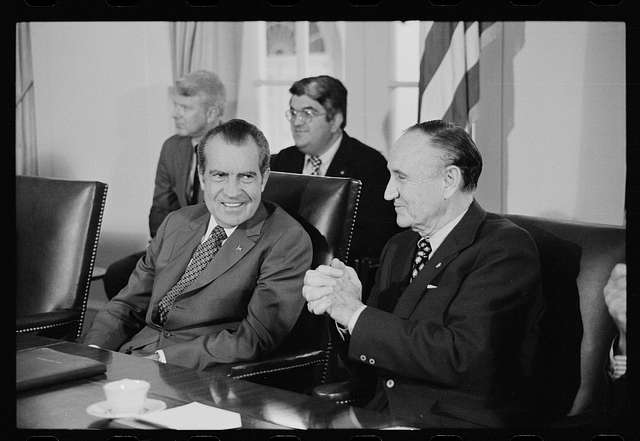
The year 1969, following directly on the heels of the deeply turbulent 1968, proved to be another pivotal period, laying groundwork for profound shifts in global economics and international relations. As President Richard Nixon settled into office, his administration began to grapple with inherited challenges, notably the precarious state of the U.S. dollar, while geopolitical realities were dramatically altering, exemplified by open military conflict between the Soviet Union and China.
June 1969: Paul Volcker Presents Broad Options for Saving the Dollar to Nixon
When Richard Nixon took office in January 1969, he inherited a nation struggling with economic strain, including significant inflation and a weakening U.S. dollar. The post-World War II Bretton Woods system, which had established fixed exchange rates and relied on the dollar’s convertibility to gold at $35 an ounce, was showing severe cracks. The world had shifted from a “dollar shortage” immediately after the war to a “dollar glut” by the end of the 1950s, with too many dollars circulating abroad. This situation was compounded by persistent U.S. payments deficits.
Despite the gravity of these economic issues, Nixon himself was “not comfortable with international economic policy” and explicitly stated he did not want to be “bothered with international monetary matters,” preferring to prioritize “arms control negotiations with the Soviets, future openings to China, and other big, traditional foreign policy initiatives”. His initial Treasury Secretary, David Kennedy, a moderate Republican, was seen as a less dominant figure who was “happy to cede the limelight to Volcker on international monetary policy”.
Enter Paul Volcker, then Undersecretary for Monetary Affairs. Despite being a Democrat and not an initial supporter of Nixon, Volcker saw the urgent need for a new dollar policy, driven by his conviction that “price stability belongs to the social contract” and that international trust in the dollar, anchored by its gold equivalency, was paramount. He had previously viewed a dollar devaluation as “anathema” and believed the $35 gold price was “sacred”.
In January 1969, National Security Advisor Henry Kissinger, despite his own discomfort with international economics, initiated a permanent working group on international monetary policy, to be chaired by Volcker. Though Volcker initially bristled at reporting to the National Security Council, he ultimately forged ahead. From February to June 1969, his group meticulously crafted a 48-page document titled “Basic Options in International Monetary Affairs”.
This comprehensive report, presented to President Nixon and his top economic and foreign policy advisors in the White House Cabinet Room in June 1969, painted an alarming picture: “The international monetary system is under great strain. There have been repeated currency crises in the past decade that have undermined confidence in it, and more crises could be under way”. The core dilemma, as Volcker articulated, was how to compel Western Europe and Japan to “more equitably” share the burden of managing international monetary arrangements without rupturing critical political alliances or triggering a financial meltdown.
Volcker’s presentation aimed to offer “broad options” for reform. However, Nixon’s response was notably “short and noncommittal,” a mere “Good job, and keep me posted”. Volcker famously characterized this as “policy by default”. This initial interaction underscored Nixon’s preference to delegate economic details while reserving his attention for what he perceived as the “big” foreign policy plays. Nevertheless, this report marked a significant intellectual step away from the previous administration’s “short-term crisis management” toward a more deliberate, long-term strategic approach to international finance for the Nixon era.
1969: The Soviet Union Openly Clashes with China Militarily
While Volcker was grappling with the dollar, a dramatic shift was occurring in the global balance of power, specifically within the Communist bloc. The relationship between the Soviet Union and China, once ideologically aligned, had been deteriorating since the mid-1960s. Despite outward expressions of Communist solidarity, deep-seated differences in ideology and national interests led to increasing friction. Mao Zedong’s ambition to export his unique brand of communism clashed with Moscow’s authority, and these tensions erupted into military skirmishes along their shared border in eastern Siberia by the mid-1960s, intensifying into open clashes in 1969.
This overt military confrontation between the two Communist giants presented a unique opportunity for newly inaugurated President Richard Nixon and his National Security Advisor, Henry Kissinger. Nixon, a staunch anti-Communist, had shrewdly speculated as early as 1968 about the possibility of “playing Russia and China off against each other”. He recognized that these two powers, far from being unified, were “deeply wary of one another”.
Nixon’s grand strategy, often termed “realpolitik,” aimed to transcend the “sterile and dangerous bipolar Cold War” by integrating China into the global power dynamic. This approach prioritized national interest over ideological purity. Kissinger acknowledged that these 1969 Soviet-Chinese military clashes were a crucial factor, creating a “shift in thinking in Beijing and the opportunity to pursue Nixon’s bold approach”. The “triangular diplomacy” envisioned by Nixon and Kissinger sought to leverage these tensions to gain critical advantage, particularly in extricating the U.S. from the Vietnam War “with honor”.
In line with this strategic shift, Nixon unofficially launched the “Nixon Doctrine” in July 1969, emphasizing that the U.S. would no longer shoulder the primary burden of defending all of the “free world” and would provide financial and technical support, but not troops, unless a country was attacked by a foreign power or had a defense treaty with the U.S. This doctrine would form a cornerstone of his administration’s foreign policy, further detailed in his “State of the World” reports, the first of which was issued in February 1970. The military clashes between the Soviet Union and China in 1969 thus served as a stark demonstration of a fracturing global landscape, validating Nixon’s radical gamble to fundamentally reshape American foreign policy and pursue a new era of “permanent peace” through strategic maneuverings among rival great powers.
In conclusion, 1969 stands as a testament to shifting realities. Domestically, economic pressures were mounting, forcing Nixon’s administration to confront the limitations of the existing monetary system, even if the President himself initially preferred to defer on such matters. Simultaneously, the open military confrontation between the Soviet Union and China underscored a geopolitical reordering, providing Nixon and Kissinger the impetus and opportunity to launch their ambitious “realpolitik” foreign policy, which sought to transform a bipolar world into a multipolar one through strategic engagement and leveraging rivalries. The year marked a decisive move toward a new era where economic and geopolitical strategies became increasingly intertwined, with the U.S. seeking to redefine its global responsibilities and manage shifting power dynamics.