

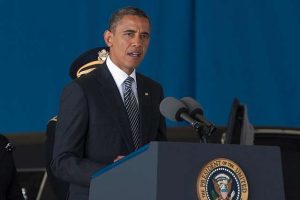
Indeed, let us shed light on the significant event of 2011, when President Barack Obama authorized air strikes in Libya, an action notably underpinned by the Justice Department’s articulation of specific national interests at stake. This episode, as the sources reveal, reflects the complex evolution of U.S. foreign policy in the post-9/11 era, balancing a desire for retrenchment with the perceived necessity of intervention.
The directive for military action in Libya in 2011 was accompanied by a legal justification from the Justice Department’s Office of Legal Counsel (OLC), which identified three key national interests: “promoting regional stability,” “preventing a humanitarian disaster,” and “deterring the use of chemical weapons”. This approach falls within a broader pattern where the executive branch, through OLC opinions, asserts the President’s authority to initiate military force abroad even without a formal congressional declaration of war. These OLC opinions, while not possessing the force of law, play a critical role in shaping presidential war powers. The OLC’s framework suggests that the President, as Commander-in-Chief, may lawfully use military force when it serves an “important national interest” and “does not rise to the level of war in the constitutional sense,” distinguishing between a “perfect war” (formally declared) and an “imperfect war” or “limited engagement”. Critics, however, contend that this “national interest” test is overly flexible and does not effectively check presidential power.
President Obama’s decision to intervene in Libya presents an intriguing case when viewed against his broader foreign policy philosophy. The sources indicate that Obama, particularly after the long wars in Iraq and Afghanistan, aimed for a “less assertive retrenchment” and acknowledged that the United States was “overextended”. His caution and capacity for “national self-criticism were understandable”. He articulated a vision where “9/11 is not a way to scare up votes but a challenge that should unite America and the world against the common threats of the 21st century”. Despite this general inclination, Obama was also prepared to act unilaterally when Congress became “increasingly dysfunctional,” famously declaring, “Whenever they won’t act, I will”. This willingness to use executive authority, as seen in other instances during his presidency, was a response to “rising partisan intolerance” and an “erosion of institutional forbearance”.
Historically, U.S. administrations have navigated the complex interplay between foreign threats, domestic politics, and the scope of executive power. The “war on terror” declared by President George W. Bush after September 11, 2001, marked a significant shift towards a global, open-ended conflict, moving beyond previous, more localized responses to terrorism. Prior to 9/11, law enforcement agencies like the FBI were primarily responsible for countering terrorism, operating under specific statutory authorizations and focusing on solving crimes after they occurred or identifying specific individuals. However, the 1990s saw a growing recognition of terrorism as a national security problem, not just a law enforcement issue.
President Bill Clinton, for instance, in response to the 1998 embassy bombings in Kenya and Tanzania, authorized cruise missile strikes against al-Qaeda targets in Afghanistan and Sudan. Clinton’s administration, while emphasizing law enforcement and international law, also pursued covert actions and considered lethal force against Osama bin Laden, albeit with legal ambiguities and internal debates. This reflected a “divided policy” within his national security cabinet, oscillating between treating terrorism as a “law enforcement matter demanding a judicial response or a military matter in which the use of armed force was justified”. Clinton’s actions set a precedent for using military force as a “firm and commensurate response” to deter violence and affirm sovereignty.
The post-Cold War era also saw a continuous search for a new “grand strategy” for American foreign policy, with concepts like “democratic enlargement” and “global war on terror” emerging. Despite a general sentiment of avoiding extensive foreign entanglements, particularly after Vietnam, military interventions continued, often justified by notions of “deterrence” or “limited retaliation”. The judicial branch, meanwhile, has largely deferred to the executive on matters of national security, recognizing a “political-question doctrine” that seeks to avoid “embarrassment from multifarious pronouncements by various departments on one question”. This deference grants presidents considerable latitude in defining and responding to perceived security crises.
In the case of Libya in 2011, Obama’s administration, facing immediate concerns about humanitarian catastrophe and regional instability, utilized this expansive view of presidential power. The Justice Department’s three national interests—regional stability, humanitarian concerns, and chemical weapons deterrence—provided the legal and policy rationale for the air strikes. This approach, while distinct from a full-scale “war” in the constitutional sense, nonetheless demonstrates the ongoing tendency for presidents to act decisively in perceived crises, using military force within the flexible interpretations of executive authority, and drawing on a legacy of interventions that have continuously shaped America’s role on the global stage.