

The year 2016 marked a watershed moment in American politics, characterized by significant shifts in political norms, a contentious presidential election, and deeply rooted ideological battles. The events of this year, particularly surrounding the Supreme Court vacancy and the rhetoric of Donald Trump’s campaign, offer a profound insight into the unraveling of traditional democratic guardrails and the ascent of new political dynamics.
Early in February 2016, the political landscape was dramatically altered by the unexpected passing of Justice Antonin Scalia. Scalia, a prominent conservative voice on the Supreme Court, died suddenly while on a hunting trip in Texas. This created a critical vacancy on the nation’s highest court, immediately setting the stage for a major political battle.
Within a mere week of Scalia’s death, Republican Senate Majority Leader Mitch McConnell swiftly declared that the Senate would not even consider anyone nominated by then-President Barack Obama to fill the Supreme Court vacancy. This was an unprecedented move in American history. As the sources highlight, prior to this, the U.S. Senate had never refused to consider an elected president’s nominee for the Supreme Court when the nomination was made before the election of his successor. The Republicans’ stated aim was to leave the nomination to the “next president”. This decision was characterized as an “extraordinary instance of norm breaking,” effectively “stealing a Supreme Court seat”. Senator John Cornyn, a Republican, explicitly stated that the next justice “could change the ideological makeup of the Court for a generation,” underscoring the partisan strategic motivation behind McConnell’s decision. This move signaled a radical departure from historical precedent and contributed significantly to the “unraveling” of America’s democratic traditions.
Against this backdrop, Donald Trump’s presidential campaign gained momentum, fueled by rhetoric that was both polarizing and unprecedented for a major party candidate.
One of Trump’s signature slogans, “America First,” was prominently revived during his 2016 campaign. Historically, this phrase has roots in a movement that sought to prevent the United States from opposing Nazi Germany and opposed internationalism and immigration. Its re-emergence in 2016 connected to a broader narrative of an empire in decline, suggesting that the “safety valve of empire closed” after the 2008 financial crisis and the Iraq War, leading to a need for a new national focus. This slogan resonated with a public that was increasingly “exhausted—and frustrated—by the succession of twenty-first-century disappointments,” including long wars, financial collapse, and a perceived loss of control.
Trump launched his presidential campaign by controversially denouncing Mexican immigrants as “rapists”. This rhetoric, along with questioning President Obama’s birth certificate (“birtherism”), helped propel him from a “minor television star to legitimate political candidate” by attracting a “large, receptive audience”. His campaign also employed language that aimed to create “moral panic about the sexual danger refugees posed for American white girls,” utilizing false stories disseminated online.
Furthermore, a video surfaced in 2016 showing Donald Trump making “harshly demeaning comments about women”. While other Republican figures like Mitt Romney and Paul Ryan denounced these remarks, their responses often framed women in “traditionally subordinate roles in families, as ‘wives and daughters'” or as “objects of ‘reverence’ rather than equal respect,” revealing an underlying patriarchal ideology typical of Republican Party policy.
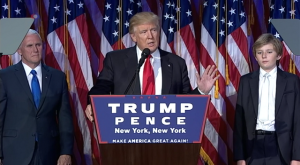
Trump’s “Make America Great Again” slogan, with its vague historical reference to a time when America was “great,” often hinted at the 1930s, an era that Steve Bannon, Trump’s chief strategist, described as “exciting” and one that “had its most sympathy for fascism”. This signaled a desire for a different kind of order, one reflecting “soft authoritarianism”.
Despite being an “outsider” with no endorsements from Republican power brokers in the “invisible primary”, Trump’s celebrity and wealth, significantly bolstered by the “dramatic increase in the availability of outside money” (accelerated by the 2010 Citizens United ruling), allowed him to bypass traditional party gatekeepers. His campaign was perceived as effective in tapping into deep populist anger at the status quo, especially among blue-collar workers who felt disconnected from the Democratic Party.
The November 2016 Election Day saw Trump’s surprise victory over Hillary Clinton, a result that was also influenced by “substantial Russian interference” through disinformation, social media campaigns, and hacking of Democratic committees. The Republican Party, despite warnings from some of its prominent members about Trump’s danger to democracy, largely failed to prevent his nomination and ascent. This collective “abdication” meant that Republican leaders, who were “virtually weaponless to halt Trump’s rise,” did not undertake the “unthinkable” act of backing Hillary Clinton, even though the future of the country was perceived to be at stake.
Ultimately, the events of 2016, from the unprecedented obstruction of a Supreme Court nomination to the divisive and norm-breaking rhetoric of a successful presidential campaign, deeply entrenched the political polarization in America. The actions taken during this year, particularly the “stealing” of a Supreme Court seat, would have lasting repercussions, setting the stage for future legal and political battles over judicial appointments and governmental authority. The election highlighted a shift where public disaffection combined with a weakening of democratic norms to bring a demagogue to power.