

The year 2017 unfolded as a stark illustration of the seismic shifts continuing to reshape the American political and social landscape, further revealing the “unraveling” of long-standing democratic norms and the intensification of ideological conflicts. From domestic events marred by racial violence and the proliferation of disinformation to significant changes in judicial appointment protocols and foreign policy, the themes of polarization, weaponized rhetoric, and the erosion of institutional guardrails became undeniably prominent.
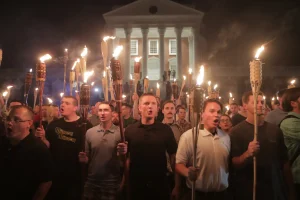
August 2017 brought a chilling and tragic manifestation of America’s deep-seated racial tensions to the forefront in Charlottesville, Virginia. During protests, a woman was tragically run over and killed by a suspected far-right sympathizer. In the aftermath, President Trump was widely criticized for his declaration that “both sides” were to blame for the violence, rather than condemning the neo-Nazis and white supremacists explicitly. This incident, where a white nationalist killed counter-protester Heather Heyer, connected directly to a historical pattern: periods of Black achievement and expanding rights have often been met with assertions of white supremacy and a rise in white nationalism. The participants in the Charlottesville “Unite the Right” rally were, as one source starkly put it, “straight out of central casting for a post-Civil War drama,” embodying a history of “white violence, terrorism and revanchism”. The event underscored the complex and contested nature of America’s national identity, particularly when white populations perceive a loss of control, leading to competing narratives about the nation’s character. The context of “pro-free-speech rhetoric” from far-right nationalists at “Trump Free Speech Rallies” further highlights the environment in which such violence could occur.
Following closely on the heels of Charlottesville, September 26, 2017, saw The New York Times publish an article by Caitlin Dickerson, which brought attention to the insidious spread of disinformation. The piece detailed false claims about Syrian refugees in Twin Falls, Idaho, alleging they had raped a young girl. These fabricated stories, propagated through online platforms and even a major internet news aggregator like the Drudge Report, created a “moral panic about the sexual danger refugees posed for American white girls”. The articles were entirely false, and it was confirmed that no Syrian refugees had even been resettled in Twin Falls. This incident served as a potent example of a broader societal “loss of logical faculties” in the face of a “barrage of propaganda,” a tactic deeply rooted in the political discourse of the era and reflective of Donald Trump’s own campaign launch which infamously denounced Mexican immigrants as “rapists”.
Later in 2017, the United States made a significant foreign policy move by recognizing Jerusalem as the capital of Israel and announcing plans to relocate its embassy there. This decision immediately “prompted anger in Arab countries,” marking a notable shift in American diplomatic stance regarding the Israeli-Palestinian conflict.
Perhaps one of the most consequential developments of 2017, deeply impacting the long-term trajectory of American governance, concerned the judiciary. Republican Senate Judiciary Committee Chairman Chuck Grassley announced that he would hold hearings for two circuit court nominees who lacked the traditional positive endorsements from their home state senators. This action effectively signaled the end of the “blue slip” courtesy, a long-standing senatorial tradition that allowed individual senators to block judicial nominees from their home states by withholding a literal “blue permission slip”. This was not an isolated event but a continuation of the deliberate “unraveling” of judicial confirmation norms. Just a year prior, in 2016, Republican Majority Leader Mitch McConnell had already made the unprecedented move of refusing to even consider President Obama’s Supreme Court nominee, Merrick Garland, after Justice Scalia’s death, explicitly stating the nomination should be left to the “next president”. The elimination of the blue slip for circuit court nominees further underscored a growing trend where judicial nominations ceased to be a bipartisan process and became “a wholly political exercise”. This strategic dismantling of procedural norms, largely driven by organizations like the Federalist Society, which has “politicized the judiciary” to align with conservative free-market values, ensures a “spectacularly effective pipeline” for conservative judges. While the Trump administration later boasted about high “well-qualified” ratings from the American Bar Association (ABA) for its judicial appointees, sources reveal that some nominees were “grossly unqualified nepo babies” and that the administration’s complaints about the ABA’s bias were “bologoney,” highlighting the extent to which judicial appointments became an arena for partisan maneuvering rather than a commitment to merit.
In sum, the events of 2017, from the Charlottesville tragedy and the dissemination of migrant-related disinformation to the fundamental changes in judicial confirmation processes and shifts in foreign policy, were not disparate incidents. Rather, they were interconnected threads in a tapestry of escalating polarization and the strategic erosion of democratic conventions. They revealed a political environment where rhetoric could be weaponized to stoke fear and division, where facts were increasingly fungible, and where institutional norms were sacrificed in pursuit of ideological and partisan advantage. The consequences of these shifts would continue to resonate, profoundly shaping the American experience in the years that followed.