

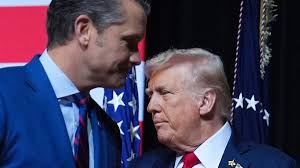
The address delivered by President Donald J. Trump yesterday, September 30, 2025, to the military leadership in Quantico, Virginia, was far more than a routine motivational speech; it was a potent ideological statement about the nature of American power, domestic politics, and the relationship between the executive and the institutions of the state. Speaking before the senior leadership of what he explicitly called the “Department of War”, the President solidified a narrative that frames governance not as democratic deliberation, but as relentless, singular combat against enemies both foreign and domestic. For citizens seeking to understand the trajectory of the republic in this tumultuous year, the speech offers critical insights, rooted deeply in the patterns of history.
The Militarization of Rhetoric and the Mythic Past
The most immediate and symbolic shift articulated in the address is the rebranding of the military establishment itself. By proudly using the term “Department of War”, the administration signals a stark commitment to an aggressive stance, aiming to “reawaken the warrior spirit”. This language connects the contemporary military leadership directly to an idealized, triumphalist American past—citing figures like Patton, Bradley, and MacArthur—who are presented as men who built and won the nation.
As historians understand, the invocation of a “mythic past” is a core strategy in fascist politics, harnessing nostalgia to ideology and hierarchy. The constant emphasis on “American might” and “American muscle” serves to reinforce a national exceptionalism which assumes that America, by its nature, is impervious to decline or internal critique. This rhetoric is deployed to justify present actions, regardless of their controversial nature. When the President links the military’s current mission to historical conflicts ranging from the “cavalry that tamed the Great Plains” to the “jungles of Vietnam” and the “dusty streets of Baghdad”, he is deliberately shaping the memory of the state, defining military service solely through the lens of unwavering victory and absolute might.
The Tyranny of the Negotiator: Personalizing Global Conflict
A striking element of the Quantico speech is the degree to which the President subordinates global affairs and conflict resolution to his own persona and transactional skill. He touts his success in solving wars that were previously “not solvable,” such as the conflicts involving Kosovo and Serbia, and the Congo with Rwanda (a 31-year conflict that left 10 million dead). This framing emphasizes that he personally saved millions of lives and that his expertise in “deals” surpasses all others.
This personalization of political success, where the nation is represented in the person of an authoritarian leader, echoes concerns raised by ancient philosophers like Plato, who warned that demagogues exploit popular will to install themselves as tyrants. Moreover, the President’s simultaneous complaint that he will not win the Nobel Prize—a prize he suggests will instead be given to a writer who studies “the mind of Donald Trump”—and calls this an “insult to our country” is highly revealing. It demonstrates a deep preoccupation with his historical legacy and an intent to write his own history, a trait shared by leaders like Nixon and Churchill.
Crucially, this transactional approach to foreign policy follows a trajectory set early in his second term, where his focus has been on “transactional dealmaking over the diplomacy of ongoing partnerships”. This approach has already manifested in controversial military actions, such as the strikes on Iran in June 2025, which were launched without consulting Congress, relying instead on a broad interpretation of presidential authority to protect “national interest”—a flexible test critics say fails to keep executive power in check. The implication for citizens is that decisions of war and peace are now driven by the individual will and personal political ambition of the President, rather than institutional checks or collective deliberation.
Domestic Security as War
While addressing military leadership, the President spent significant time framing domestic challenges as existential threats requiring military-level response. He thanked service members for having “bravely helped us secure the nation’s capital and make America safe for the American people”. This justification aligns with the administration’s use of federal forces against civilian protesters in Los Angeles, which officials characterized as necessary to protect federal property and halt “a form of rebellion against the authority of the government”.
The rhetoric of necessary, extreme force is chillingly direct. He warns that those who “try to poison our people, we will blow you out of existence because that’s the only language they really understand”. This level of rhetoric, referring to domestic critics as “animals and foreign enemies” and promising that “disrespect will not be tolerated”, contributes to the growing fascist tendency within the political landscape, including the threat to prosecute political rivals and silence dissent. This is not the language of governing in a democracy, but of waging an internal war.
The President also reiterated the need for core institutional changes: “We need borders. We need borders, we need an honest press, we need fair elections”. His attacks on the media, calling them “corrupt” and noting their image is “at the lowest point it’s ever been”, mirrors the anti-intellectual and unreality tactics common in authoritarian movements designed to displace truth and allow leaders to create their own realities.
The Assault on Democratic Institutions
The address briefly mentioned that one of his first executive orders upon taking office was “to restore the principle of merit”. This seemingly neutral bureaucratic phrase must be understood within the context of the intense efforts in early 2025 to increase executive authority and place the federal workforce under political control. This move reflects a “determination to concentrate executive branch power in the West Wing”, a fundamental shift that undermines the long-standing tradition of non-partisan expertise and civic institutions, creating a system where “everything but everyone can be bought or sold”.
The speech’s overall tone—a blend of triumphalism, threat, and personal grievance—is designed to make the concentration of power seem both heroic and necessary. By casting the previous administration as marked by “incompetence” and “the most embarrassing day in the history of our country”, the President creates a pretext to justify his “shock and awe campaign” of executive actions seen since his inauguration.
In the end, this address confirms that for American citizens, the challenge of 2025 is not merely ideological; it is fundamentally constitutional. The President’s rhetorical framework actively seeks to erode the pillars of democratic resistance—the media, universities, and courts—by framing legitimate criticism and protest as treasonous attacks on the nation itself. As the Founding Fathers contemplated the descent of republics into tyranny, this speech serves as a clear historical warning that the struggle to uphold the Constitution is a perpetual fight against the normalization of power exercised outside the law.