

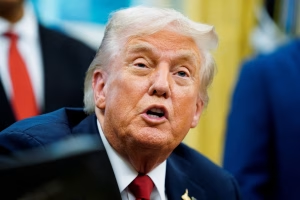
The commencement of the second Trump presidency in January 2025 marked an inflection point in American history. It was characterized by rapid, aggressive executive action aimed at fundamentally restructuring the federal government, coupled with an unprecedented concentration of power and a pronounced erosion of institutional guardrails.1 The historical significance of this period lies in the deliberate realization of a radical conservative agenda, the explicit weaponization of the justice system for political ends, and a pronounced pivot toward populist policies defined by trade conflict, mass deportations, and pervasive conflicts of interest.
I. The Systematic Dismantling of the Administrative State
The most immediate significance of the second term stems from the swift campaign to overhaul the federal bureaucracy, largely implementing blueprints developed by conservative think tanks, most notably Project 2025.
The administration prioritized the centralization of executive authority and the purging of career staff to ensure loyalty, a process that drew comparisons to historical fascist takeovers. President Trump signed a record 143 executive orders in his first 100 days, testing the limits of presidential authority. Key actions included establishing the Department of Government Efficiency (DOGE) and reviving “Schedule F” as “Schedule Policy/Career,” which classified large swaths of employees as at-will workers who could be easily fired for perceived disloyalty. The establishment of DOGE, led by Elon Musk, aimed to reduce federal spending and eliminate regulations; its internal documents were controversially classified as presidential records, blocking public access until at least 2034.
Simultaneously, the administration targeted independent agencies with deep cuts and outright dissolution, actions that courts sometimes deemed “likely unlawful.” For instance, Trump initiated mass firings across independent watchdogs, dismissing 17 inspectors general shortly after taking office. The administration also moved to terminate the EPA’s Office of Research and Development and announced plans to end the agency’s “endangerment finding,” formally cementing climate denial as the official policy of the United States government. Furthermore, Secretary of State Marco Rubio celebrated the cancellation of nearly all programs at USAID, a move estimated to cause hundreds of thousands of preventable deaths globally. These extensive changes signaled a profound shift away from the traditional model of a professional, nonpartisan civil service and decades of bipartisan consensus on global engagement.
II. Weaponization of the Justice System and Erosion of the Rule of Law
According to numerous legal experts, the administration’s most alarming feature was the systematic transformation of the Justice Department into a mechanism for political retribution. Legal professionals expressed “universal fear and anguish” over these actions, noting that the president’s abuses of power were “far worse than they imagined.”
A hallmark of this politicization was the direct targeting of political rivals. This included the indictment of former FBI Director James Comey and an order from Deputy Attorney General Emil Bove—a former Trump lawyer—compelling the Southern District of New York to drop a corruption case against Mayor Eric Adams. The latter was described as a clear quid pro quo tied to assistance with Trump’s immigration agenda.
The administration’s actions struck at the foundation of impartial justice:
- Chilling Effect on Defense: Trump’s “bullying of law firms” instilled widespread fear among legal professionals, undermining the bedrock principle that every citizen deserves proper representation.
- Abuse of Pardons: On his first day, Trump granted clemency to approximately 1,500 people convicted of offenses related to the January 6, 2021, Capitol attack, including leaders of the Proud Boys and Oath Keepers. This immediately unraveled the work of the DOJ’s largest-ever investigation.
- Judicial Enablement: The Supreme Court contributed to this atmosphere by ruling that the president is immune from criminal prosecution for most official actions, a decision critics believe “set the country up for disaster” by enabling executive overreach.
Collectively, these actions represented a profound breach of democratic norms. Observers warned that if left unchecked, the abuse of power would destroy the ethos of the Justice Department and could lead the nation toward monarchy or dictatorship.
III. Radical Domestic and Social Policy Shifts
The domestic agenda of the second term reflected a rapid acceleration of “America First” populism, particularly on immigration and social issues.
The administration engaged in intense mass detention and deportation efforts. It declared a second national emergency on the southern border, immediately shut down the CBP One app, and revived the “Remain in Mexico” policy. ICE arrests surged by nearly 200% at federal courthouses, with record numbers of people detained. Furthermore, the president ordered the expansion of the Guantanamo Migrant Operations Center to house up to 30,000 “high priority” detainees and deployed thousands of troops to U.S. cities to quell immigrant rights protests—an “unprecedented use of military force against civilians” since the Civil Rights era.
The appointment of Robert F. Kennedy Jr. as Health and Human Services Secretary signaled a fundamental departure in public health policy. Kennedy, a noted anti-vaccine activist, withdrew U.S. funding from GAVI and reconstituted the CDC’s vaccine advisory panel by firing all 17 existing members and appointing new ones known for their anti-vaccine views. In the realm of gender rights, the administration defined gender as an “immutable male-female binary,” banned transgender people from the Air Force and VA healthcare, and threatened to cut federal funding to states that refused to comply with its social policies.
IV. Economic Instability and Unprecedented Corruption
The second Trump presidency marked a historical apex in using the presidential office for personal financial gain while ushering in an era of aggressive trade protectionism.
Critics described the administration’s actions as turning up “the existing corruption in Washington… to 11.” The most explicit scandal involved President Trump launching a memecoin, with its website advertising that the top 220 coin holders would be invited to an exclusive dinner with the president. This contest, which boosted the coin’s value, was denounced by one senator as “the most brazenly corrupt thing a president has ever done.” This scheme, combined with Trump’s failure to divest from his businesses, raised grave concerns regarding federal bribery and Emoluments Clause violations.
Meanwhile, Trump fully embraced his role as a “tariff man.” New tariffs of 25% on Mexico and Canada, and 10% on China, were imposed in early 2025, triggering immediate retaliatory measures.23 He also announced new tariffs on 14 other countries and threatened 50% tariffs on nations like India and Brazil. This aggressive imposition of trade penalties was linked to a U.S. stock market crash and severely disrupted international relationships.
V. The Shift in Global Engagement
In foreign policy, the administration accelerated its isolationist “America First” stance, promoting a worldview articulated by Vice President JD Vance known as the “Trump doctrine.” This doctrine advocated for a foreign policy based on ethnicity, opposing multiethnic nations and defining the U.S. as a “white country.”
The major foreign policy shifts included:
- Unilateral Force: Trump ordered U.S. air strikes on Iranian nuclear sites in coordination with Israel. This military action proceeded without consulting Congress, with the administration relying solely on the president’s authority as commander-in-chief, testing the limits of the War Powers Resolution.
- Chaotic Policy Process: Policy regarding Ukraine was inconsistent. Secretary of Defense Pete Hegseth ordered a halt to arms shipments without informing the White House, contributing to the impression of a disorganized and chaotic process.
- Targeting International Institutions: The administration withdrew the U.S. from the Paris Agreement and the World Health Organization. Secretary of State Marco Rubio also imposed sanctions on judges at the International Criminal Court for issuing warrants against Israeli leaders.
In conclusion, the second Trump presidency describes a government determined to consolidate power, dismantle institutional checks, and pursue radical policy objectives.29 Legal experts viewed the period as an unprecedented threat to the rule of law, transforming what were once political norms into fragile relics and setting a historical precedent for the explicit fusion of executive power with personal and financial interests.