

The final week of January 2025 saw a flurry of executive actions and significant governmental shifts as President Trump continued to rapidly implement his agenda, demonstrating a clear intent to reshape federal policy and administration. This period was marked by notable directives on transparency, clemency, foreign policy, and a concentrated effort to overhaul the federal workforce.
January 23, 2025: Expanding Transparency and Clemency
On January 23, President Trump ordered the release of assassination records pertaining to John F. Kennedy, Robert F. Kennedy, and Martin Luther King Jr.. This action, consistent with a pattern of declassification that has seen previous administrations also release portions of these historically sensitive files, aimed to bring further transparency to long-standing national mysteries.
The same day, President Trump exercised his pardoning power by granting clemency to 23 anti-abortion protestors. This group included Lauren Handy and nine co-defendants, who had been convicted of violating the Freedom of Access to Clinic Entrances Act. This act of clemency fulfilled a campaign promise.
January 24, 2025: Reinstating Prior Policies and Global Shifts
On January 24, President Trump used executive power to reinstate anti-abortion pacts. This specifically involved the re-implementation of the Mexico City policy. This policy generally denies foreign aid to any agency that includes abortion in its services or even mentions the word “abortion”.
Additionally, January 24 marked the formal confirmation of the U.S. exit from the World Health Organization (WHO). This withdrawal was initially set in motion by an executive order signed on January 20, Trump’s first day in office, signaling a non-interventionist foreign policy and a reevaluation of international agreements.
January 25, 2025: Sweeping Federal Workforce Changes
A significant move on January 25 involved the firing of 17 independent inspectors general at various federal agencies, who received an email from the White House informing them of their immediate terminations. This action, described as an “illegal firing” by some officials and journalists, immediately raised concerns about executive overreach and the undermining of oversight mechanisms.
Concurrently, the Trump administration gave the “green light” to begin firing federal workers in Diversity, Equity, and Inclusion (DEI) roles. This move was part of a broader effort to dismantle DEI programs, which the administration defined as “illegal and immoral discrimination” in a day-one executive order. This meant federal agencies were directed to “purge” employees who had run or even voluntarily attended DEI programs.
January 26, 2025: Initial Poll Reactions
On January 26, CNN analyst Harry Enten commented on the initial Reuters/Ipsos poll findings from January 21, which showed President Trump starting his new term with a 47% approval rating. Enten described CNN’s reaction as “stunned,” interpreting the poll’s findings as “a sign that the American people, at least initially, like what they are seeing”. However, it is important to note that this initial approval rating was historically low for a president, matching his 2017 rating and setting a new high for inaugural disapproval. The poll also indicated that his pardons related to January 6 were unpopular.
January 28, 2025: Workforce Reorganization and Judicial Pushback
The administration continued its focus on the federal workforce on January 28, when the Office of Personnel Management (OPM) introduced a “deferred resignation” scheme. This offer allowed federal employees to resign by February 6, while still receiving their salary and benefits until September 30, 2025. This initiative was part of a larger strategy to “cut tens of thousands of civil service workers and replace them with political appointees”.
However, the administration faced immediate judicial pushback on other policy fronts. On the same day, a federal judge, United States District Judge Loren AliKhan, temporarily blocked a controversial memo from the Office of Management and Budget (OMB) that had ordered a temporary freeze on all federal funding for program review. This memo had caused widespread uncertainty and led to the shutdown of various programs, including Medicaid portals and FAFSA. The memo was subsequently withdrawn the next day.
January 29, 2025: Immigration Actions and Policy Reversal
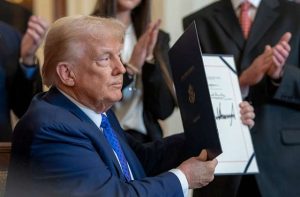
On January 29, President Trump signed the Laken Riley Act into law, marking the first piece of legislation enacted in his second term. Named after a nursing student murdered by an illegal immigrant, the law mandates that Immigration and Customs Enforcement (ICE) detain undocumented immigrants accused or charged with theft-related crimes or assaulting a police officer. It also grants states the ability to sue the Department of Homeland Security (DHS) for damages caused by undocumented immigrants or for the DHS’s failure to enforce immigration laws.
Following the signing of the Laken Riley Act, President Trump issued a presidential memorandum ordering the Pentagon and the Department of Homeland Security to begin expanding the migrant operations center at the Guantanamo Bay naval base. The goal was to house up to 30,000 “high priority” undocumented immigrant detainees, utilizing a facility previously used for temporary migrant housing during prior presidencies.
Finally, completing a busy week, the White House officially rescinded the controversial federal aid freeze memo that had been temporarily blocked by a federal judge the previous day.
Continued Workforce Turmoil
The emphasis on re-shaping the federal workforce continued to manifest directly. On January 29, USDA Inspector General Phyllis K. Fong, who had continued working despite receiving an email notice of her immediate termination the previous Friday, was escorted out of her office by security guards. This incident underscored the administration’s aggressive approach to replacing career civil servants and independent oversight officials. The objective of these changes, aligning with “Project 2025,” was to “destroy longstanding protections for career government employees” and staff the federal government with political appointees who serve at the president’s pleasure. This, in effect, marked a concerted effort to remove perceived “disloyal civil servants” and ensure that policy implementation would face no “deep state sabotage”. The broader implications suggested a move to ensure federal employees are “hired, promoted and retained based on merit not political loyalty”.
In essence, the last week of January 2025 was a concentrated display of President Trump’s commitment to swiftly enact his promised agenda, employing executive power to target specific policy areas, overhaul governmental structures, and consolidate control, often sparking immediate legal challenges and public debate.