

World War I, a cataclysmic event of the twentieth century, reshaped global dynamics, leading to profound transformations in international relations, economies, and societies. Its origins were complex, rooted in long-standing imperial rivalries, economic pressures, and a “metaphysics of war”—a societal belief that viewed conflict as a purifying force. This concept of an ingrained societal metaphysics was such that even pacifists like William James sometimes extolled war’s virtues. By 1914, US foreign investments had already reached $3.5 billion, indicating a growing economic presence on the global stage.
Europe, meanwhile, was a tinderbox of crisscrossing alliances and rising tensions, as highlighted by events like the Sino-Japanese War of 1894-95, the Russo-Japanese War of 1904-05, and the First Moroccan Crisis. Germany, with its rapidly outperforming industry, was determined to expand its global footprint. The prevailing belief in 1904 that war had been banished from civilized nations proved to be a profound misjudgment. While often cited as the immediate trigger, the assassination of Archduke Francis Ferdinand in 1914 was seen by some as hardly sufficient to plunge the world into such a conflict.
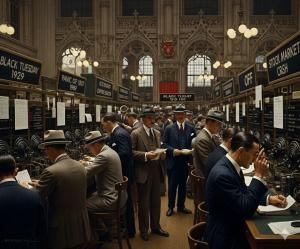
When the “guns of August” boomed in 1914, panic struck financial markets, leading to the closure of the New York Stock Exchange for six months. While European nations quickly mobilized, the United States officially maintained neutrality, upholding a long-standing diplomatic tradition dating back to Washington and Hamilton. President Woodrow Wilson famously campaigned in 1916 on the slogan “He kept us out of war”. However, economic realities were rapidly drawing the US into the conflict, even beneath this stated neutrality. War orders for the Allies stimulated the American economy, pulling it out of a 1914 recession and leading to a significant boom, creating a “fateful union of war and prosperity”. American industries, including J.P. Morgan & Co. as the Allies’ purchasing agent, reaped immense profits from military exports.
The German strategy of unrestricted submarine warfare, however, became a critical factor in drawing the US into the war. Despite Germany’s relatively small U-boat fleet, it wreaked havoc on Allied shipping, sinking over 5,700 surface ships between 1914 and 1918, leading British officials to believe they were on the brink of losing the war. Key events, such as the sinking of the British liner Lusitania on May 7, 1915, which killed 1,198 passengers, including 128 Americans, further escalated tensions. President Wilson, known for his progressive domestic reforms, was also an internationalist who envisioned a world government. He came to believe that American entry into the war was a necessary evil to achieve this ultimate good, allowing the US to dictate the terms of peace due to Europe’s financial dependence. The government worked assiduously to build consensus for war through a draft and an elaborate propaganda campaign led by George Creel, acknowledging that spontaneous public support for war was limited.
The Great War itself was a devastating display of modern industrial power turned to destruction. It was a dehumanizing conflict marked by mechanical and chemical slaughter, where trenches stretched across Europe as landscapes of stark ruin. Poison gas, introduced by German chemist Fritz Haber, killed or disabled over a million men. Battle lines remained virtually stationary for three years, resulting in immense casualties for minimal territorial gains, such as the Third Battle of Ypres which cost the British 400,000 men for only five miles. The British public was largely kept unaware of the true extent of the slaughter, with official dispatches often reporting “All Quiet on the Western Front”.
For the United States, the war effort was impressive despite initial unpreparedness; its military establishment grew from 174,000 to 2.8 million men within 19 months. However, the US still relied on its British and French allies for much of its artillery and equipment, and American-manufactured fighting planes were not put into combat. The conflict also highlighted issues of standardization, as American and British military equipment often had incompatible specifications. While the war boosted production and employment, it also led to higher prices and a reduction in workers’ purchasing power, with the poor disproportionately bearing the cost through increased taxes on goods. Seventy percent of the war’s cost was paid by inflation, orchestrated by the Federal Reserve, effectively transferring European war costs to American taxpayers.
The end of World War I brought about monumental shifts. The Treaty of Versailles, negotiated in Paris in 1919, aimed to establish a new international order, with President Wilson advocating for a League of Nations based on collective security and the equality of trade. However, the US Senate failed to ratify the Treaty of Versailles, primarily due to concerns over Article X, which required signatories to join in League-declared wars. This refusal marked a return to a “normalcy” and a reluctance to become entangled in European affairs, often accompanied by hard feelings towards Europe for its war debts.
The war left Europe in ruins, its markets broken and treasuries impoverished, leading to widespread fear and mistrust. New states emerged from the dissolved Austro-Hungarian, German, and Ottoman Empires, creating new national and ethnic rivalries. The Spanish influenza pandemic, exacerbated by wartime conditions, claimed an estimated 50-100 million lives worldwide between 1918 and 1920, a toll far exceeding the military casualties of the war. The post-war period saw a rise in ideological chaos, with communism taking root in Russia and nascent fascism emerging in various European countries, ultimately leading to dictatorships in many nations within a decade.
In the United States, the war transformed it into an economic and military superpower, no longer dependent on European investors. However, the post-war period also brought social unrest, bitter strikes, and the “Red Scare” in 1919. The “stab in the back” legend, claiming Germany was sold out by pacifists and socialists, fostered pervasive violations of the peace treaty. While the war temporarily pacified unemployment and economic distress, it exemplified an “old lesson learned by governments: that war solves problems of control”. The war is widely understood as a principal root of the Great Depression, which would follow. The disappointment with the outcomes of World War I contributed to American resistance to involvement in a second global conflict that loomed on the horizon.