
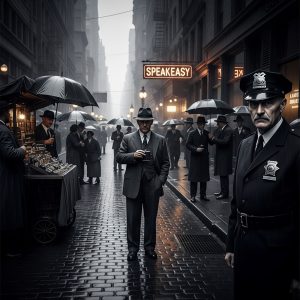
It is my commitment to lay bare the historical narrative of Alcohol Prohibition in the United States, a period that profoundly tested the fabric of American democracy and the very principle of the rule of law. Drawing directly from the comprehensive sources at hand, we can trace the arc of this extraordinary social experiment, from its fervent inception to its eventual, telling repeal.
The roots of Alcohol Prohibition stretch deep into the 19th century, nurtured by powerful societal impulses. By the early 1800s, America was, by some accounts, an “Alcoholic Republic,” with per capita alcohol consumption reaching a staggering 7.1 gallons by 1830. This pervasive drinking spurred a counter-movement. Led by pietistic Christians, who linked excessive drinking to moral laxity and immoderate behavior, and joined by nascent medical authorities noting the deleterious effects of alcoholism, employers concerned about unproductive workers, and various moral stewards fearing threats to rational self-determination, a national temperance movement had forged by the 1830s. Women, witnessing firsthand the physical abuse and economic havoc inflicted by drunken men on their families, played a major role in this fight, including the notable Carrie Nation who famously used a hatchet to dismantle saloons. This deeply religious and moralistic zeal, especially from the Pietist movement, launched a determined prohibitionist crusade at both state and local levels that endured for a century.
The culmination of this long campaign arrived in 1919 with the passage of the Eighteenth Amendment to the Constitution, which broadly outlawed “the manufacture, sale, or transportation of intoxicating liquors” within the United States. This was not a measure imposed on an unwilling populace; temperance societies had demonstrably won the battle for public opinion, with 46 out of the then 48 states ratifying the constitutional amendment. The Volstead Act quickly followed, defining intoxicating liquor as any beverage with more than 0.05 percent alcohol, though notably, it did not prohibit purchasing or drinking alcoholic beverages. The proponents of Prohibition envisioned a society free from the perceived ills of alcohol, promising reduced crime, lower prison populations, stronger families, and less spousal abuse. Indeed, early data suggested some success: drinking substantially decreased, and admissions to state hospitals for alcoholism dropped significantly, particularly in smaller towns and among working classes.
However, the noble aspirations of Prohibition soon collided with unforeseen realities, illustrating a “signal demonstration of unintended consequences” that severely impacted American democracy and the rule of law.
Firstly, and perhaps most fundamentally, Prohibition exposed the inherent shakiness of the rule of law when it lacked broad public buy-in, especially across class lines. While the law was enforced, its application “broke sharply along class lines”. In major urban centers like New York and Chicago, the business, political, and social elites “virtually ignored it”. Flasks were “freely displayed at Harvard-Yale games,” and quality spirits were never wanting for the likes of Scott, Zelda, and their friends. This blatant flaunting of the law by the privileged, as highlighted in films and by the open consumption even by the President during the Harding administration, greatly “undermined respect for authority” and contributed to waning support by the 1930s. When parental lectures on law and social canons “rang hollow” because parents themselves were enjoying cocktails before dinner, the moral authority behind the law eroded.
Secondly, and directly related to the erosion of legal authority, Prohibition proved to be an unexpected boon for organized crime. While it did not create existing gangster networks, it “vastly expanded their revenues” through bootlegging and illegal supply chains, facilitating their expansion into other illicit enterprises like casinos, prostitution, loan sharking, and dope trafficking. Millions of Americans, desiring alcohol, became “scofflaws,” turning to these criminal organizations to supply their needs. This institutionalization of a “black” market for alcohol, which previously did not exist, meant that government authorities had to craft a strict anti-narcotics regime, paving the way for the later, more punitive War on Drugs.
Thirdly, Prohibition became a divisive political issue, revealing vulnerabilities within the democratic process. It “split the country along ethnic lines” and became a convenient “sham fighting” issue for powerful financial and utility interests. In the lead-up to the 1932 presidential election, these groups actively encouraged Democratic candidates to focus on the unpopular ban on liquor, thereby diverting attention from pressing economic issues like tax cuts for the wealthy and the need for systemic change. This tactic effectively manipulated the political agenda, preventing a focus on fundamental economic reforms that might challenge concentrated power. The perceived need for legal liquor taxes to reduce other taxes, including those on the wealthy, underscored how economic interests could subtly influence the policy debate surrounding a moral issue.
Ultimately, the accumulating problems—the elite’s open defiance, the frightening rise of gangland violence in cities like Chicago, and the widespread public’s decision to simply ignore the law—led to a broad consensus for repeal. In 1933, Congress passed the Twenty-First Amendment, which repealed the Eighteenth Amendment, thus ending nationwide Prohibition. This repeal was almost as uncontroversial as its imposition had been. Critically, the Twenty-First Amendment’s second section “constitutionaliz[ed] the basic understanding of the extent of the States’ power to regulate alcohol” that existed before Prohibition, granting each state the option to ban alcohol if its citizens chose. However, the Supreme Court later clarified that this power was not absolute, ruling that the Twenty-First Amendment did not “immunize all laws from Commerce Clause challenge” and invalidated state alcohol laws that aimed to give competitive advantages to in-state businesses.
The legacy of Prohibition on American democracy and the rule of law is complex. While it demonstrated the power of a popular social movement to enact a sweeping moral reform through constitutional means, it simultaneously revealed the limits of law in shaping behavior when a significant portion of the population, particularly the powerful, chose to disregard it. It inadvertently fueled organized crime and fostered a widespread disregard for legal authority, weakening the very respect for the law it sought to uphold. Furthermore, it highlighted how social issues could be manipulated to obscure deeper economic inequalities within the political system. The experience “tempered many Americans’ enthusiasm for embedding in the Constitution what properly belonged, if anywhere, in the statute books,” pushing future reforms towards legislative rather than constitutional amendments. In essence, Prohibition taught America a harsh lesson: that even a law born of widespread moral conviction could, through its unintended consequences and selective enforcement, inadvertently undermine the principles of a unified rule of law and challenge the very mechanisms of democratic governance.