

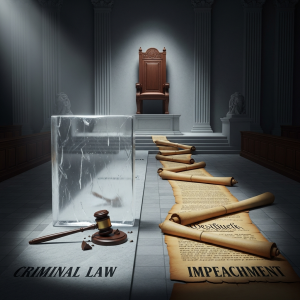
The constitutional architecture of American government, rooted in the separation of powers, mandates a delicate balance between granting the President sufficient authority to govern effectively and ensuring rigorous accountability for potential abuses of that power. Within this framework, the concept of Presidential Immunity has evolved dramatically, culminating in recent rulings that define the extent to which the office “insulates Presidents from criminal liability.”
To understand this insulation, one must trace the doctrine from its origins in civil litigation immunity to the profound, and contested, modern interpretations concerning criminal prosecution.
The Foundation of Immunity: Absolute Protection from Civil Suits
The initial definition of presidential immunity arose not in criminal law, but in response to civil litigation stemming from official actions. The Supreme Court established in Nixon v. Fitzgerald (1982) that the President is entitled to absolute immunity from civil damages liability for all official acts committed while in office,. This immunity is viewed not as a personal right but as a “functionally mandated incident of the President’s unique office,” essential for maintaining the constitutional separation of powers.
The fundamental rationale underlying this civil immunity is pragmatic: without such protection, a President would be perpetually harassed by lawsuits stemming from “virtually every allegation that an action was unlawful or was taken for a forbidden purpose,” distracting the Chief Executive from the crucial, sensitive, and far-reaching duties of the office,. This shielding is broad, extending to the “outer perimeter of his official responsibilities”,,.
The Framers anticipated mechanisms to hold the executive accountable despite this necessary civil shield. As the Supreme Court noted, absolute civil immunity for the President does not leave the nation without protection, as there remains the constitutional remedy of impeachment, along with checks provided by Congress and the press,.
Crucially, this traditional immunity doctrine was understood to be limited to official acts; it did not apply to “unofficial acts” or conduct that occurred before the President took office, as confirmed in the context of President Clinton’s litigation,,,.
The Pre-2024 Stance on Criminal Accountability
Before recent judicial decisions, the question of whether a President could be criminally prosecuted was understood through the lens of constitutional text and Justice Department policy, leading to a period of practical ambiguity rather than categorical immunity.
The Constitution itself seems to presume the applicability of criminal law to former officials. The Impeachment Judgment Clause states that an official convicted and removed by the Senate “shall nevertheless be liable and subject to Indictment, Trial, Judgment and Punishment, according to Law”,,. This provision, according to legal scholars, clearly contemplates that a former President may be subject to criminal prosecution for the same conduct that could have led to impeachment, including high crimes like bribery.
Despite this constitutional text, the Department of Justice (DOJ) historically maintained an internal policy that prevented the indictment of a sitting President,. This policy necessitated that the independent counsel investigating President Clinton in the 1990s considered whether he could be criminally indicted for perjury while in office, though it did not occur. Similarly, Special Counsel Robert Mueller during the Trump presidency stated he was bound by the DOJ regulation and therefore could not express views on whether illegal activity occurred, stressing he was “not exonerating” the President. This meant that while in office, a President was practically insulated from federal indictment by executive branch policy, even as the constitutional debate raged on.
The landmark Watergate case involving President Nixon showed that a sitting President could be compelled via subpoena to produce records, as the public interest in criminal proceedings was strong enough to overcome the President’s presumptive privilege to withhold confidential communications,,,,. Nixon was ultimately pardoned of federal criminal charges by President Ford, demonstrating the path toward accountability (or lack thereof) for former chief executives.
The Modern, Conclusive Insulation: The Trump v. United States Ruling
The landscape of criminal liability shifted fundamentally following the 2024 Supreme Court decision regarding the criminal prosecution of a former President for official acts. The court’s majority effectively granted expansive immunity, establishing a framework that legal experts argue creates a “law-free zone” around the President for most official conduct,,.
This decision distinguishes between categories of presidential actions and establishes varying levels of immunity from criminal prosecution,:
- Core Official Acts (Absolute Immunity): The President is deemed absolutely immune from criminal prosecution for the exercise of core constitutional powers,. These core powers include commanding the military and exercising “investigative and prosecutorial functions”,. This absolute immunity means that the President’s actions cannot be used as evidence in a prosecution, and the President’s motives—even if corrupt (e.g., using power for “personal gain or retribution”)—are completely irrelevant to determining whether the act is official and immune,,,. For instance, attempts to pressure the Justice Department into launching baseless investigations were categorized as falling under these protected, core prosecutorial functions,.
- Non-Core Official Acts (Presumptive Immunity): For other official acts falling within the “outer perimeter of his official responsibility”, the President is entitled to at least presumptive immunity,. To prosecute these acts, the government must demonstrate that applying a criminal prohibition would pose “no dangers of intrusion on the authority and functions of the Executive Branch”. Critics argue that this standard is “vanishingly small” and almost impossible to _meet, effectively creating absolute immunity for nearly all official actions,,.
The judicial rationale is based on preventing the President from being “chilled from taking the bold and unhesitating action required of an an independent executive”, fearing prosecution for communicating with aides or executing official duties.
This profound change in legal precedent was met with significant concern. Legal scholars and dissenting justices warned that the ruling marked a “sea change in the relationship between the people and the President”. Under this new standard, a President could hypothetically be immune from criminal liability for acts such as ordering a political rival’s assassination, organizing a military coup to retain power, or taking a bribe in exchange for a pardon, so long as those actions could be characterized as an exercise of an official power,,.
The Continuing Role of Impeachment
Given this extensive judicial insulation from criminal prosecution for official acts, the constitutional mechanism of impeachment has become even more central as the definitive check on presidential abuse of power. Alexander Hamilton, in arguing for the impeachment clause, stressed that the remedy was intended for “offenses which may with peculiar propriety be denominated POLITICAL”,, focusing on injuries done “immediately to the society itself”,.
Impeachment is thus viewed as the necessary remedy for a President who “corrupts the system of elections” or uses extraordinary powers to “subvert the constitutional order”,. The constitutional framers feared a President abusing power to advance “personal interests and to undermine the public interest”. With the criminal justice system largely inaccessible as a remedy for official conduct, the preservation of democratic principles relies heavily on Congress exercising its power to hold the President accountable for “high crimes and misdemeanors,” which need not necessarily correspond to statutory crimes but rather constitute grave offenses against the Constitution and the functioning of the government,,,.
In sum, the President’s insulation from criminal liability, once primarily a matter of internal DOJ policy concerning sitting Presidents, is now cemented by judicial precedent that grants sweeping immunity for actions deemed official, shifting the burden of accountability almost entirely onto the political processes of Congress.