
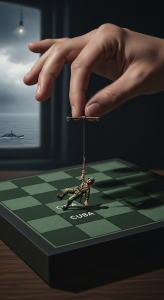
The Bay of Pigs invasion in April 1961 stands as a stark testament to the complexities and unforeseen consequences of U.S. foreign policy during the Cold War. It was an ambitious, yet ultimately disastrous, attempt by Washington to overthrow Fidel Castro’s socialist regime in Cuba, a mere 90 miles from Florida, utilizing a force of Cuban exiles. This event, inherited and approved by the newly elected President John F. Kennedy, profoundly shaped his administration’s foreign policy approach and had lasting repercussions for U.S.-Cuba relations.
The origins of the invasion plan trace back to the Eisenhower administration. Following Castro’s revolutionary victory on January 1, 1959, the United States became increasingly wary of his actions in power. Castro moved swiftly to nationalize American-owned property in Cuba and signed a trade agreement with the Soviet Union after the U.S. proved reluctant to lend money and the International Monetary Fund imposed “stabilization” conditions that seemed to undermine the revolution. American-owned oil companies in Cuba then refused to refine Soviet crude oil, leading Castro to seize these companies. In response, Eisenhower’s administration placed an embargo on Cuban sugar, prompting the Soviets to buy all the sugar Cuba could produce. With Cuba “slipp[ing] into the Soviet sphere” and the CIA finding “Communist infiltration into Castro’s inner circle,” Eisenhower secretly authorized the Central Intelligence Agency (CIA) to arm and train anti-Castro Cuban exiles in Guatemala for a future invasion.
By the time Kennedy assumed the presidency in January 1961, the CIA had approximately 1,400 exiles armed and trained. Kennedy, keen to demonstrate a tough stance against communism, embraced the plan, despite initially appearing uncertain about the scheme. He had, in fact, publicly stated during his campaign that the U.S. “must attempt to strengthen the . . . anti-Castro forces in exile”. This decision reflected his team’s emphasis on “vigor” and “activism,” a “bias toward boldness” that sometimes prioritized action over meticulous planning. Indeed, one aide noted, “Nobody in the White House wanted to be soft”.
The invasion itself was set in motion on April 17, 1961, with 1,400 Cuban exiles attempting a landing at the Bay of Pigs on Cuba’s south shore. The operation was characterized by thinly disguised American involvement from the start. Just two days prior, on April 15, six old B-26 bombers “strafed and bombed three Cuban airfields”. American warplanes, including unmarked navy jets with American pilots, were involved. The CIA even utilized “Radio Swan,” posing as a private station from Swan Island, to broadcast “false news reports” and “cryptic messages” to confound Castro and give “courage to the rebels and spread fear among the authorities”. The operation was contingent upon a mass anti-Castro uprising, which critically, “never occurred” as Castro’s regime was, in fact, popular.
The invasion was an “immediate fiasco”. Castro, forewarned and prepared, had amassed “several thousand troops and more than fifty Soviet-made tanks at the invasion site by the time the landing force consolidated on the ground”. The exiles “floundered” and were “crushed by Castro’s army” in just three days. When the CIA and Navy urged Kennedy to authorize U.S. air strikes to salvage the situation, he refused to “send Americans to war and risk escalation elsewhere,” including Berlin.
The aftermath was immediate and far-reaching. Kennedy accepted responsibility for the failure and subsequently “fired the CIA leaders” involved. Allen Dulles, then CIA Director, was forced into retirement, which was perhaps poetic, given his reported interest in Bond novels and seeking Ian Fleming’s advice on dislodging Castro. The “whole Bay of Pigs affair was accompanied by hypocrisy and lying,” as Kennedy had publicly denied any U.S. armed forces intervention in Cuba just four days before the invasion, despite direct American involvement. This violated the Charter of the Organization of American States, a treaty the U.S. had signed.
Far from weakening Castro, the invasion ironically solidified his power and public support. It was only after this failed attempt that Castro declared his revolution to be “Marxist-Leninist,” leading him to draw “closer to the Soviets” for protection. This increased Cuban fear of a second U.S. invasion directly contributed to Soviet Premier Nikita Khrushchev’s decision to deploy intermediate-range nuclear missiles to Cuba in 1962, setting the stage for the Cuban Missile Crisis, a monumental Cold War confrontation.
The Bay of Pigs taught Kennedy crucial lessons. Eisenhower, despite being out of office, offered public support to Kennedy while imparting the wisdom of ensuring thorough debate and hearing all “pros and cons” before making critical decisions, something Kennedy admitted he had not done for the Bay of Pigs. This event, along with the subsequent Cuban Missile Crisis, reinforced the Kennedy team’s reputation for “crisis management,” though some argued they became too “enamored, even stimulated” by such situations. The botched operation also contributed to later investigations into the CIA, particularly regarding secret plans to assassinate foreign leaders, highlighting the issue of “plausible deniability” that presidents sought to maintain. The Bay of Pigs stands as an early and defining example of the U.S. government’s willingness to “prevent or overthrow revolutionary governments” perceived as hostile, even through covert and legally dubious means. It also underscored the limitations of projecting U.S. power, particularly against popular indigenous movements, a lesson that would echo in future conflicts like Vietnam.